
Zrano Bowles had already spent about four years inside Forrest City↗ET when the board asked him to run it. He had come back to the district as an assistant superintendent, and he says he took that job without any expectation of where it would lead.
"My decision to return was not based on an expectation that I would eventually become superintendent," Bowles wrote in response to questions from The AREdTribune. "I saw an opportunity to continue growing professionally while contributing the leadership experience I had gained as a superintendent to the work already underway in Forrest City."
He had held a superintendency once before. "I served as the state-appointed superintendent of the Lee County School District," he wrote of his years in Lee County↗ET. He was later chosen for the top job in Blytheville↗ET and turned it down. "I was later selected for the superintendent position in Blytheville, but I declined that opportunity and did not serve as superintendent there," he wrote.
Tiffany Hardrick told the board in January that her last day would be March 23, 2026, according to the January board minutes. At its February 18 regular meeting, the board voted unanimously to accept Zrano Bowles as interim superintendent effective March 23, according to the February minutes. He confirmed the interim appointment to The AREdTribune in April. The district's May board minutes record a board member stating that Bowles would serve as superintendent effective July 1.
Because the interim assignment came first, Bowles was not learning the district and steadying it at the same time.
"Because I had already been part of the district's leadership team for several years, I was able to provide continuity during the transition and begin making decisions immediately," he wrote.
Stability first, then systems
Asked what the job needed once he knew it was his to keep, Bowles drew a line between the two phases.
"When I stepped into the interim role, the immediate priority was stability," he wrote. The district was in transition, decisions could not wait, and in his account employees, families and the community needed to know that the work would continue.
"Once I knew I would remain as superintendent, my focus expanded from managing the immediate transition to building systems that can produce sustainable improvement," he wrote.
What he thinks those systems have to deliver, he listed plainly: "consistency, accountability, strong instructional leadership, safe and supportive schools, and clear expectations at every level of the organization." He added that the district also has to strengthen confidence among employees, students, families and the broader community.
Forrest City's stated focus is Every Student. One Level Higher. Bowles said he does not treat it as a slogan, and that it points in two directions at once.
"It means meeting students where they are academically and expecting measurable growth," he wrote. "It also applies to the adults in the organization."
A district a third smaller than it was in 2014-15
Forrest City enrolled 1,809 students in 2025-26, last school year and the most recent year in the state's published enrollment record. In 2014-15 it enrolled 2,668. That is 859 fewer students, a decline of 32.2%. Measured from the start of the published series, in 2004-05, the district has gone from 3,854 students to 1,809, a loss of 2,045 students or 53.1%.
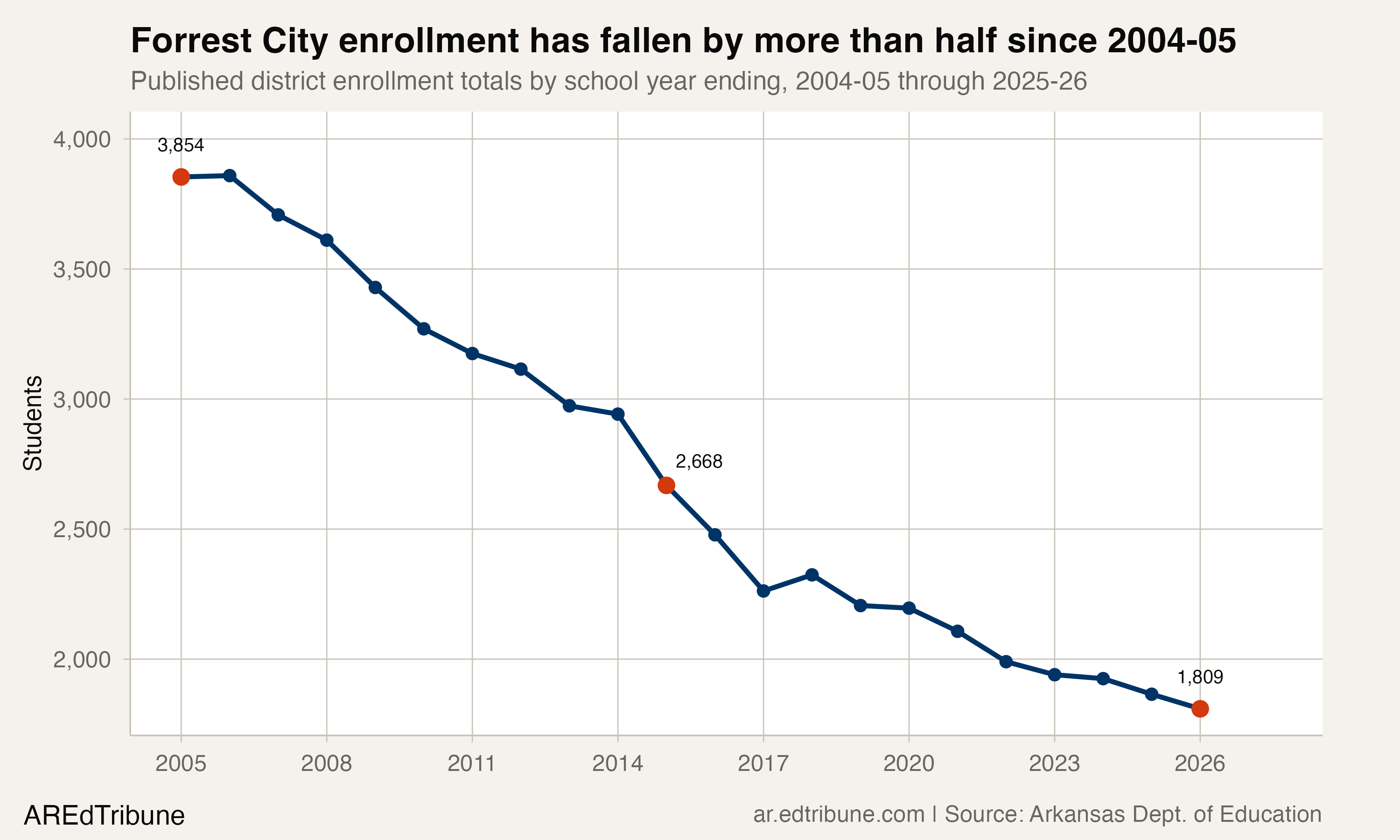
The decline has been gradual rather than abrupt. Enrollment fell in eight consecutive annual transitions across the nine reporting years from 2017-18, when the district enrolled 2,324 students, through 2025-26. The most recent year moved down by 56 students, or 3.0%.
We asked Bowles which part of a loss that size a district can act on and which part belongs to the region. He answered on both sides of it.
"There are demographic and economic factors affecting enrollment throughout the Arkansas Delta that a school district cannot control by itself," he wrote, naming population shifts, employment, housing and families relocating.
"At the same time, I do not believe we should use regional decline as an excuse," he wrote. "We have to take responsibility for the things we can control."
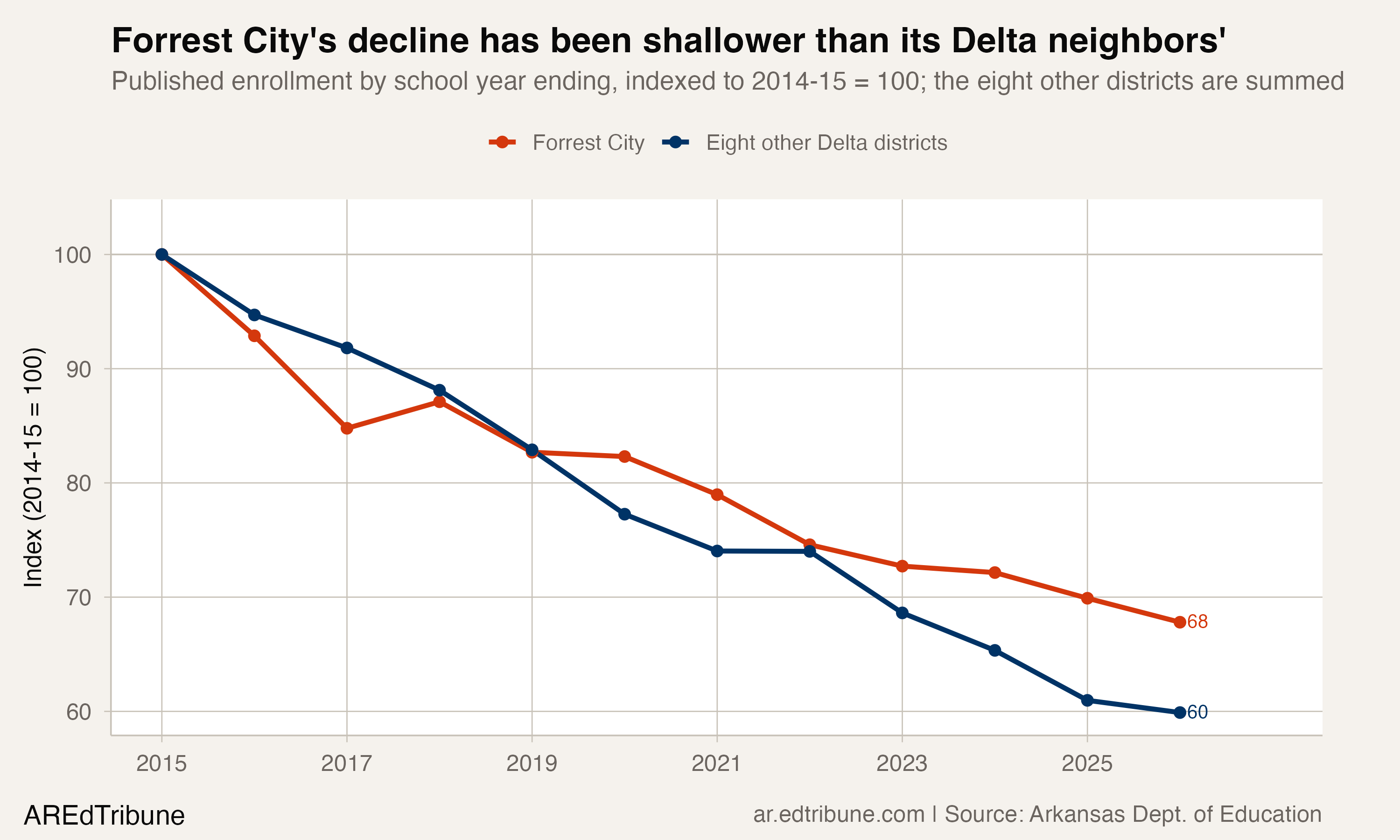
The published record shows that Forrest City was part of a broader enrollment decline. Across the same span, the eight other Delta districts The AREdTribune has tracked as a group fell together from 15,542 students in 2014-15 to 9,309 in 2025-26, a decline of 6,233 students or 40.1%. Forrest City's 32.2% is the shallower of the two.
RELATED: Nine Delta Districts Lost 55% of Their StudentsET
That ordering flipped in the latest year, when Forrest City lost 3.0% and the other eight districts lost 1.8% between them. And the state record establishes movement, not its causes. It cannot show whether a family left the county or stayed and enrolled somewhere else, and Arkansas publishes no district field that would settle it.
Bowles put the district's share of the problem in terms of what families choose.
"Families have choices, and our responsibility is to make Forrest City School District a place where families want their children to attend," he wrote. He listed safe schools, strong academics, quality teachers and leaders, extracurricular and career opportunities, and responsive service to families, and added that the district has to do a better job of telling its own story.
"We may not be able to control every demographic trend affecting the Delta, but we can control the quality of the education we provide," he wrote. "My goal is to strengthen that quality to the point that families who have a choice see Forrest City School District as their first choice."
The widest part of the pipeline is the bottom
The grade counts Arkansas published for 2025-26 are widest at the bottom. Forrest City enrolled 170 kindergarteners that year and 122 twelfth-graders. Grades K through 5 accounted for 926 students, 51.2% of the district.
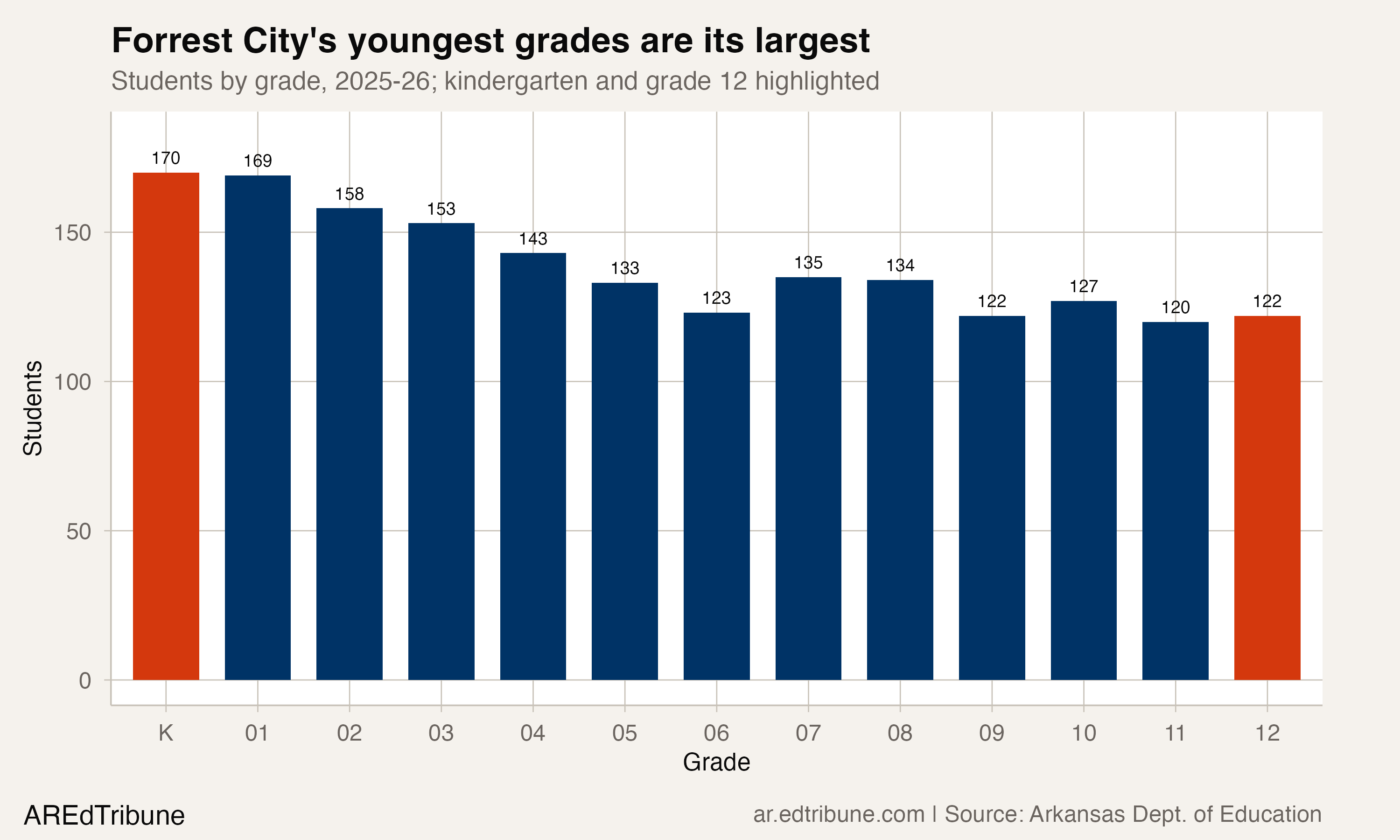
That is a single year's cross-section rather than a forecast. Arkansas began publishing district-level grade rows only in 2024-25, so there is no grade trend to read yet, and one kindergarten class is not a prediction about the next decade. In 2025-26, elementary grades accounted for more than half of the district's enrollment.
Forrest City enrolled 1,681 Black students in 2025-26, 92.9% of its published total, and the state's published race categories account for the district's entire enrollment, so that share is a full count rather than a floor.
What Bowles says he wants the district judged on is not its enrollment.
"I want Forrest City School District to become known not simply for the challenges it has faced, but for how we responded to those challenges and the results that followed," he wrote.
The 2026-27 count, when Arkansas publishes it, will say whether the gap with his Delta neighbors held.
Enrollment figures come from the Arkansas Department of Education Data Center's published district enrollment records. Bowles answered our questions in writing and supplied the professional portrait above.
Detailed code that reproduces the analysis and figures in this article is available exclusively to EdTribune subscribers.
Discussion
Sign in to join the discussion.
Loading comments...