In 2005, nine school districts in the Arkansas Delta collectively enrolled 24,887 students. By 2025-26, that number had fallen to 11,118. The loss of 13,769 students, 55.3% of the total, spans two decades and has not paused or reversed. Not a single year in the dataset shows a collective gain.
These are not suburban districts adjusting to demographic shifts or urban systems losing students to charters. They are majority-Black districts in the poorest part of Arkansas, where population loss, agricultural mechanization, and generational poverty have been compressing communities for decades. The schools did not cause the decline. But as the schools shrink toward the threshold of viability, the communities may not survive without them.
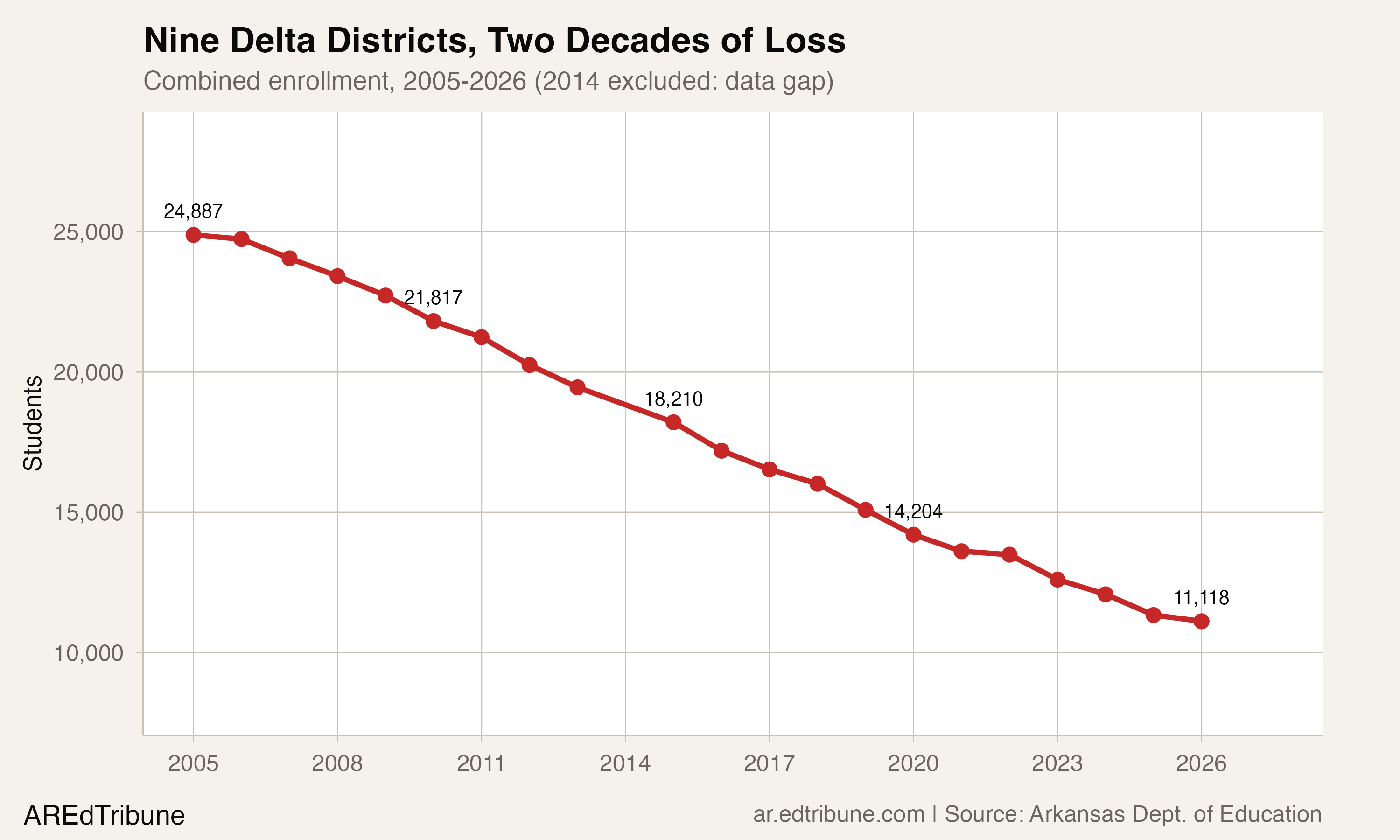
The arithmetic of emptying out
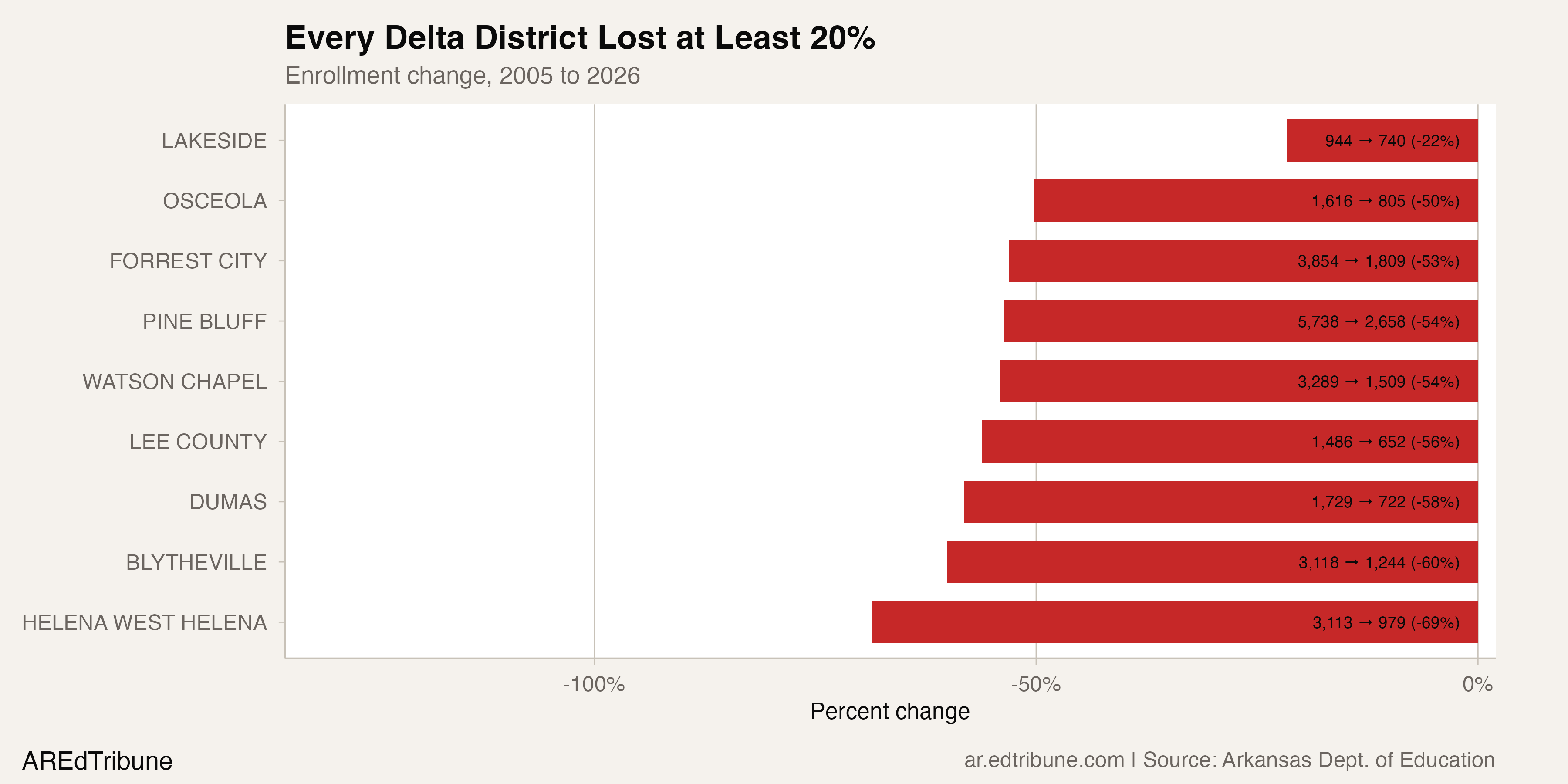
Helena-West Helena↗ET has lost more of its student body than any other Delta district: 3,113 students in 2005, 979 in 2025-26, a 68.6% decline. The district briefly dipped to 920 students in 2023-24 before a modest rebound. At its current size, the entire district enrolls fewer students than a single large elementary school in Northwest Arkansas.
Pine Bluff↗ET, once the largest of these nine districts at 5,738 students, has fallen to 2,658, a 53.7% decline. Blytheville↗ET dropped from 3,118 to 1,244, a 60.1% loss spread across 16 consecutive years of decline. Forrest City↗ET lost 2,045 students (53.1%) over eight straight years of contraction.
Seven of the nine districts sit at all-time enrollment lows in 2025-26. Five now enroll fewer than 1,000 students: Lee County↗ET at 652, Dumas↗ET at 722, Lakeside (Chicot)↗ET at 740, Osceola↗ET at 805, and Helena-West Helena at 979. Watson Chapel↗ET, at 1,509, has been declining for 14 consecutive years.
A region that halved its share of the state
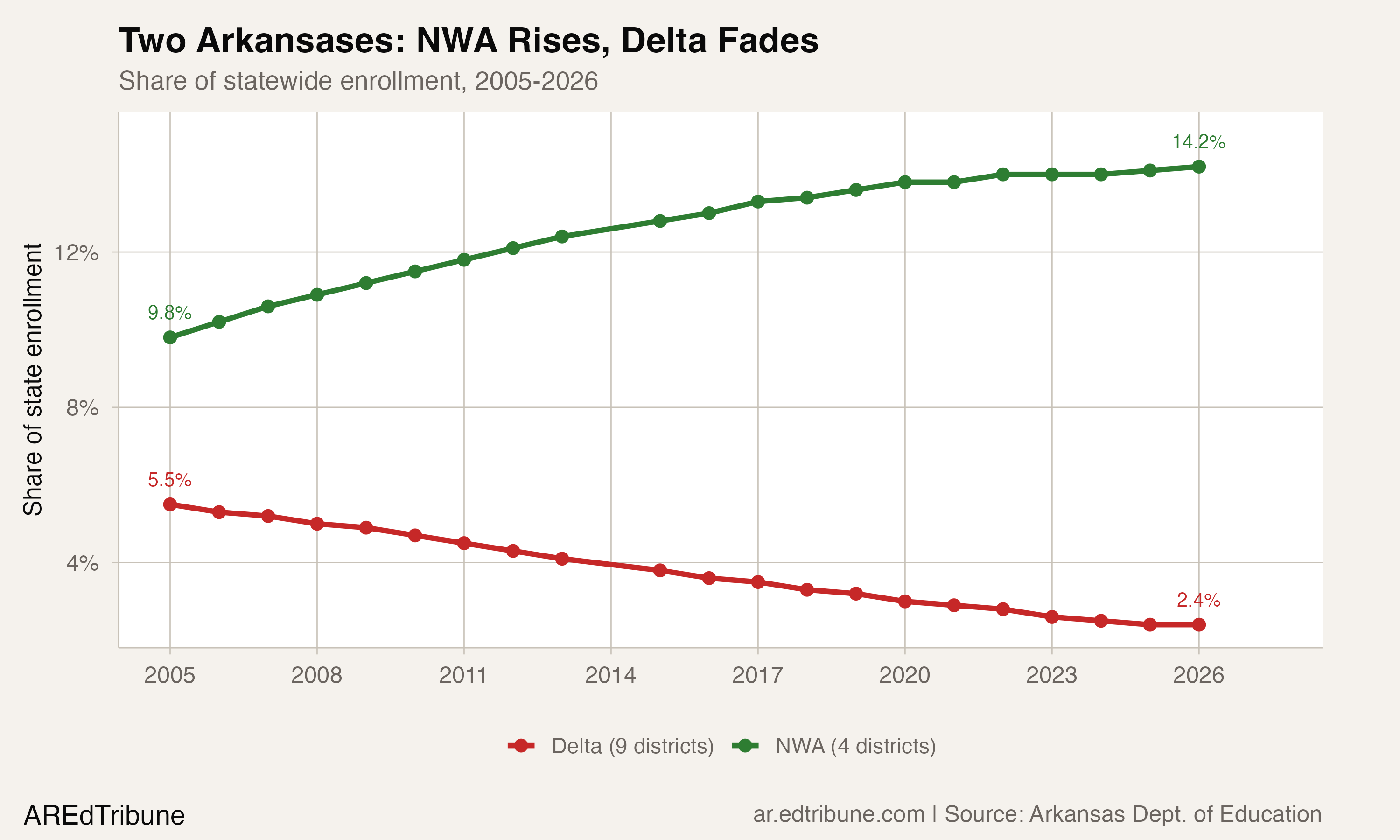
In 2005, these nine districts accounted for 5.5% of Arkansas enrollment. By 2025-26, that share had fallen to 2.4%, less than half. The loss is not proportional to the state's overall trajectory. Arkansas as a whole enrolled 455,515 students in 2005 and 465,421 in 2025-26, a modest gain. The Delta's collapse is not a statewide story. It is a regional one.
The contrast with Northwest Arkansas makes the divergence concrete. Four NWA districts (Bentonville, Rogers, Springdale, Fayetteville) gained 21,488 students over the same period, climbing from 9.8% to 14.2% of state enrollment. The Delta lost 13,769 students while NWA gained 21,488. Arkansas's educational center of gravity has shifted northwest.
What the year-over-year data shows
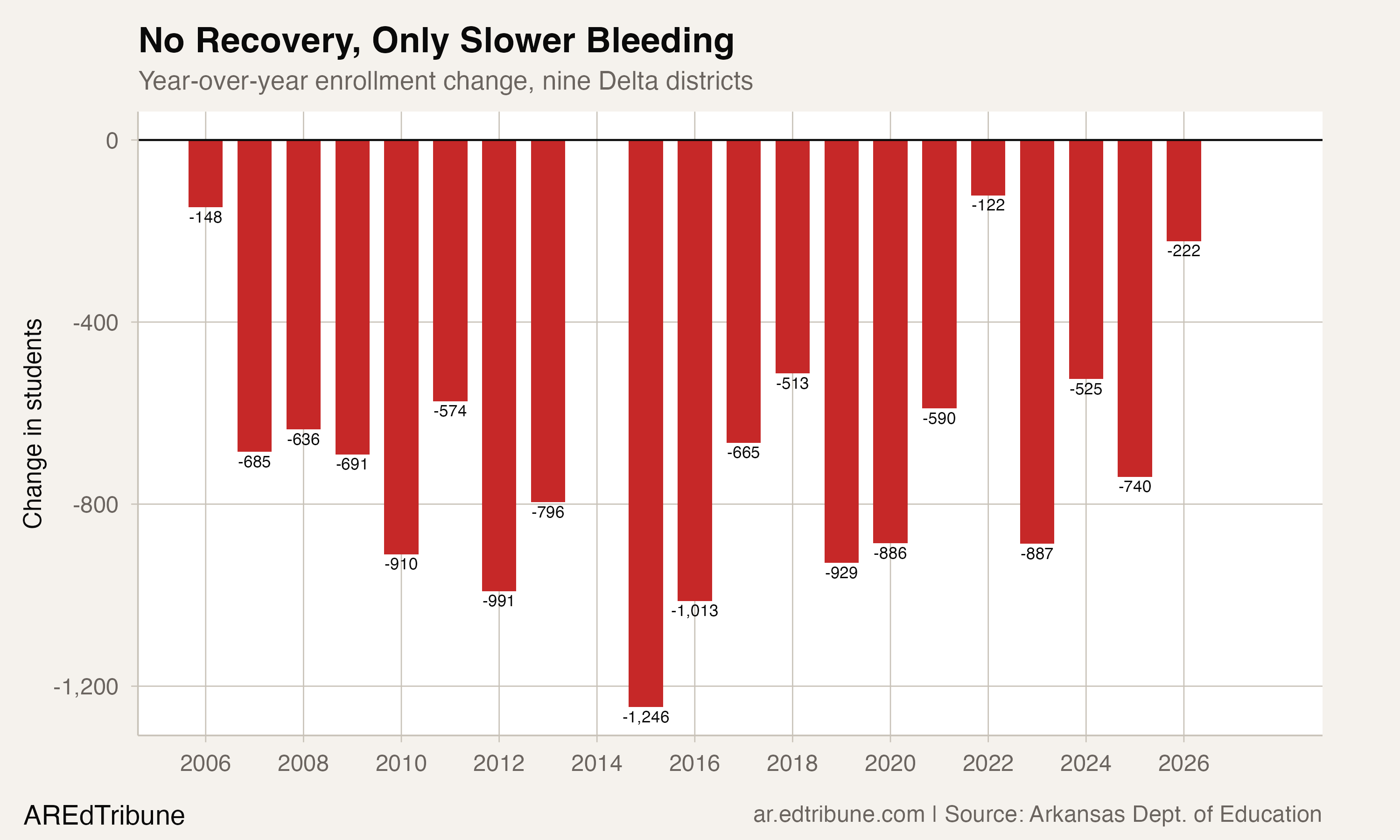
The Delta's losses have not been uniform across time. The worst single year was 2015, when the nine districts shed 1,246 students collectively, likely reflecting the transition across the 2014 data gap. But the pattern is relentless: losses of 600-1,000 students per year in the late 2000s, a slight deceleration in the early 2020s, and then renewed erosion. The 2021-22 dip to just 122 students lost appeared to signal stabilization. It did not. The following year brought a loss of 887, then 525, then 740.
In 2025-26, the combined loss slowed again to 222 students. Whether this reflects a floor or a temporary reprieve is unknowable from the data alone.
The demographic composition of decline
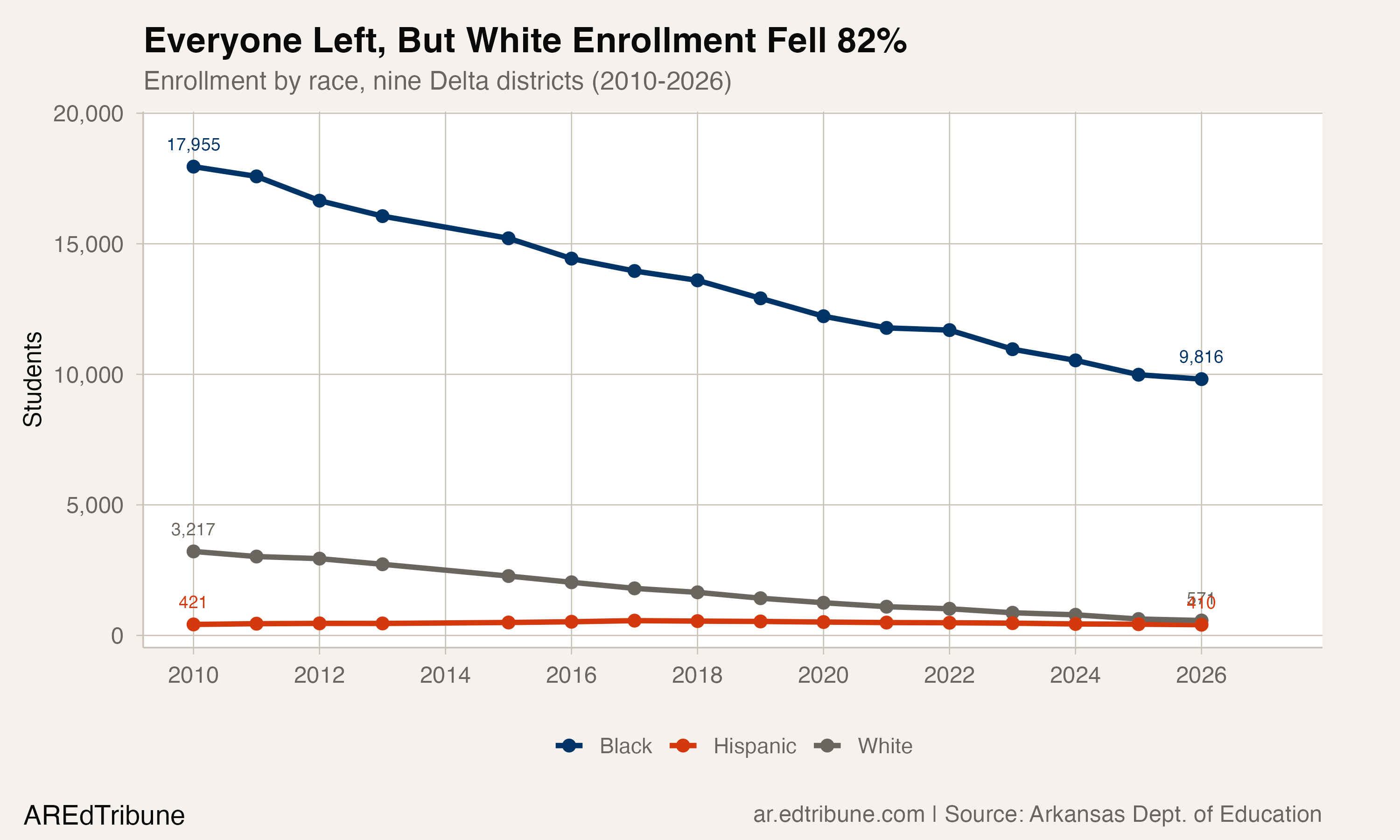
The nine Delta districts are overwhelmingly Black. In aggregate, 88.3% of the 11,118 remaining students are Black, up from 82.3% in 2010. That rising share does not reflect an influx of Black students. It reflects the near-total departure of white students.
White enrollment across these nine districts fell from 3,217 in 2010 to 571 in 2025-26, a decline of 82.3%. In absolute terms, the Black student population fell by 8,139 over the same period, a 45.3% loss. White enrollment collapsed at nearly twice that rate. Forrest City and Helena-West Helena each have a white student population share below 5%.
Hispanic enrollment, while small in absolute terms (410 students in 2025-26), has been relatively stable, hovering between 3.6% and 3.8% of Delta enrollment since 2020.
Schools as trailing indicators
The most direct driver of enrollment decline is population loss. Pine Bluff lost over 12% of its population in a single decade, earning it the distinction of being the fastest-shrinking city in the U.S. according to the 2020 Census. Helena-West Helena's population dropped from just over 15,000 in 2000 to an estimated 8,667 by 2023.
Baker Kurrus, former Little Rock School District superintendent, argued in the Arkansas Times that school quality is a consequence of economic decline, not a cause:
"School districts' relative rankings are not leading indicators of community health. School districts are trailing indicators of community health."
The pattern holds across these nine districts. Population loss driven by agricultural mechanization and the decline of the cotton economy predates any school accountability rating. A Mississippi County farmer near Blytheville described the dynamic simply: "Less people work on farms now. People are looking for other jobs or moving to towns where more stuff is available." A DeWitt High School teacher offered the downstream version: "There is no entertainment here... that is why we lose a lot of our children to the city."
The LEARNS Act adds a new variable
The LEARNS Act, signed in 2023, created Education Freedom Accounts that became universally available in 2025-26. Statewide, approximately 44,100 students enrolled in the choice program at an estimated cost of $309.4 million in state funds. Arkansas public school enrollment fell by more than 9,000 students that year, the largest drop in nearly 20 years.
For rural Delta districts, the impact may be disproportionate. April Reisma, president of the Arkansas Education Association, noted that smaller districts face greater consequences "because of where they're located in the state or their ability to have resources." Pine Bluff and West Memphis saw the sharpest enrollment declines among large districts statewide, exceeding Russellville's 5% drop.
Disentangling the LEARNS Act's effect from the Delta's longstanding population decline is not possible with enrollment data alone. These districts were losing students at comparable rates for 15 years before the program existed. The EFA program may accelerate what was already happening, but the youth exodus and the absence of economic opportunity predate school choice by generations.
The viability question
Arkansas law previously required districts whose average daily membership fell below 350 for two consecutive years to consolidate with a neighboring district. In 2023, the legislature removed that mandate, making consolidation voluntary. None of the nine Delta districts are below 350 yet. But Lee County, at 652 students, and Dumas, at 722, are within a decade of that threshold at their current rate of decline.
Pine Bluff Superintendent Jennifer Barbaree captured the stakes in a 2024 profile: "We want our kids back." The district faces not only enrollment decline but cascading consequences. Before recent improvements, only 15% of Pine Bluff third-graders read at grade level. Nine students were murdered by gun violence within nine months. The state had taken control of the district.
In these communities, the school district is often the largest employer and the last institution of any scale. When a district like Lee County, with 652 students, or Dumas, with 722, loses another 30 to 50 students per year, the issue is no longer sustaining programs at current staffing levels. It is whether the institution itself survives.
The 2026-27 enrollment data will reveal whether the 2025-26 slowdown to a 222-student loss represents a genuine floor, or whether the Delta's decline simply paused before resuming. Two decades of unbroken losses suggest the latter.
Detailed code that reproduces the analysis and figures in this article is available exclusively to EdTribune subscribers.
Discussion
Sign in to join the discussion.
Loading comments...