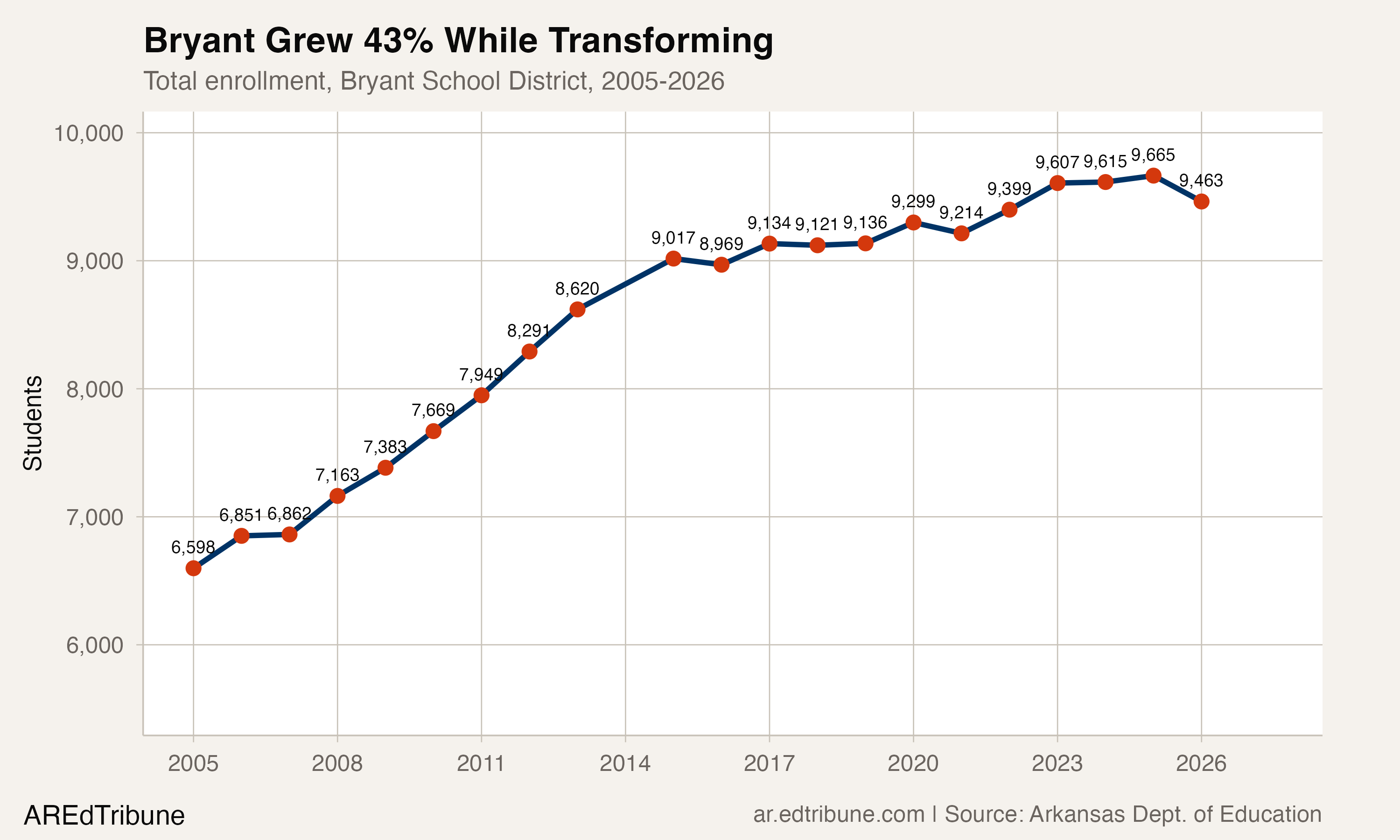
In 2005, Bryant↗ET School District enrolled 6,598 students. Ninety-four percent of them were white. The district sat in Saline County, a bedroom community south of Little Rock that the Encyclopedia of Arkansas describes as having "seen an explosive growth" since the 1950s. Bryant was growing, and it was almost entirely white.
Twenty-one years later, Bryant enrolls 9,463 students, 43% more than it did in 2005. White students now make up 50.1% of the district. The 43.7 percentage point decline in white share is the second-largest of any district with 500 or more students in both years in Arkansas, behind only Nettleton, and it happened while the district was adding nearly 3,000 students. This is not the diversification of a shrinking district. This is what happens when a growing suburb absorbs the demographic change its metro area has been undergoing for decades.
A decade-by-decade collapse in white share
The decline has been remarkably steady. Bryant's white share fell roughly two percentage points per year across every period in the dataset: 1.9 points per year from 2005 to 2010, 2.1 from 2010 to 2015, 2.0 from 2015 to 2020. The most recent stretch, 2020 to 2026, accelerated to 2.3 points per year.
The milestones came at predictable intervals. Bryant dropped below 90% white in 2008, below 80% in 2013, below 70% in 2017, below 60% in 2022, and reached 50.1% in 2026. At the current pace, white students will become a minority of Bryant's enrollment within a year.
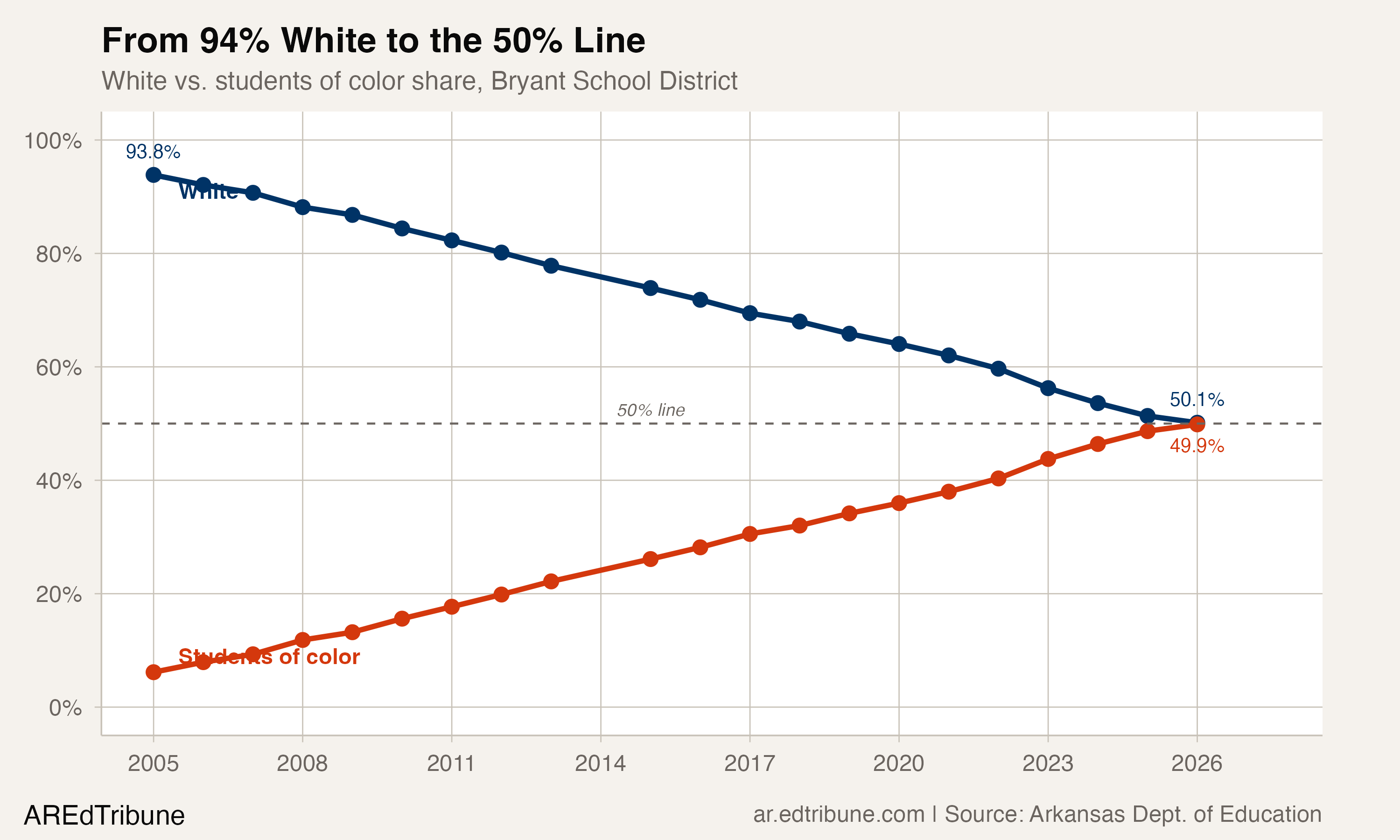
The statewide white share declined 12.9 percentage points over the same period, from 69.4% to 56.5%. Bryant's shift was 3.4 times faster.
Growth, not decline, drives the math
Most districts that experience rapid demographic change are shrinking. White families leave, the remaining student body becomes more diverse, and the district loses both enrollment and local tax base. Bryant's trajectory is the opposite.
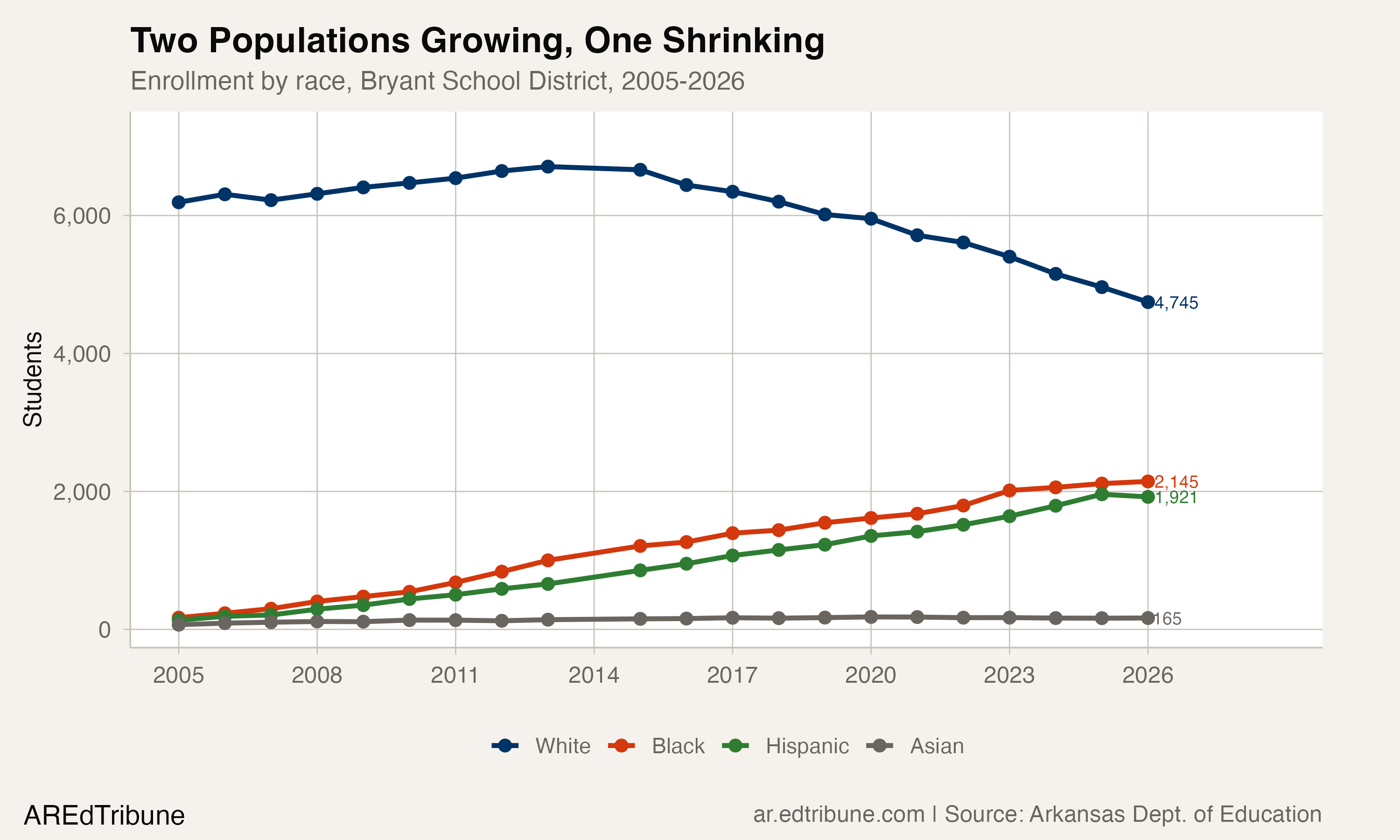
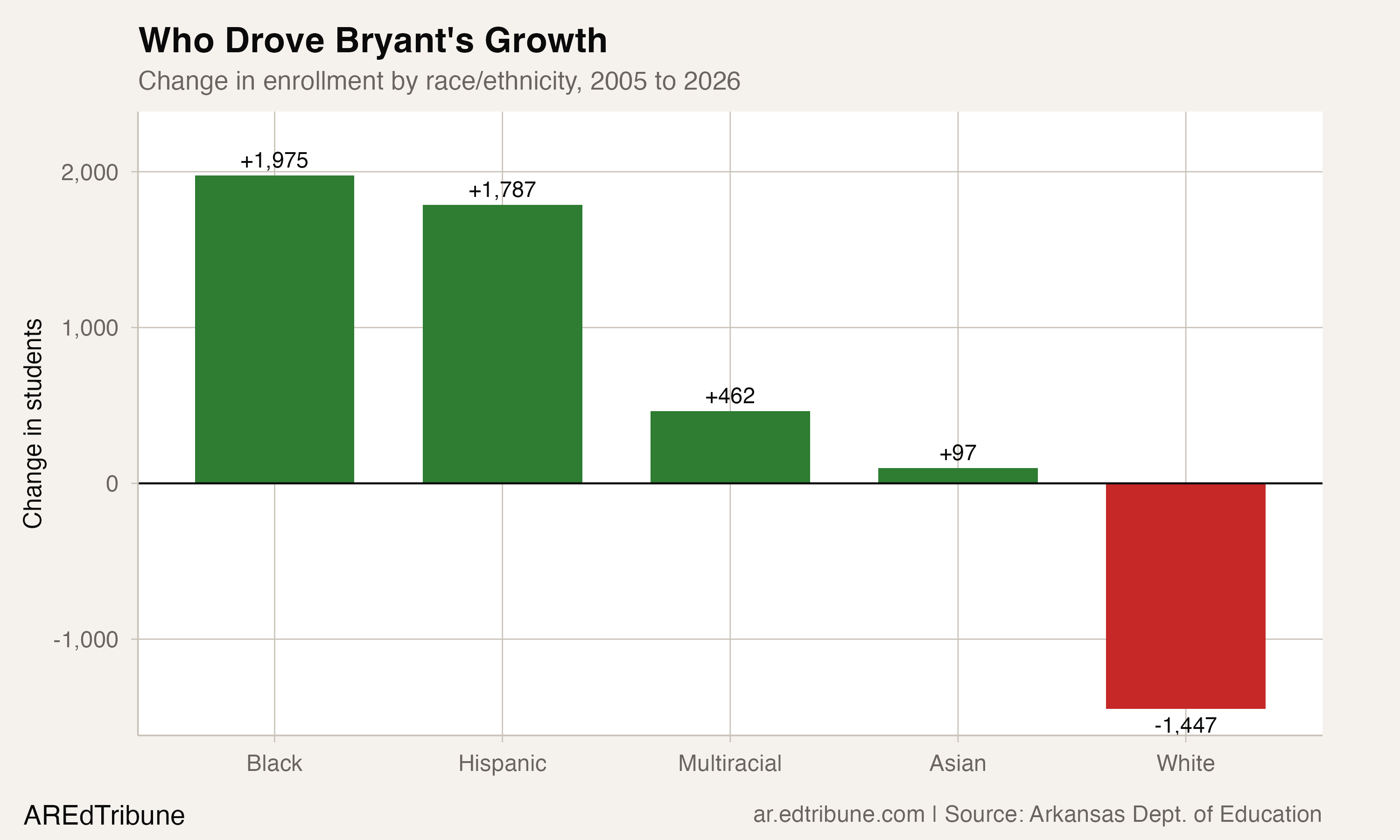
The district gained 4,312 students of color since 2005: 1,975 Black students (a 12.6-fold increase from 170 to 2,145), 1,787 Hispanic students (a 14.3-fold increase from 134 to 1,921), and 462 multiracial students. White enrollment fell by 1,447, peaking near 6,600 in the early 2010s before declining steadily.
Bryant added 2,865 students total. Every student the district gained, and then some, was a student of color.
The suburban housing engine
Saline County's population grew from 83,529 in 2000 to 123,416 in 2020, a 48% increase in two decades. USAFacts data shows the county added another 18.3% between 2010 and 2022. Bryant, positioned closer to Pulaski County than the county seat of Benton, absorbed a disproportionate share of that growth.
The most plausible driver is suburban housing development pulling families from across the Little Rock metro. Bryant's median household income of $83,024 and relatively affordable housing stock make it accessible to a broader range of families than the older, whiter suburbs that previously captured Pulaski County outmigration.
The Black enrollment surge, from 170 to 2,145, likely reflects Black middle-class families following the same suburban path that white families took a generation earlier. Little Rock School District lost 5,460 students over this period (a 22.4% decline), and North Little Rock↗ET lost 2,071 (22.7%). Not all of those families moved to Bryant, but the geographic and timing patterns are consistent with metro-area redistribution.
Hispanic growth, from 134 to 1,921, tracks the statewide pattern. Arkansas's Hispanic population reached 9% as of 2020-24, up from roughly 5% in 2005, driven by employment in construction and poultry processing. Central Arkansas construction growth during Saline County's housing boom would have drawn Hispanic workers and their families directly.
An alternative explanation for part of the white share decline is that families who would previously have been classified as white are now identifying as multiracial. Bryant's multiracial enrollment went from zero in 2005 to 462 in 2026 (4.9% of the district), all of it appearing after 2010 when federal reporting categories expanded. Some portion of this growth reflects reclassification rather than new arrivals, which would slightly overstate the pace of the underlying compositional shift.
Where Bryant sits in its metro
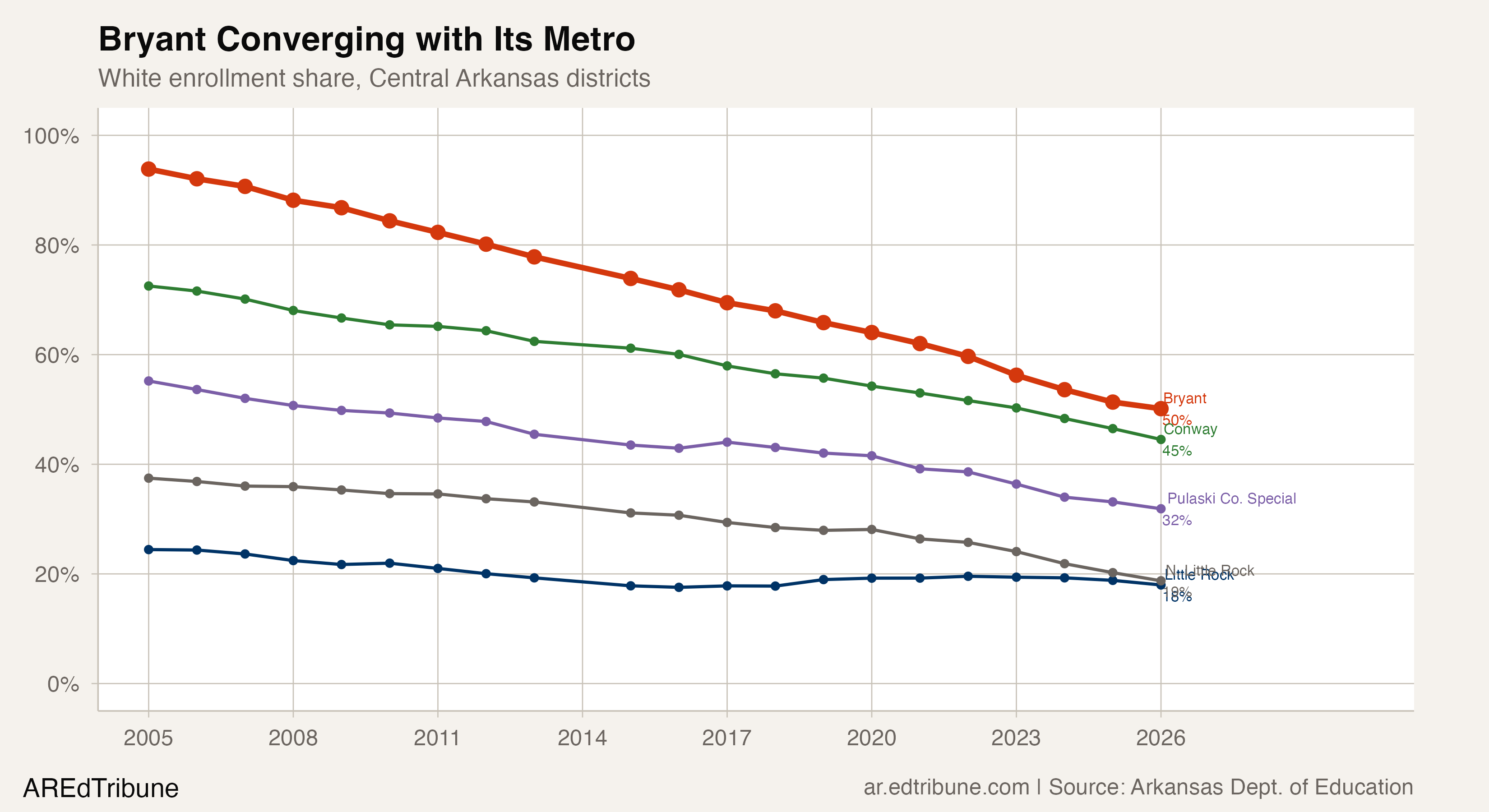
Bryant's transformation looks less unusual when placed alongside its neighbors. Every major district in the Little Rock metro saw its white share decline since 2005. Conway↗ET fell from 72.5% to 44.5%. Pulaski County Special↗ET fell from 55.2% to 31.9%. Little Rock↗ET fell from 24.4% to 18.0%.
What makes Bryant distinctive is the starting point. A district that was 94% white had further to fall, and the absolute magnitude of the change, nearly 44 points, stands out even in a metro where every district diversified.
Among all Arkansas districts with 500 or more students, only Nettleton↗ET School District in Craighead County experienced a larger white share decline: 52.1 percentage points, from 74.3% to 22.1%. Nettleton also grew, from 2,845 to 3,801 students (33.6%), making it another case of growth-driven diversification, though at a smaller scale than Bryant.
What comes next
The 2026 data shows Bryant's first meaningful enrollment decline in years: the district lost 202 students after peaking at 9,665 in 2025. Whether that marks the beginning of a new phase or a one-year fluctuation will not be clear until 2027.
A district built for a homogeneous student body now serves one that is half students of color. The enrollment data says the community changed. It does not say whether the schools kept up.
Detailed code that reproduces the analysis and figures in this article is available exclusively to EdTribune subscribers.
Discussion
Sign in to join the discussion.
Loading comments...