Little Rock School District↗ET graduated 82.3 percent of its students in 2024 — its highest rate since reappearing in the state graduation data after six years under state control. The number is up from 80.0 percent in 2022, a third consecutive year of gains.
The state average is 89 percent, leaving a 6.7-point gap. Twenty minutes south on Interstate 30, Bryant School District↗ET graduated 96.2 percent. The distance between the state capital's school system and its nearest suburb is 13.9 percentage points.
A District Coming Back From State Control
LRSD spent six years under state control, from 2015 through 2021. During that period, the district does not appear in the state graduation data under its own name. When it reappeared in 2022, its rate was 80.0 percent.
Since then, the trajectory has been upward: 80.0 to 80.9 to 82.3 percent. Three years of gains, each one modest, adding up to a 2.3-point improvement. The question is whether the pace is fast enough.
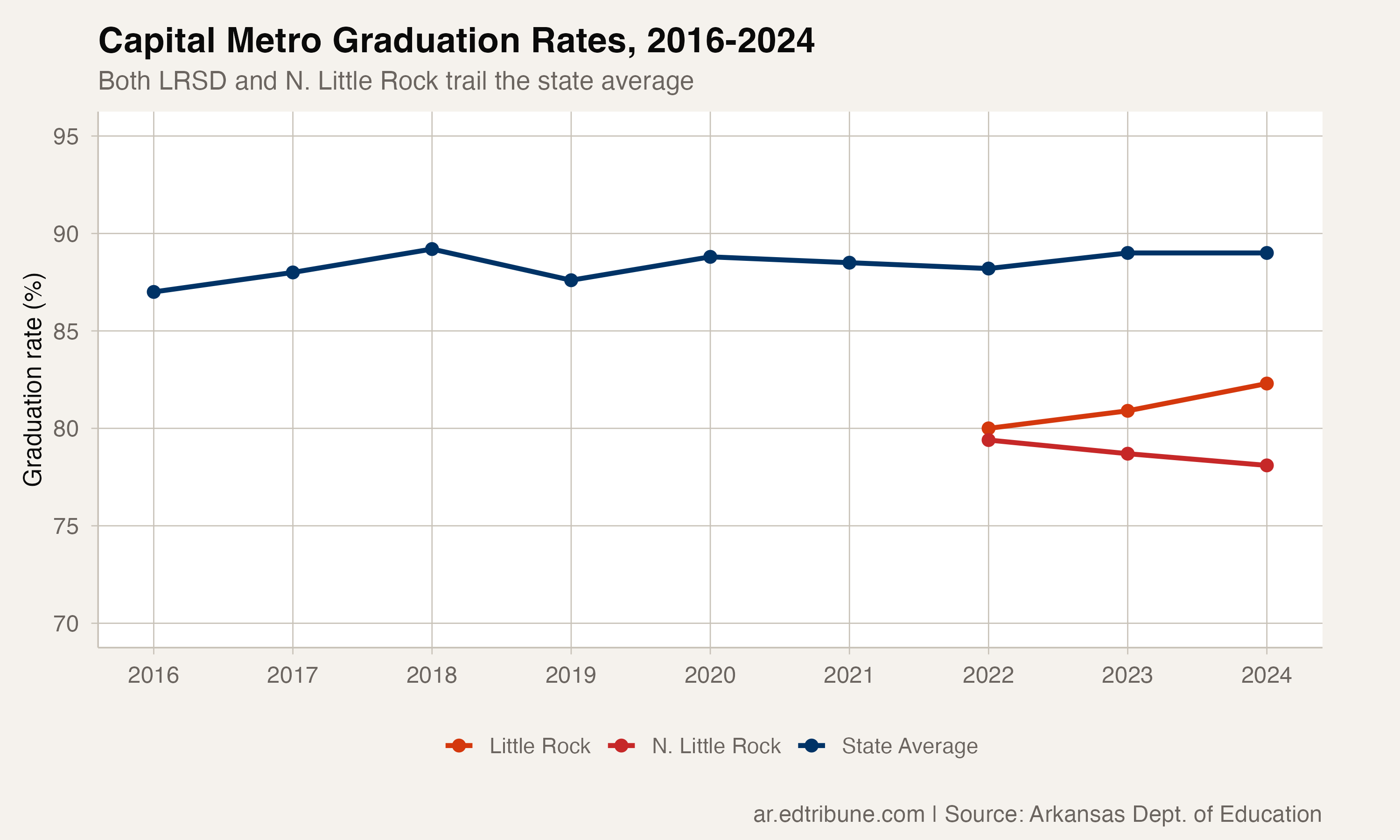
At the current rate of improvement — roughly one point per year — LRSD would not reach the state average until approximately 2031. The state average, meanwhile, is not standing still.
North Little Rock Is Moving the Wrong Direction
Across the river, North Little Rock School District↗ET has the opposite trajectory. Its graduation rate declined for three consecutive years: 79.4 percent in 2022, 78.7 in 2023, 78.1 in 2024.
North Little Rock now graduates a lower share of its students than LRSD does — a reversal from three years ago. At 78.1 percent, it is 10.9 points below the state average and falling.
The two districts together serve the heart of the state capital's metropolitan area. Between them, roughly one in five students does not receive a diploma on time.
The Suburban Ring
The contrast with suburban districts makes the capital metro gap harder to ignore.
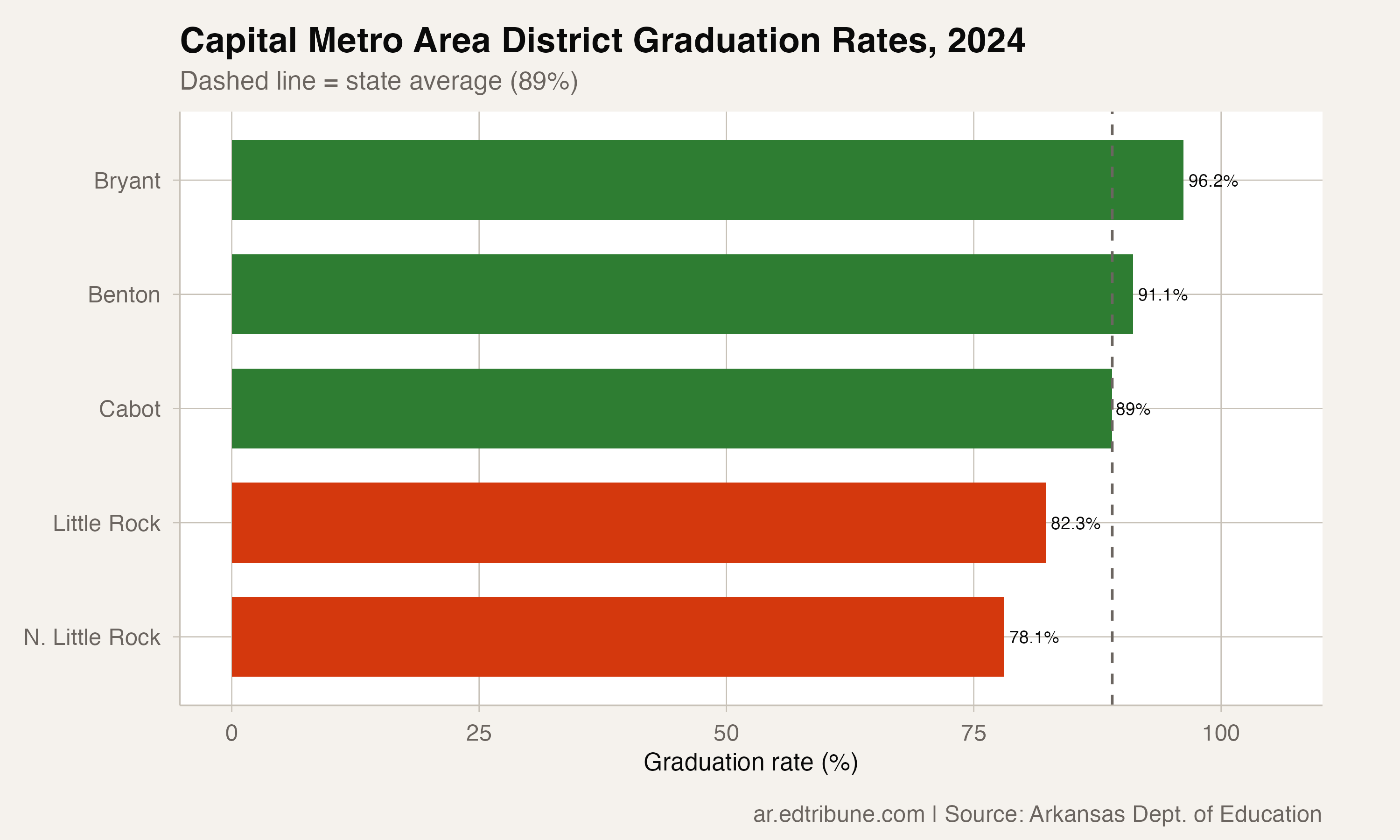
Bryant↗ET leads at 96.2 percent. Benton↗ET is at 91.1 percent. Cabot↗ET is at 89.0 percent — right at the state average. All three are within commuting distance of Little Rock. All three serve substantially different demographics.
The pattern is familiar to anyone who has studied urban education in America: suburban districts that draw from middle-class populations graduate at high rates, while urban cores serving higher concentrations of students who are economically disadvantaged and students with complex needs trail behind. The size of the gap in central Arkansas is notable even by national standards.
Inside LRSD's Numbers
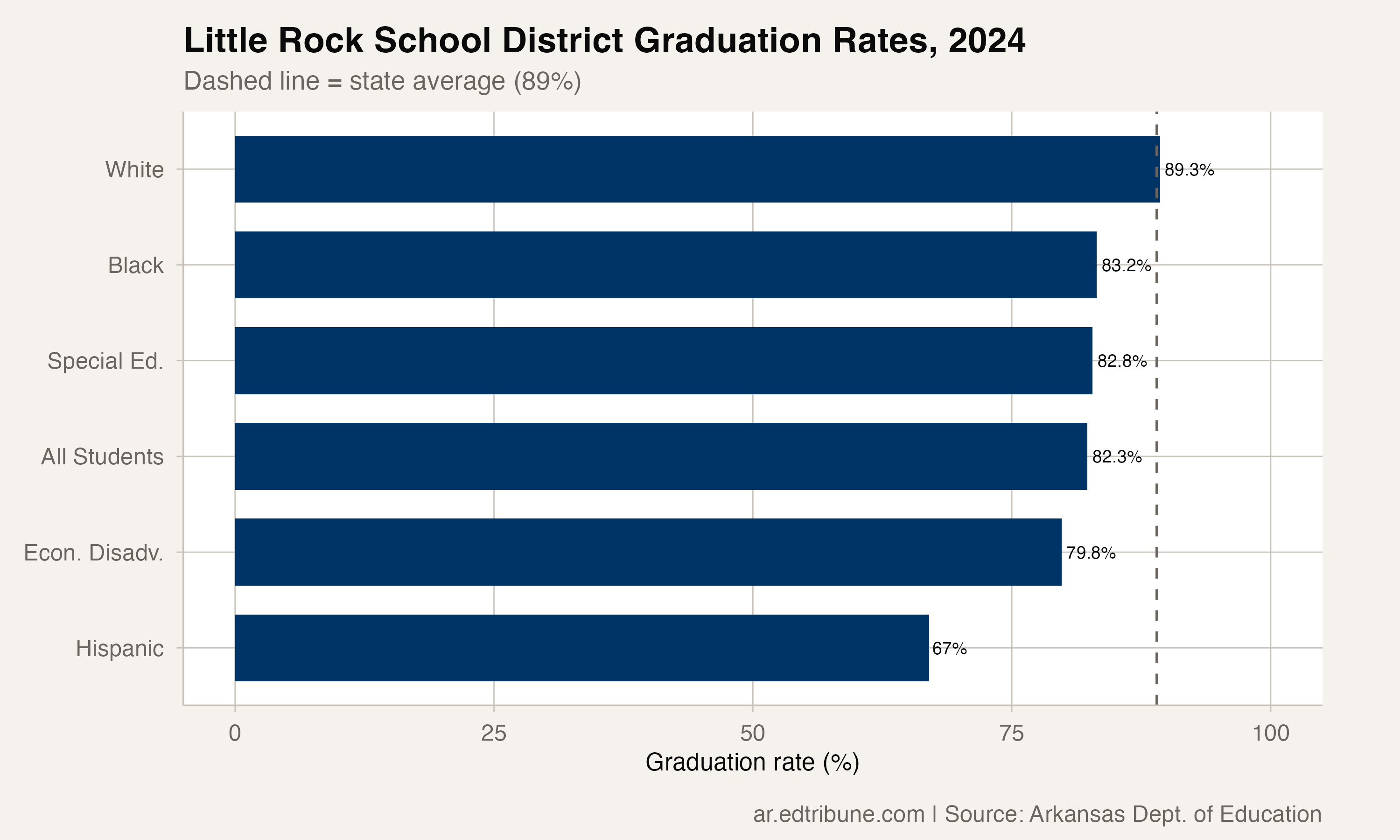
Within LRSD, the subgroup data shows where the work is. White students graduate at 89.3 percent, right at the state average. Black students graduate at 83.2 percent — a point above the district's overall rate, and the district's largest racial group. Students with special needs graduate at 82.8 percent, ahead of the all-students rate. Hispanic students are at 67.0 percent, the lowest rate in any LRSD subgroup besides students with limited English proficiency.
Students who are economically disadvantaged — a large majority of LRSD's enrollment — graduate at 79.8 percent, 7.1 points below the statewide rate for the same subgroup (86.9 percent). The poverty gap that barely exists statewide opens wide in Little Rock.
By the numbers: LRSD graduated 82.3% of its 2024 cohort, up from 80.0% in 2022. N. Little Rock fell to 78.1%, down from 79.4%. Bryant reached 96.2%. The capital-to-Bryant gap is 13.9 points.
What State Control Left Behind
LRSD was placed under state control in January 2015 after the state Board of Education voted to dissolve the elected school board, citing academic distress. Local governance was restored in stages beginning in 2020, with a fully elected school board seated in 2021.
The district that emerged from state control had new leadership, a restructured administrative team, and a community divided over what the takeover had accomplished. The graduation data suggests the district is improving — but slowly, and from a low base.
The three-year trend line is encouraging. Whether LRSD can sustain one-point-per-year gains or whether it plateaus at the low 80s, as many urban districts do, will depend on factors that graduation rates alone cannot measure: teacher retention, school climate, the willingness of families who left during state control to return.
Detailed code that reproduces the analysis and figures in this article is available exclusively to EdTribune subscribers.
Discussion
Sign in to join the discussion.
Loading comments...