Arkansas graduated 89 percent of its high school students in 2024, two percentage points above the national average of roughly 87 percent. For a state whose other education metrics tend to sit near the bottom of national rankings, that number lands differently than it might in Massachusetts or Connecticut.
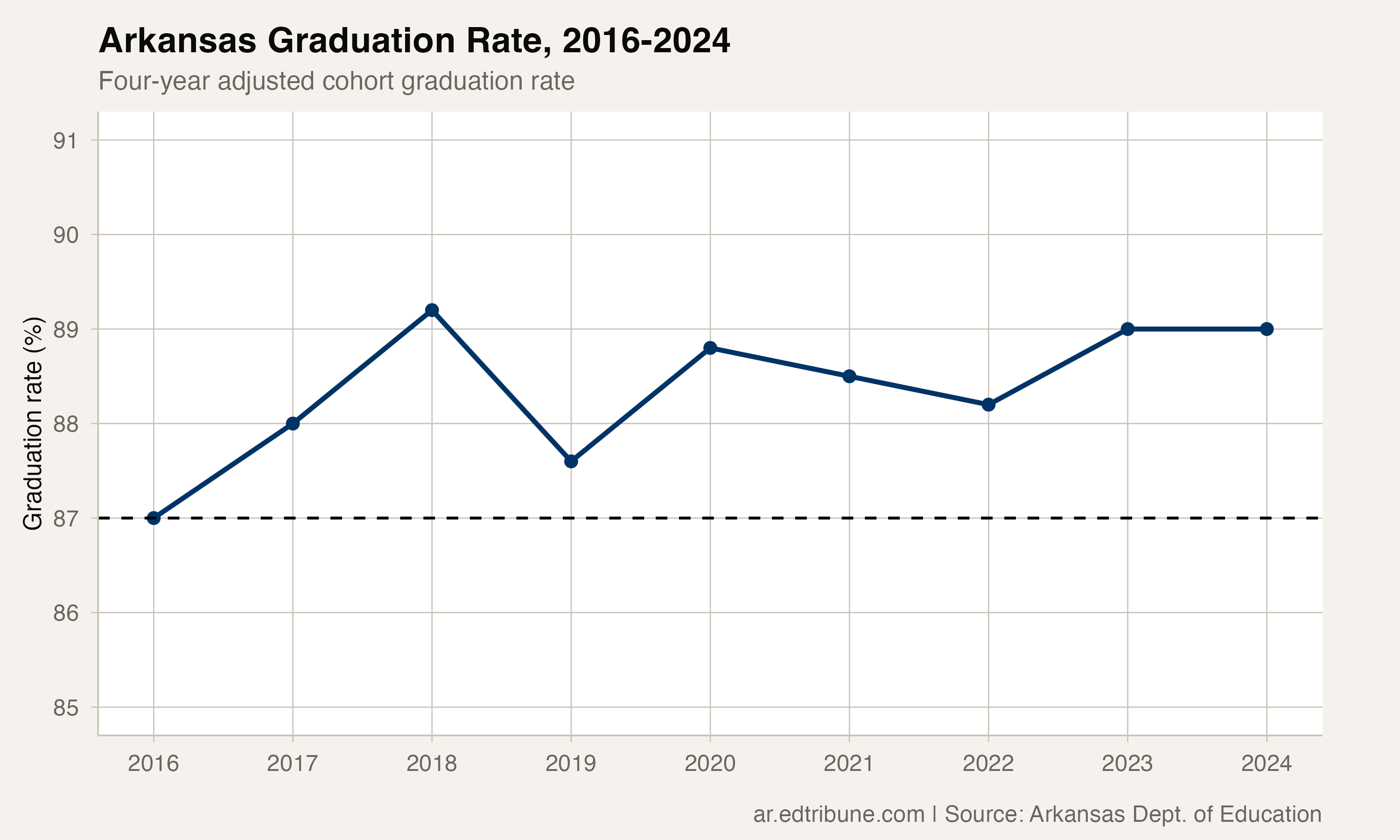
The rate has climbed from 87 percent in 2016, a two-point gain built slowly across nine years with no single leap. Unlike most states, Arkansas did not experience a COVID-era dip in graduation rates — the state continued reporting through 2020, and the rate that year was 88.8 percent, barely off the 89.2 percent posted in 2018.
Every Subgroup Improved
The statewide number is not masking divergent trends underneath. Every major racial subgroup posted gains over the nine-year window.
Asian students lead at 96.3 percent, up 5.4 points from 90.9 percent in 2016 — the largest improvement of any racial group. White students sit at 90.6 percent, up 1.4 points. Hispanic students climbed to 88.5 percent, gaining 2.8 points. Black students reached 85.1 percent, up 3.6 points from 81.5 percent.
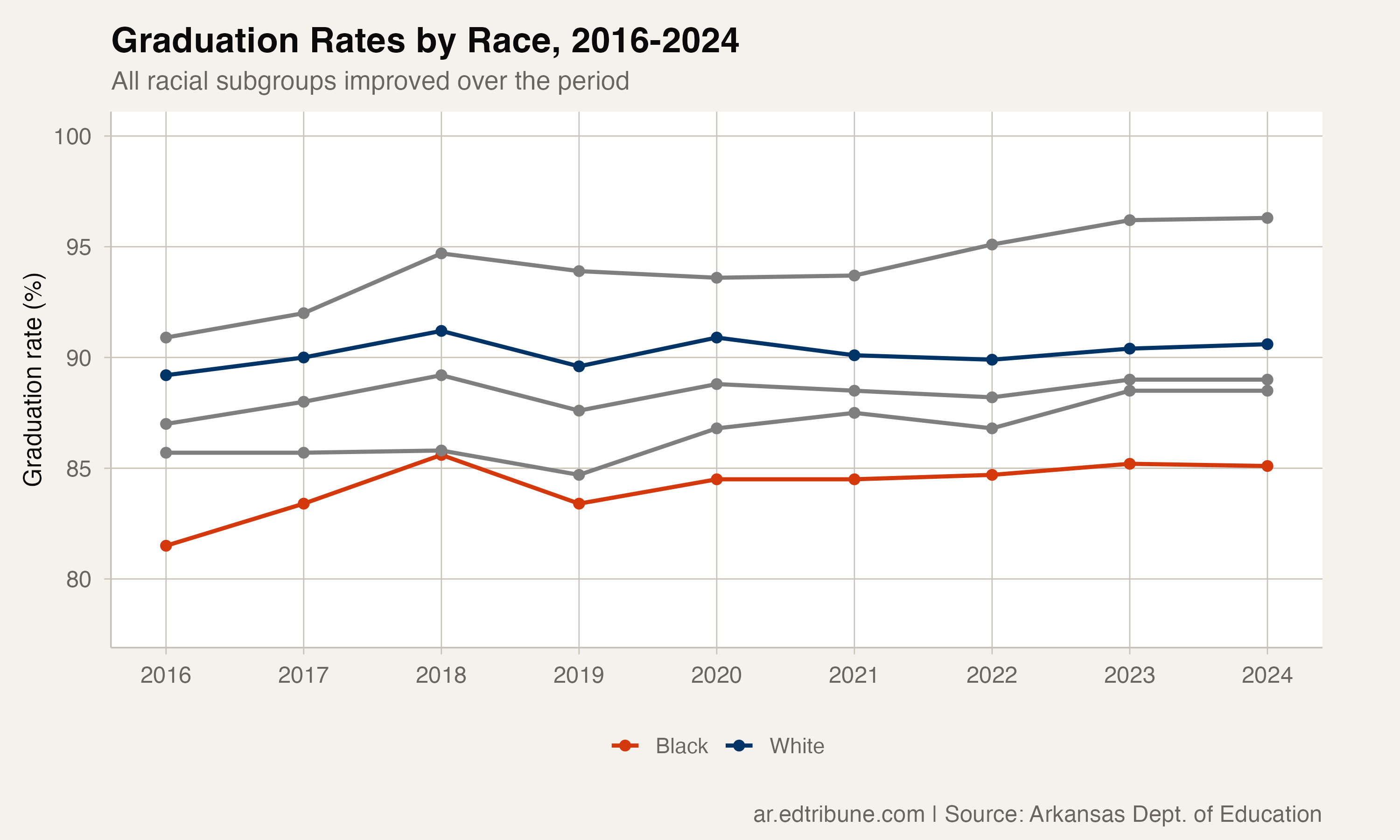
The convergence is real. The white-Black gap narrowed from 7.7 points to 5.5 points. The white-Hispanic gap shrank from 3.5 points to 2.1 points. None of these gaps disappeared, but all of them moved in the right direction.
The Ceiling at 89
The trouble is what happened after 2018. Arkansas hit 89.2 percent that year and has not meaningfully moved since. The 2023 rate was 89.0 percent. The 2024 rate was 89.0 percent. Two years at exactly 89.0 suggest the state may be approaching a structural ceiling — the point where further improvement requires reaching students that existing systems are not designed to serve.
The plateau coincides with a widening gap between the state's strongest and weakest performers. Suburban districts like Bryant↗ET are posting rates above 96 percent. Little Rock↗ET sits at 82.3 percent. Pine Bluff↗ET is at 76.2 percent. The state average can hold at 89 percent while individual districts fall further behind, as long as enough students are concentrated in high-performing systems.
Who Is Below Average
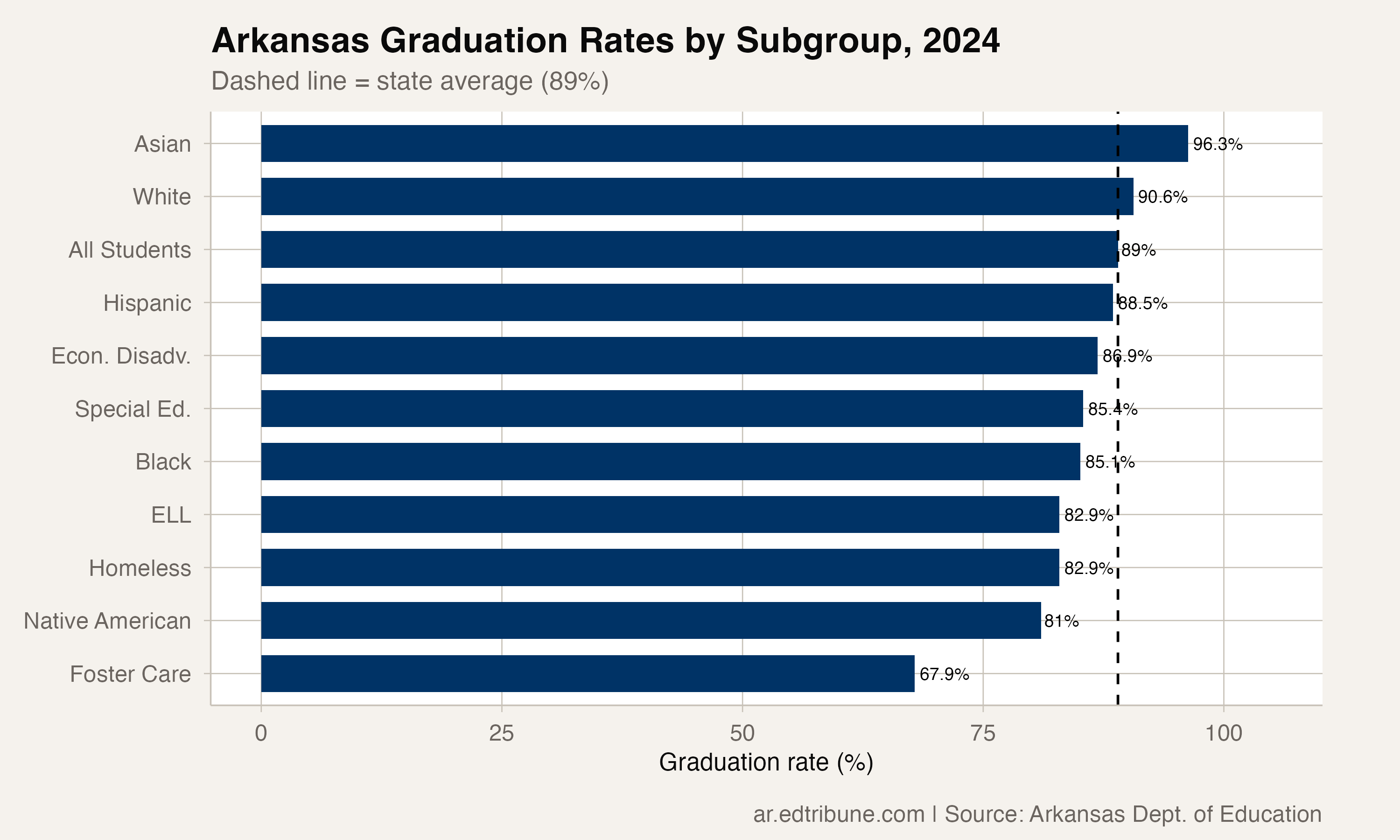
Five subgroups sit below the 89 percent state average in 2024. Black students graduate at 85.1 percent — a strong rate by national standards but still 3.9 points below the Arkansas average. Economically disadvantaged students are at 86.9 percent, only 2.1 points below average — one of the narrowest poverty gaps in the country.
Students who are English learners graduate at 82.9 percent, and students experiencing homelessness match that rate. Special education students are at 85.4 percent, just 3.6 points below average — dramatically narrower than the 30-to-40-point special education gap seen in most states.
The outlier is foster care. Students in the foster care system graduate at 67.9 percent, down from 73.5 percent in 2018 — the largest decline of any subgroup Arkansas tracks. Multiracial students (-3.7 points) and Native American students (-3.0 points) also posted declines over the same period, but foster care students fell the farthest.
By the numbers: 89.0% graduation rate in 2024 — up from 87.0% in 2016. Every racial subgroup improved. The poverty gap is 2.1 points. The foster care rate fell 5.6 points.
What 89 Percent Does Not Tell You
The number comes with a significant caveat. Seventy of Arkansas's 234 districts — nearly 30 percent — report exactly 95.0 percent graduation rates. That is not a coincidence. It is a data suppression threshold applied when cohorts are small enough that individual students could be identified. The true rates for those 70 districts could be anywhere from 95.1 to 100 percent.
This means Arkansas's real statewide rate might be higher than 89 percent. It also means the state's rural small-district landscape is largely invisible in the data — their actual performance is hidden behind a regulatory cap.
What Comes Next
Arkansas's LEARNS Act, signed in 2023, introduces a 75-hour community service requirement for graduation beginning with the Class of 2027. The law includes waivers for students experiencing homelessness, major illness, or family economic hardship. Whether the requirement pushes some students below the graduation threshold — or proves manageable with the waivers — will not show up in the data until 2027 at the earliest.
For now, 89 percent is the number. It is better than most states, better than what Arkansas's other education metrics would predict, and stubbornly resistant to moving higher.
Detailed code that reproduces the analysis and figures in this article is available exclusively to EdTribune subscribers.
Discussion
Sign in to join the discussion.
Loading comments...