Correction (July 23, 2026): An earlier version of this article left Newport, which gained 14.1 points, off the list of next-closest improvers, and its "by the numbers" box labeled the 71.2 percent baseline as 2016. District-level graduation data begins in 2022, and 71.2 percent is the 2022 figure.
In 2022 — the first year Arkansas reported district-level graduation rates — Two Rivers School District↗ET graduated 71.2 percent of its students. It was one of the lowest-performing districts in the state, sitting 17 points below the state average in a rural pocket of Yell County that most Arkansans would struggle to find on a map.
Two years later, the rate was 89.2 percent. An 18-point gain in three years — the largest of any district in the state.
Two Rivers did not just improve. It went from well below average to right at the state average. The gap that separated it from the rest of Arkansas effectively closed.
The Arc
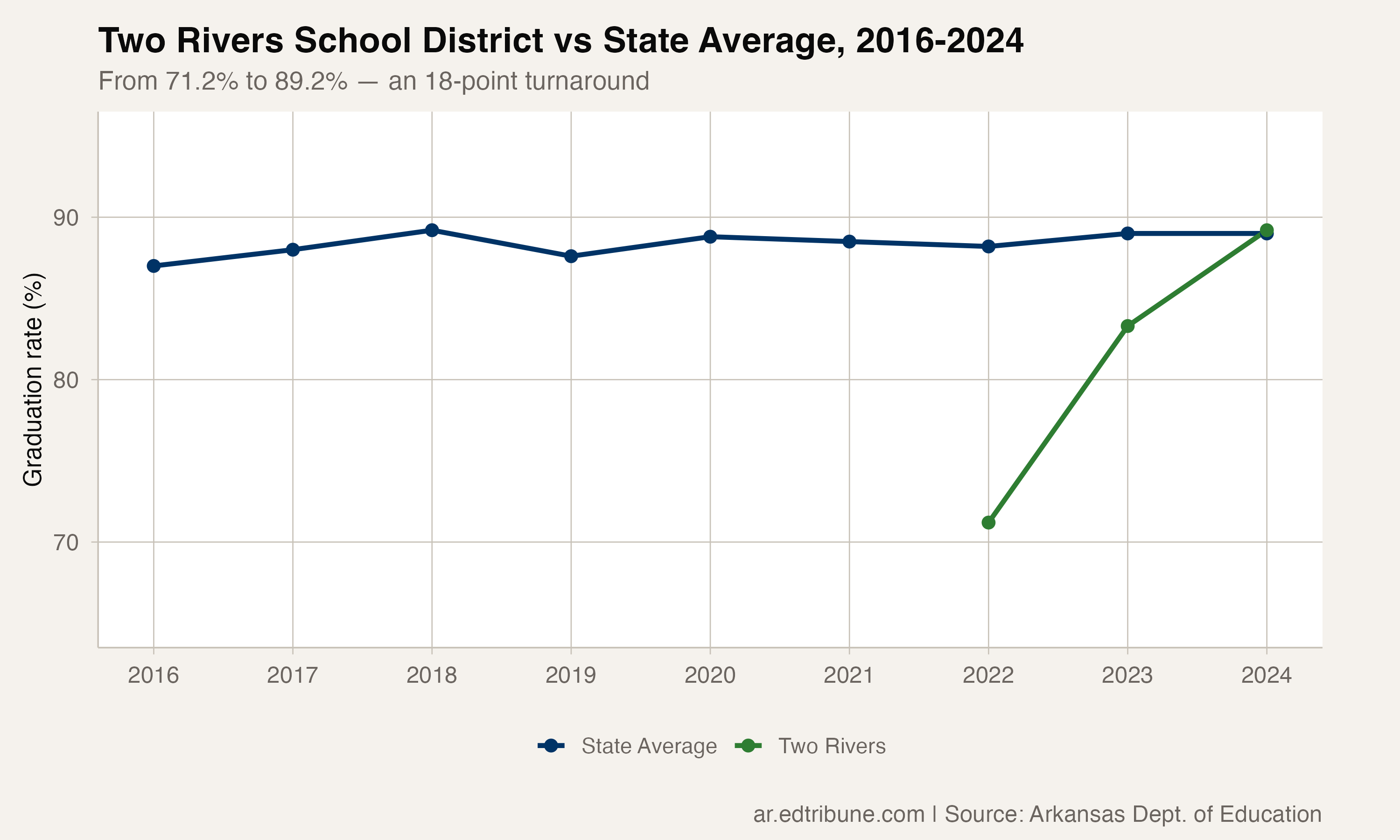
The turnaround happened fast. Over just three years of district-level data, the year-over-year numbers show the unevenness of improvement in a small district where individual students can move the numbers by several points.
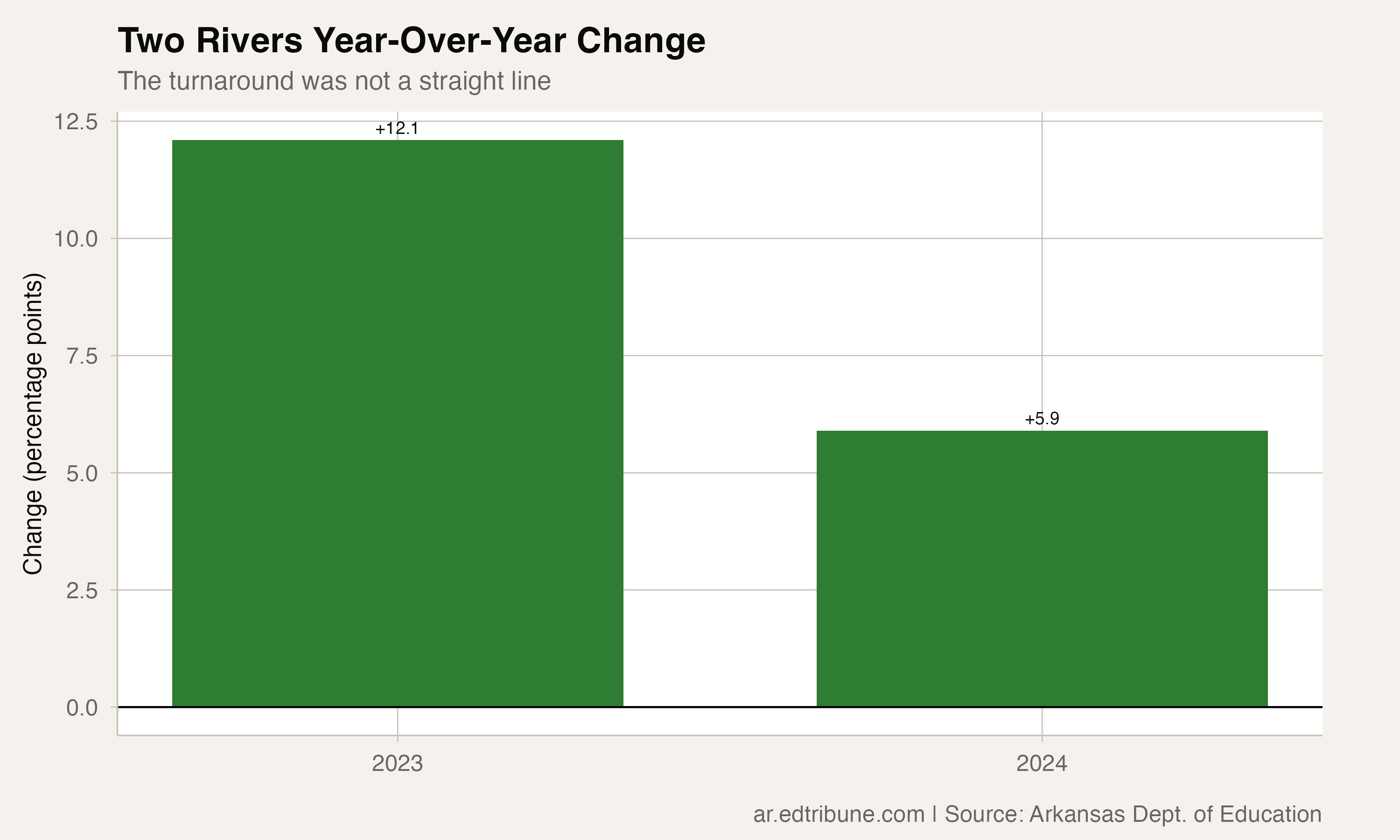
There were setback years mixed with breakthrough years. The overall direction was clear, but the path there included dips that, in a larger district, would have barely registered. In Two Rivers, where graduating classes are small, one or two students making different choices can swing the rate by 5 points in either direction.
What matters is the trajectory. From 71 in 2022 to 89 in 2024, the direction was unmistakable.
Where Two Rivers Sits Among Improvers
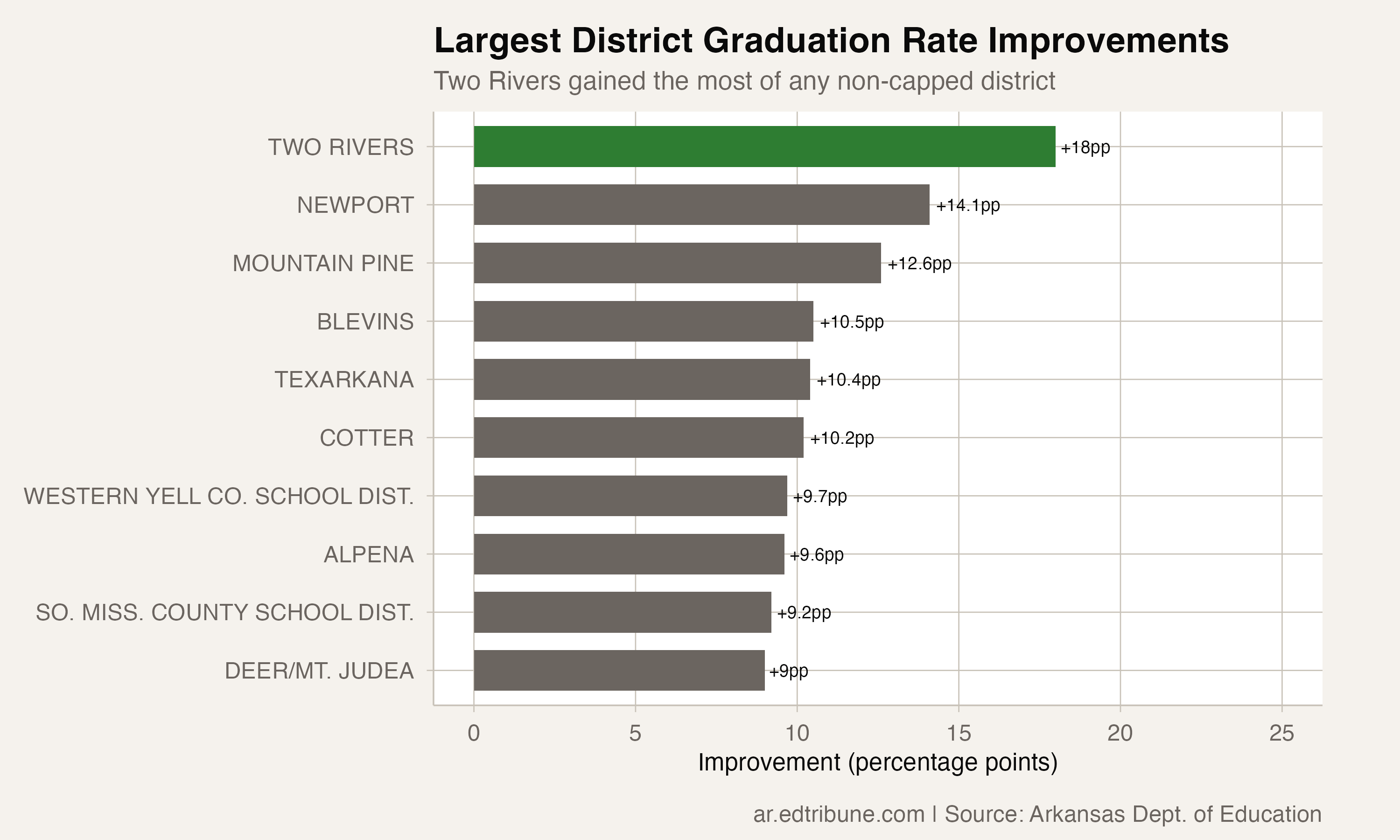
Two Rivers' 18-point gain over three years leads all Arkansas districts. The next-closest improvers — Newport (+14.1), Mountain Pine (+12.6), Blevins (+10.5), Texarkana (+10.4) — all made substantial gains but none approached Two Rivers' magnitude.
The common thread among the top improvers is that most are small, rural districts that started from low baselines. In these communities, focused intervention can produce dramatic results because the denominator is small enough that changing outcomes for a handful of students moves the needle for the whole district.
Two Rivers is distinct because it crossed the threshold from crisis to average. Most of the other big improvers moved from the low 80s to the high 80s or low 90s. Two Rivers traveled twice the distance.
What 89 Percent Looks Like in Two Rivers
The 2024 subgroup data tells an interesting story about where Two Rivers is now.
The overall rate is 89.2 percent — right at the state average. Economically disadvantaged students also graduate at 89.2 percent, matching the district average exactly. That means the poverty gap in Two Rivers is zero.
Female students graduate at 89.7 percent. Male students at 88.9 percent — a gender gap of less than one point, compared to 4 points statewide. Hispanic students are at 95 percent (likely suppressed due to small cohort size). White students, who make up the majority of enrollment, are at 85.4 percent.
Special education students graduate at 80 percent — below the state's already narrow SpEd gap but far above where the district's overall rate sat just two years ago.
By the numbers: Two Rivers went from 71.2% (2022) to 89.2% (2024), an 18-point gain. The poverty gap is zero. The gender gap is less than 1 point. The district now matches the state average.
The Small-District Question
Two Rivers' success raises a question that applies to dozens of Arkansas districts: how much of the turnaround is systemic change, and how much is the mathematics of small numbers?
In a district with graduating classes of 30 or 40 students, the difference between a 71 percent rate and an 89 percent rate is roughly 5 or 6 students. Five students who stay in school instead of dropping out. Six who finish their credits on time instead of falling a semester behind.
That is not a reason to dismiss the improvement. Those students are real people whose lives changed because they received a diploma. But it does mean that Two Rivers' turnaround may not be replicable in Little Rock or Pine Bluff, where the number of students who need to be reached is measured in hundreds, not handfuls.
Yell County
Two Rivers sits in Yell County, a rural area west of Little Rock with a population under 22,000. The county's economy depends on agriculture, timber, and a small manufacturing base. It is not a place that generates education headlines.
The Western Yell County School District, which borders Two Rivers, also improved significantly — gaining 9.7 points to reach 89.7 percent. The fact that two adjacent districts in the same rural county both posted major gains suggests something broader than luck or statistical noise. Something happened in this corner of Arkansas that pushed graduation rates up across the local education ecosystem.
Whether that something was a shared superintendent's initiative, a regional partnership, or simply the cumulative effect of stable leadership over a decade, the data does not say. What it says is that Two Rivers went from 71 to 89, and the district next door made a similar climb.
Detailed code that reproduces the analysis and figures in this article is available exclusively to EdTribune subscribers.
Discussion
Sign in to join the discussion.
Loading comments...