In 2016, white students in Arkansas graduated at 89.2 percent. Black students graduated at 81.5 percent. The gap was 7.7 percentage points.
By 2024, white students had inched up to 90.6 percent. Black students had climbed to 85.1 percent. The gap was 5.5 points.
That narrowing — 2.2 points over nine years — happened because Black students gained 3.6 points while white students gained 1.4. The students who were further behind moved faster.
The Shape of the Closing
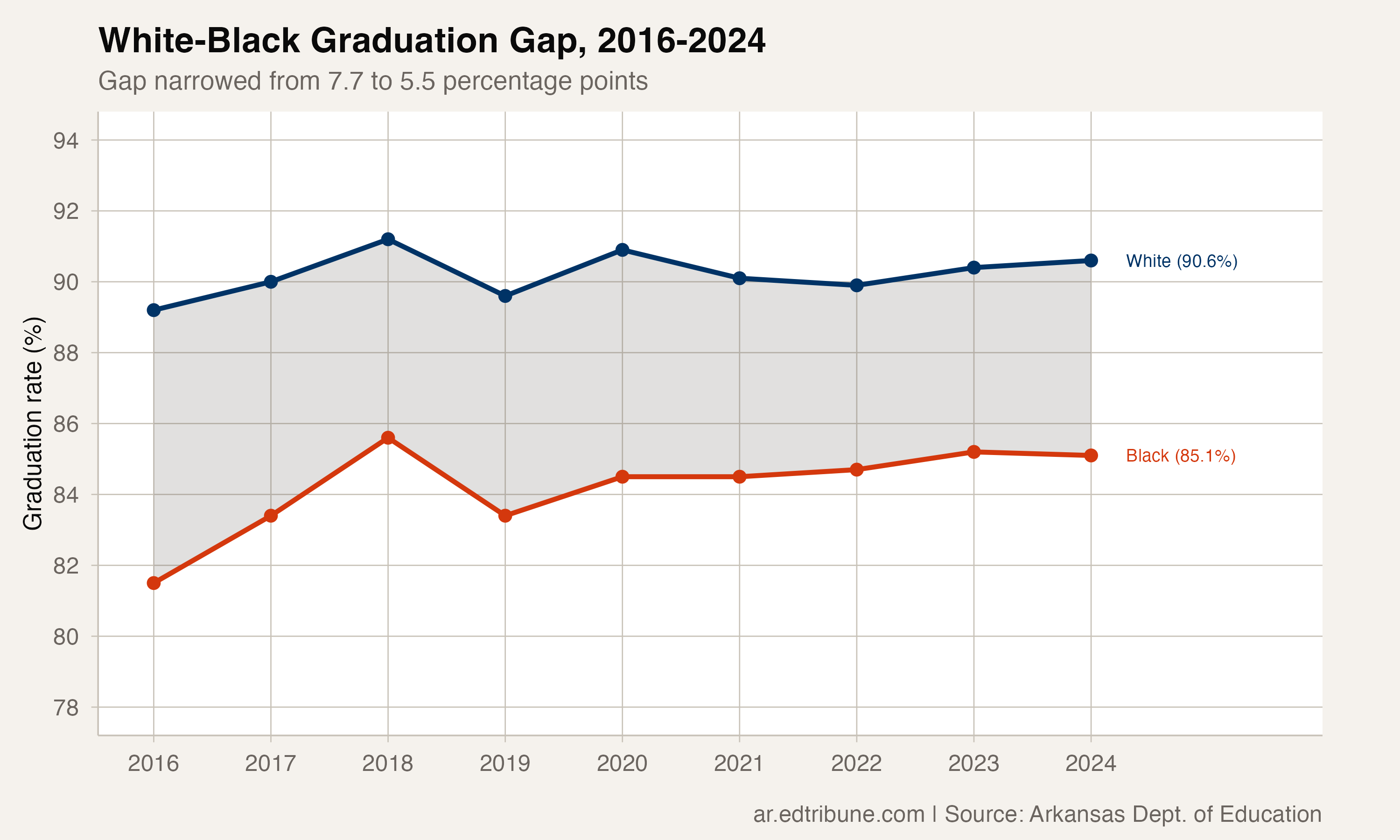
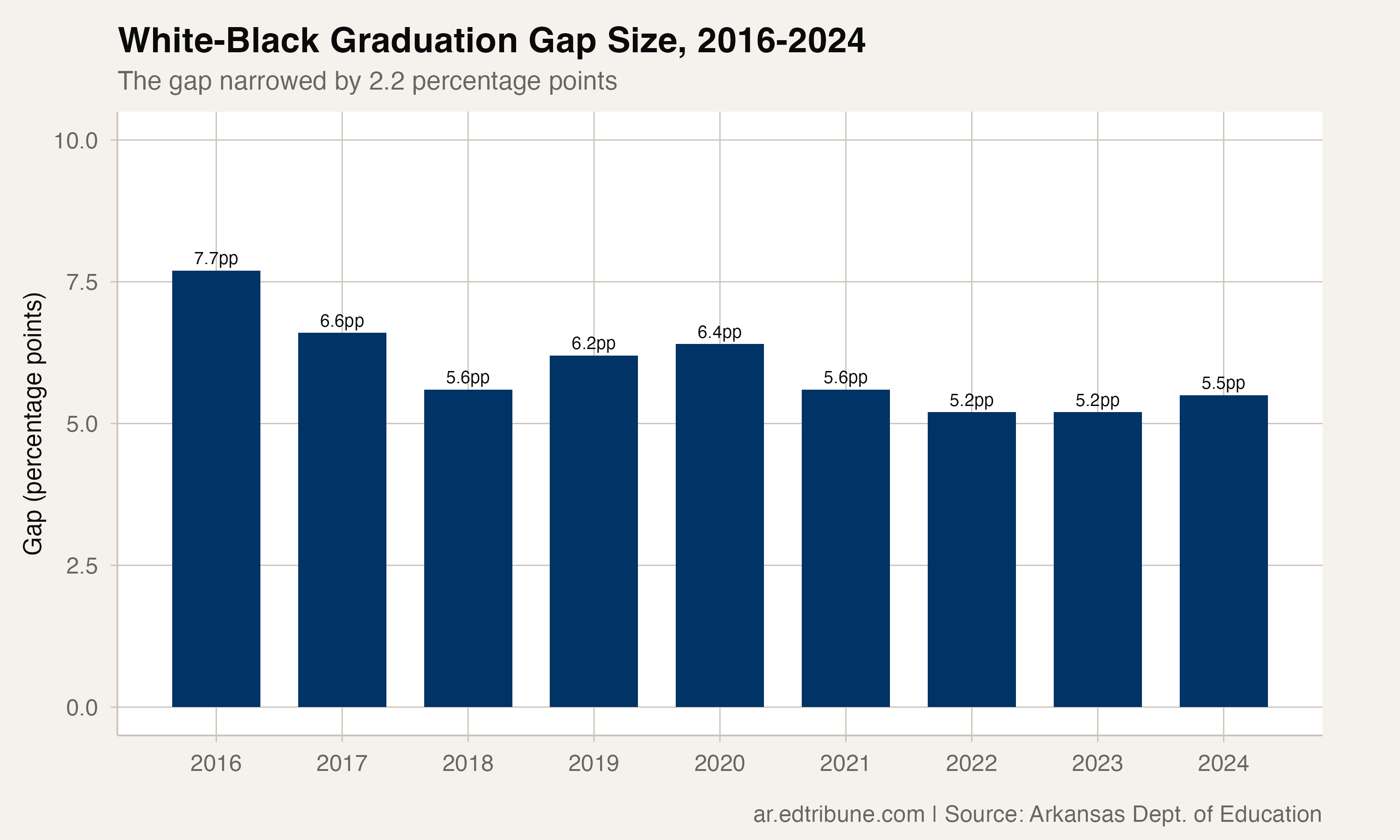
The gap did not close in a straight line. It tightened sharply in the first two years, falling to 6.6 points in 2017 and then 5.6 points in 2018. It widened back to 6.4 in 2020 before resuming a downward path. By 2022 and 2023 the gap held at 5.2 points — its lowest level on record — before nudging up to 5.5 in 2024.
The 2024 gap of 5.5 points sits 0.3 points above the record low of 5.2 set in 2022 and 2023. It is not the narrowest it has ever been, but it is within striking distance.
Most Racial Groups Improved — One Did Not
The white-Black story is not the only trend worth watching. Most racial subgroups posted gains between 2016 and 2024, but the picture is uneven.
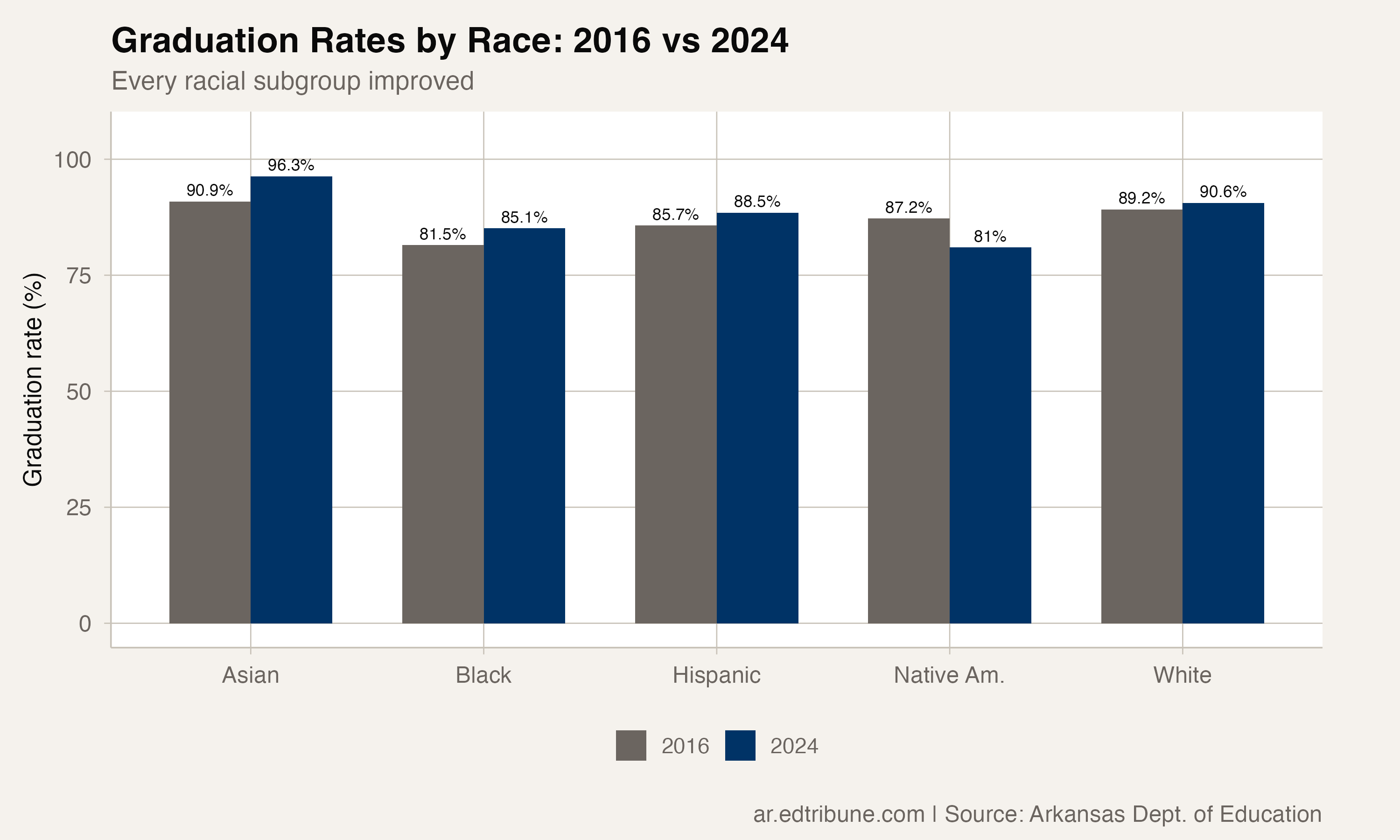
Asian students climbed from 90.9 to 96.3 percent, a gain of 5.4 points and the largest improvement of any racial group. Hispanic students went from 85.7 to 88.5 percent, gaining 2.8 points and nearly erasing their gap with the state average. Native American students moved in the opposite direction: their rate fell from 87.2 percent in 2016 to 81.0 percent in 2024, a decline of 6.2 points. Their small population makes trend analysis less stable, but the eight-year drop is the steepest of any racial subgroup and a counterweight to the broader story of progress.
The white-Hispanic gap tells a particularly clean story. It started at 3.5 points in 2016, and by 2024 it had narrowed to 2.1 points. In 2023, it hit 1.9 points — effectively negligible. Hispanic students in Arkansas are graduating at rates nearly indistinguishable from their white peers.
By the numbers: Black students gained 3.6 points (81.5% to 85.1%). White students gained 1.4 points (89.2% to 90.6%). The gap narrowed from 7.7 to 5.5 points.
Where Black Students Are Graduating at the Highest Rates
The statewide number of 85.1 percent for Black students sits well above the national average for Black graduation rates. But district-level data shows the range is wide.
Among districts large enough to report a Black graduation rate below the 95 percent suppression cap, Magnolia↗ET tops the list at 94.7 percent, with several smaller districts in southern and central Arkansas clustered just behind. Among the larger northwest and border districts, Fayetteville↗ET reports 93.8 percent and Texarkana↗ET 93.7 percent. These are districts where Black students are graduating at rates that would be strong for any subgroup in any state.
At the other end, North Little Rock↗ET graduated Black students at 75.5 percent in 2024. Pine Bluff↗ET was at 77.3 percent. Brookland↗ET and Lake Hamilton↗ET each posted 72.7 percent. In the Delta, Blytheville↗ET was at 81.1 percent and Helena-West Helena↗ET at 81.8 percent.
The gap between the best and worst performing districts for Black students — roughly 22 points — is wider than the statewide white-Black gap itself.
What 5.5 Points Means in Context
A 5.5-point gap is not small. It means that for every 100 white students who receive diplomas, roughly 6 fewer Black students do. Across the state's Black student population, that translates to hundreds of students each year who finish four years of high school without a diploma.
But a 5.5-point gap in Arkansas compares favorably to most states, where white-Black graduation gaps of 10 to 20 points are common. And the direction matters: across the eight year-over-year transitions in the series, the gap narrowed in four, widened in three, and held steady in one — but the long-run drift is downward, and four of the five smallest gaps have come in the last five years.
The question is whether the narrowing continues or whether both groups are approaching their respective ceilings. White students at 90.6 percent have limited room to grow. Black students at 85.1 percent have more room but face steeper barriers. The gap could close further if Black gains continue at their current pace — but stalling at 85 percent, as the overall state rate has stalled at 89 percent, remains possible.
Detailed code that reproduces the analysis and figures in this article is available exclusively to EdTribune subscribers.
Discussion
Sign in to join the discussion.
Loading comments...