Correction (July 21, 2026): The original headline and article incorrectly called foster care the only declining subgroup and compared its 2018 starting point with the state's 2016 rate. Across the consistent 2018-2024 window, foster care had the largest decline, but seven other subgroup or statewide series also declined, and the statewide rate slipped 0.2 point rather than rising 2 points. The correction also removes explanations and student-level conclusions the aggregate graduation file cannot test.
Among 18 Arkansas subgroup series with reported values in both 2018 and 2024, foster care had the largest graduation-rate decline. Its rate fell 5.6 points, from 73.5% to 67.9%.
It was not the only decline. Multiracial students fell 3.7 points, Native American students 3.0, female students 1.0, gifted students 0.7, white students 0.6 and Black students 0.5. The statewide rate moved from 89.2% to 89.0%, down 0.2 point.
Foster care nevertheless stands apart in magnitude: its decline was 1.9 points larger than the next-largest drop.
The Trajectory
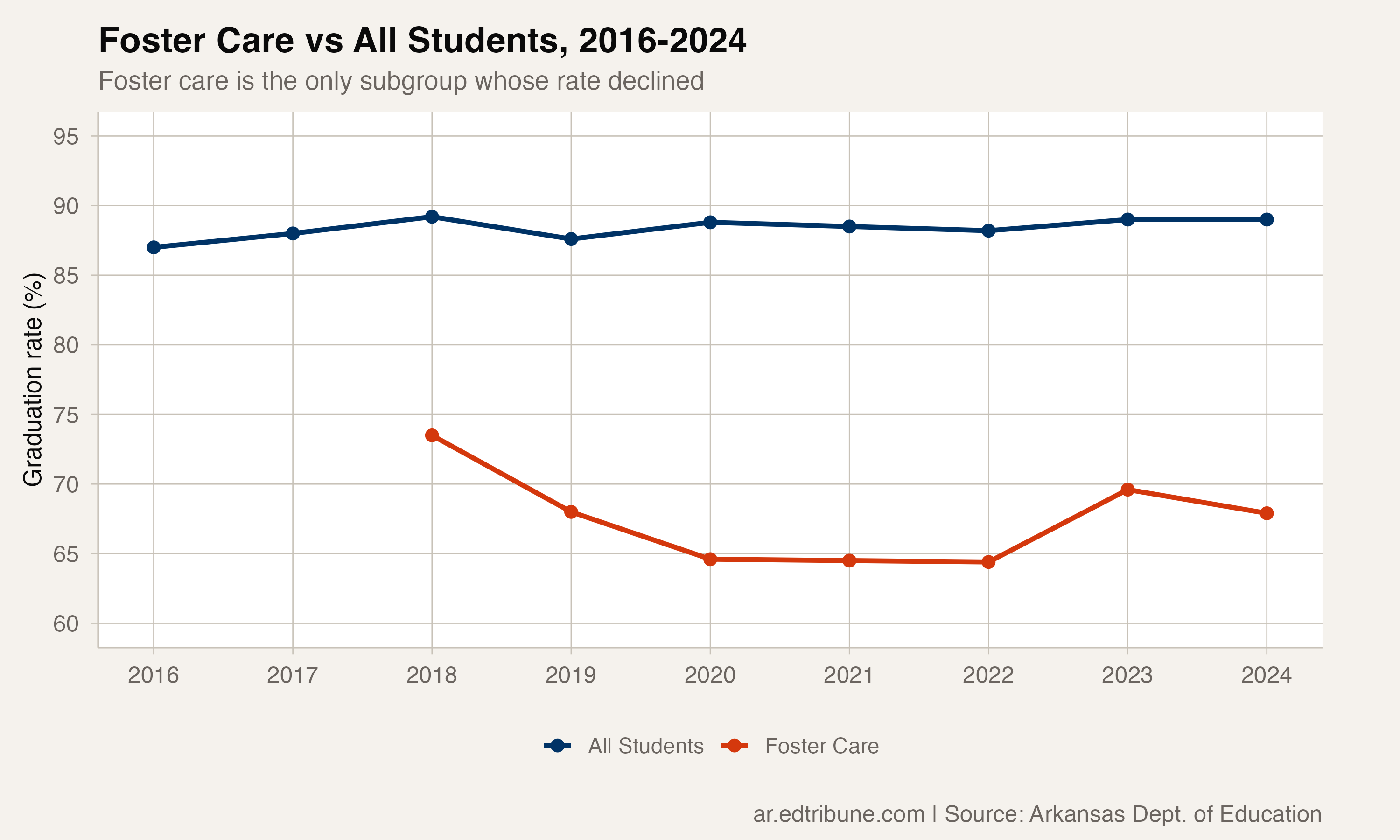
The decline was not gradual. The foster-care rate dropped from 73.5% in 2018 to 64.4% in 2022, a 9.1-point fall in four years. It recovered to 69.6% in 2023, then moved back to 67.9% in 2024. No year after 2018 matched the starting rate.
The gap between foster care and the statewide rate widened from 15.7 points in 2018 to 21.1 in 2024, an increase of 5.4 points.
Where Foster Care Sits Among Vulnerable Groups
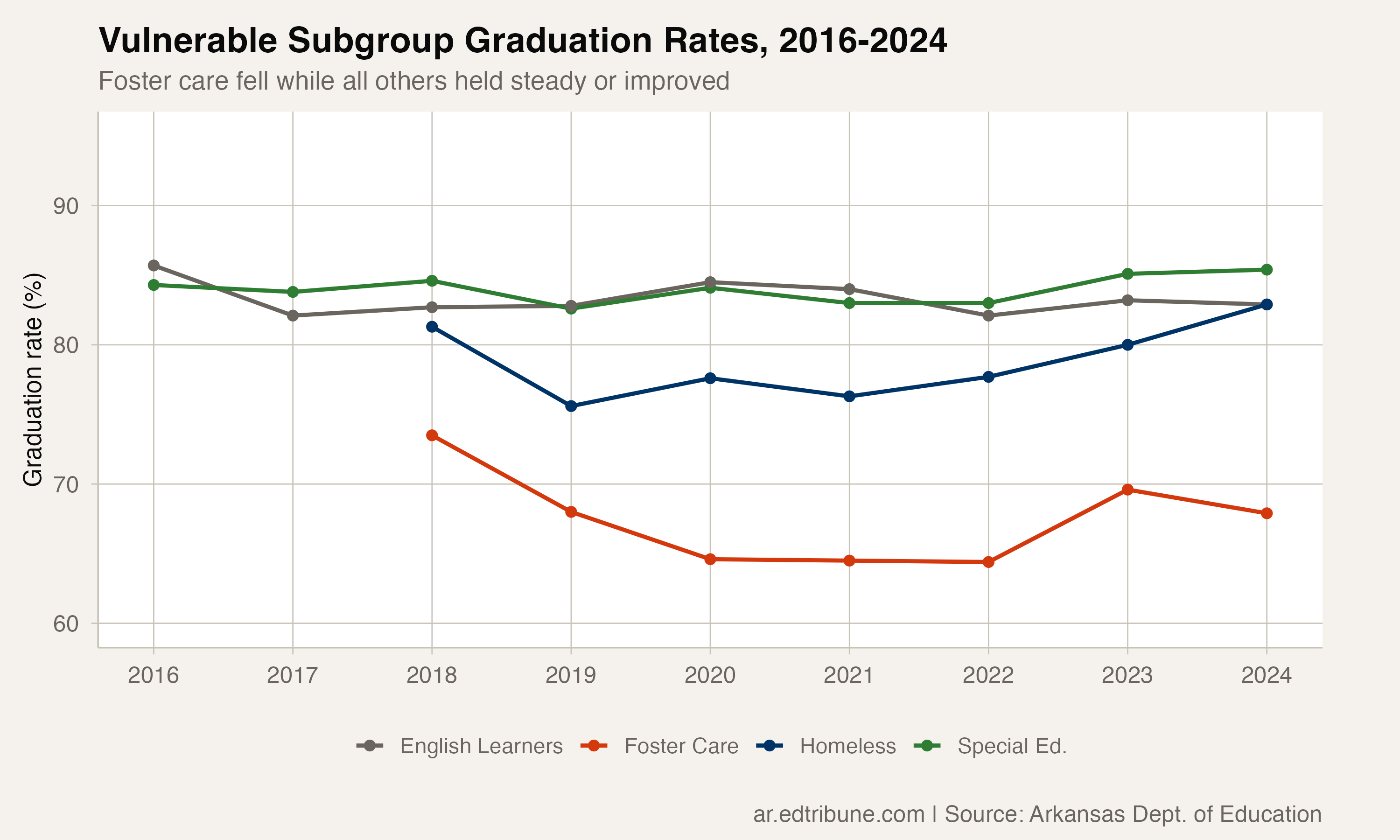
In 2024, the reported foster-care rate was 67.9%. The comparison rates were 82.9% for students who were currently homeless, 82.9% for English learners and 85.4% for students receiving special education services.
The reported homeless-student rate was 15.0 points higher than the foster-care rate. These are separate aggregate subgroups; the file does not show placement histories, school changes or other mechanisms that could explain the difference.
The Largest Subgroup Decline
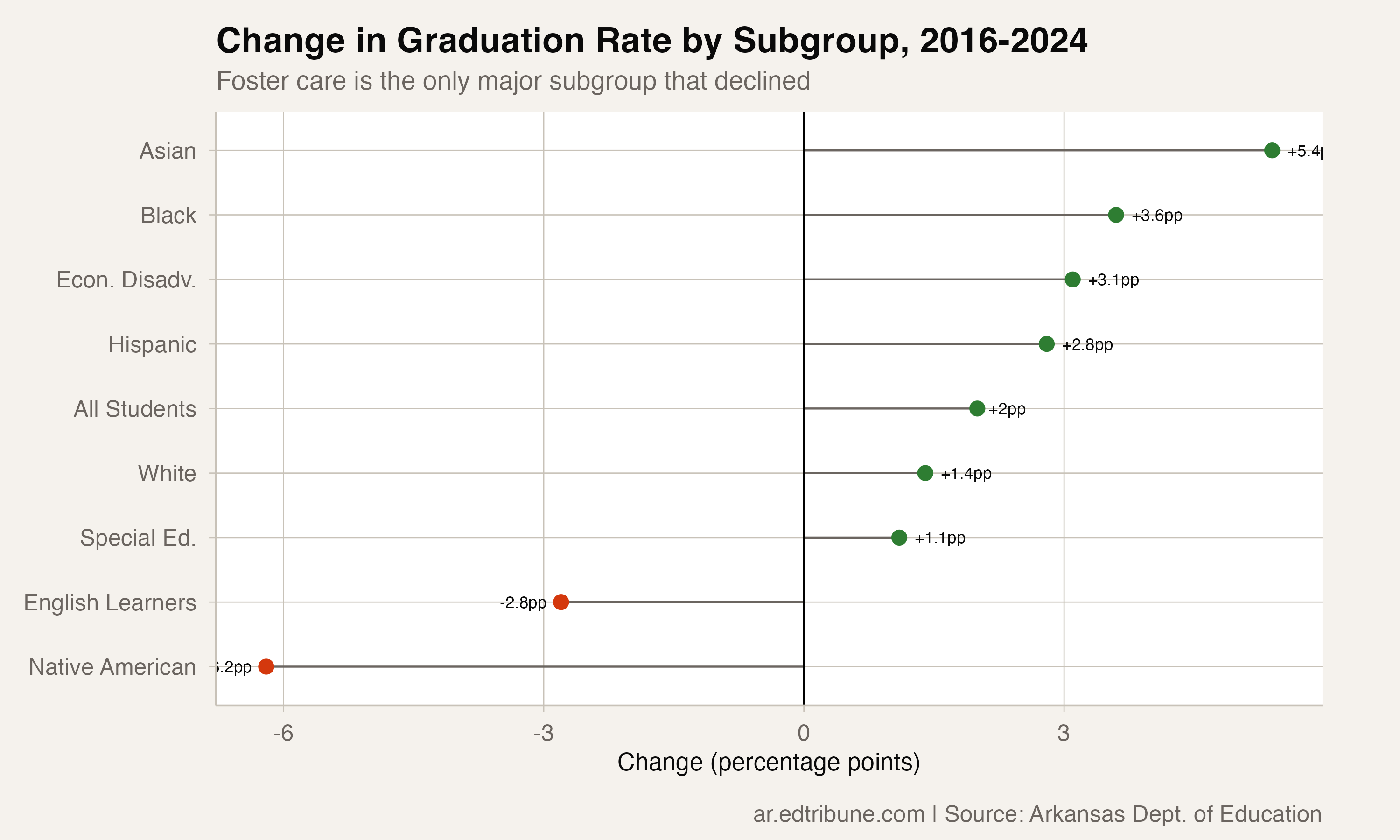
The comparison uses the 2018 starting point because that is the first year the package reports foster care. On that same window, foster care's 5.6-point decline was larger than the 3.7-point multiracial decline and the 3.0-point Native American decline.
Using a 2016 baseline for other groups answers a different question. It produces a 6.2-point Native American decline and a 2.8-point English-learner decline, but those values cannot support an only-decliner claim about foster care, which has no 2016 record.
By the numbers: The foster-care graduation rate fell from 73.5% in 2018 to 67.9% in 2024, a 5.6-point decline. Its gap to the state widened from 15.7 to 21.1 points.
What 68 Percent Means
A reported four-year rate of 67.9% has a 32.1% complement. It does not mean that 32.1% of every student who entered foster care during high school failed to graduate: the package reports an aggregate cohort subgroup, not matched placement histories or individual later outcomes.
The seven reported foster-care values range from 64.4% to 73.5%. Every value after 2018 was below 73.5%, but the series alone cannot identify why.
What the Data Cannot Answer
The graduation file establishes the reported rates, changes and subgroup comparisons. It does not contain caseworker caseloads, transportation records, placement changes, credit transfers or student-level timelines. Those would be needed to test explanations for the foster-care decline.
Detailed code that reproduces the analysis and figures in this article is available exclusively to EdTribune subscribers.
Discussion
Sign in to join the discussion.
Loading comments...