Correction (July 21, 2026): The original article incorrectly said the gender gap showed no narrowing, put its 5.5-point peak in 2019 instead of 2021, and misstated where the male rate ranked among other subgroups. It also presented unsupported explanations and treated the gap as permanent. The corrected article reports the executed state and district data without assigning causes or predicting what happens next.
Arkansas reported a 91.0% four-year graduation rate for female students in 2024 and 87.0% for male students. The female-minus-male gap was 4.0 percentage points.
That was 1.4 points narrower than the 5.4-point gap reported in 2018. The endpoint comparison shows narrowing, but the path was not steady.
Seven Years of Movement in Both Directions
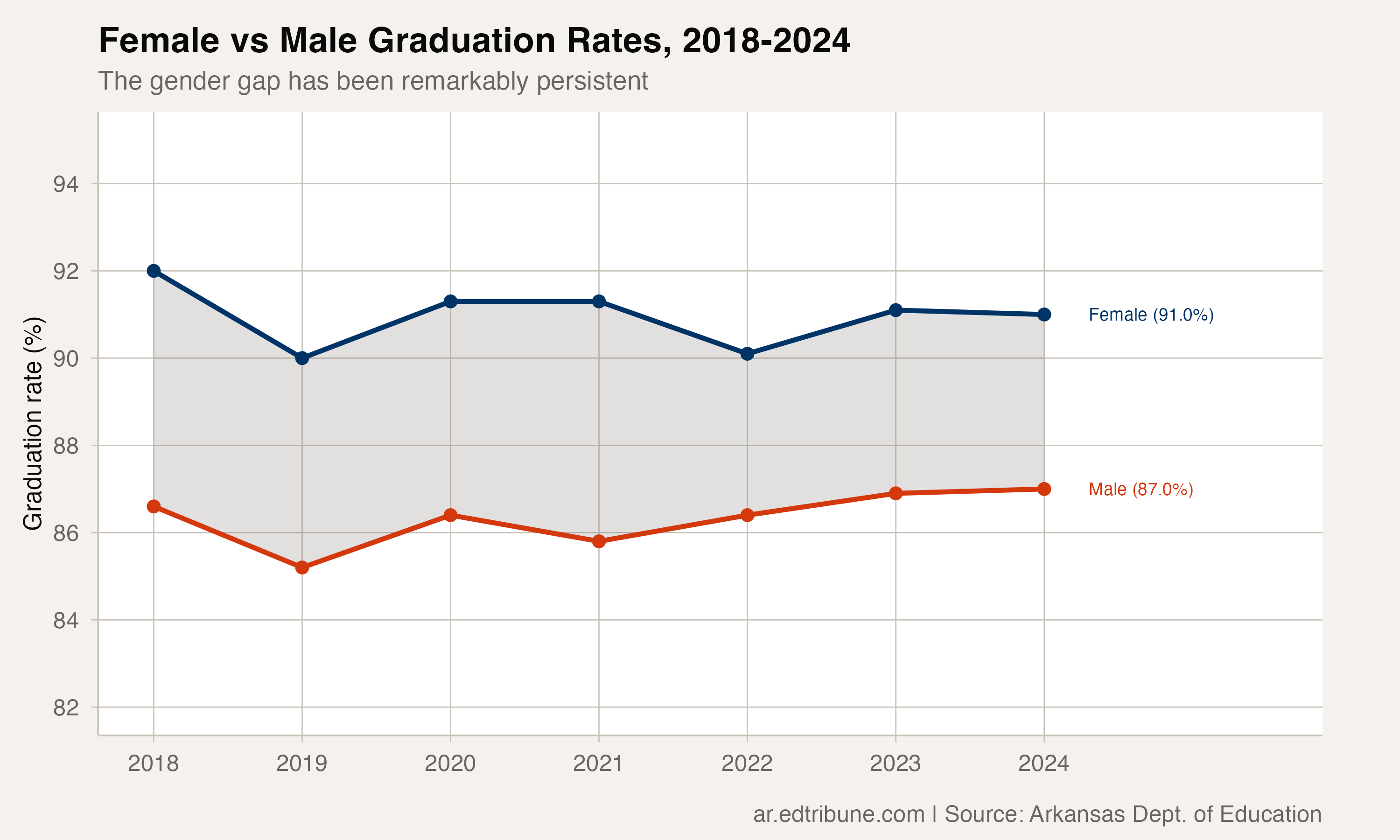
The reported gap moved from 5.4 points in 2018 to 4.8 in 2019, 4.9 in 2020 and a seven-year high of 5.5 in 2021. It then fell to a seven-year low of 3.7 in 2022, widened to 4.2 in 2023 and narrowed to 4.0 in 2024.
Across those six annual transitions, the gap narrowed three times and widened three times.
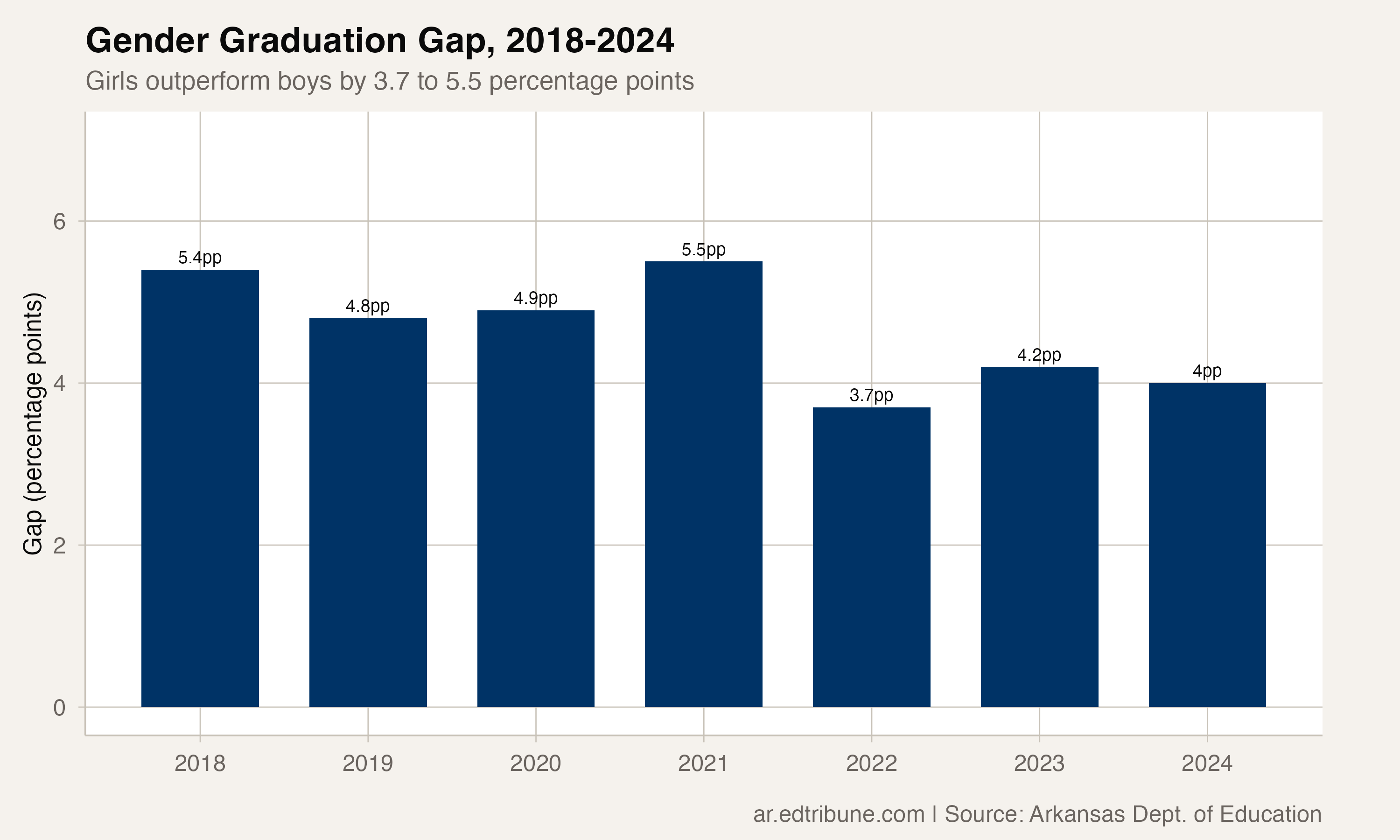
The data therefore support two conclusions at once: the 2024 gap was smaller than the 2018 gap, and that change did not follow a consistently narrowing annual pattern. The graduation file does not establish whether the endpoint change will continue.
By the numbers: Female graduation rate: 91.0%. Male: 87.0%. Gap: 4.0 points. Seven-year range: 3.7 to 5.5 points. Change from 2018: -1.4 points.
Where the Male Rate Ranked in 2024
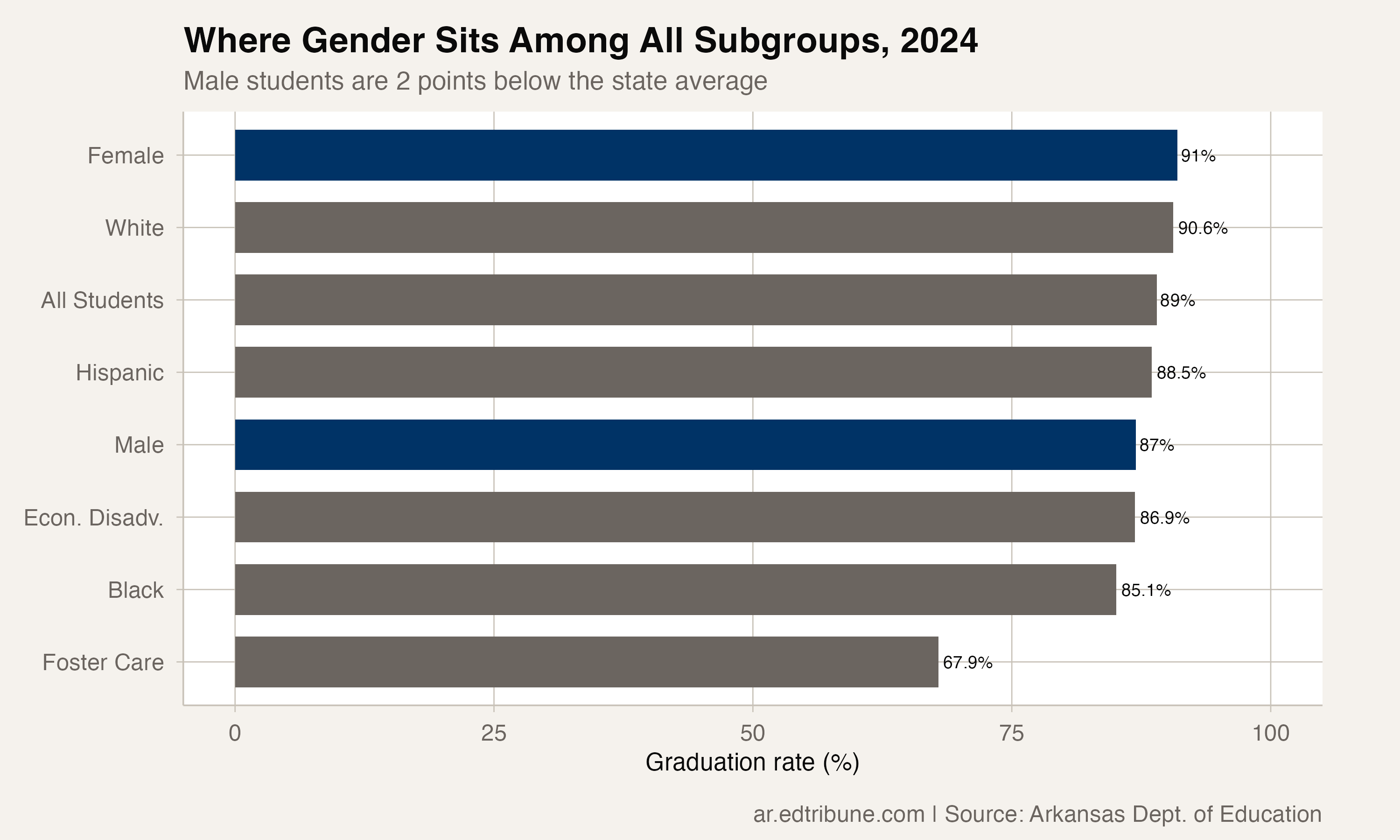
The male rate ranked eighth among 18 statewide subgroup series reported for 2024. Seven were higher and 10 were lower.
The 87.0% male rate was 2.0 points below the 89.0% all-student rate. It also sat below the female, gifted, Asian, military-connected, white and Hispanic series. It sat just above the 86.9% free- or reduced-price-lunch series, as well as the multiracial, special education, Black, English learner, homeless, migrant, Native American, Pacific Islander and foster-care series.
These categories overlap. A subgroup ranking does not isolate gender from race, income, disability status or other characteristics, and it does not measure the effect of any one characteristic on an individual student's graduation outcome.
Districts With the Lowest Reported Male Rates
At Mount Ida↗ET, the reported male rate was 58.3% in 2024, lowest among district male series in the file. The female rate was 78.6%, producing a 20.3-point gap.
Barton-Lexa reported a 61.3% male rate and a 25.1-point gap. Shirley reported 62.5% and a 19.3-point gap. Marvell-Elaine followed at 66.7% with a 17.9-point gap.
Pine Bluff↗ET reported a 70.5% male rate and a 12.0-point gap. Blytheville reported 70.8% and a 13.6-point gap.
The package output used for this analysis supplies these rates but not district cohort or graduate counts. That prevents a count-based comparison and does not support claims about how many individual students did or did not graduate.
What the Graduation File Cannot Explain
The state file describes reported outcomes; it does not identify why female and male rates differ. It contains no measures of discipline, retention, school climate, family behavior or policy exposure that could test the explanations offered in the original article.
It also cannot show that Arkansas's four-point gap is permanent. The verified record instead shows annual movement in both directions and a 2024 endpoint below 2018.
Detailed code that reproduces the analysis and figures in this article is available exclusively to EdTribune subscribers.
Discussion
Sign in to join the discussion.
Loading comments...