Principal Stan Karber of Lincoln High School told state media that the mentor program was the single biggest factor behind the school's attendance numbers. Every student has a designated adult who checks in on them. The data backs him up.
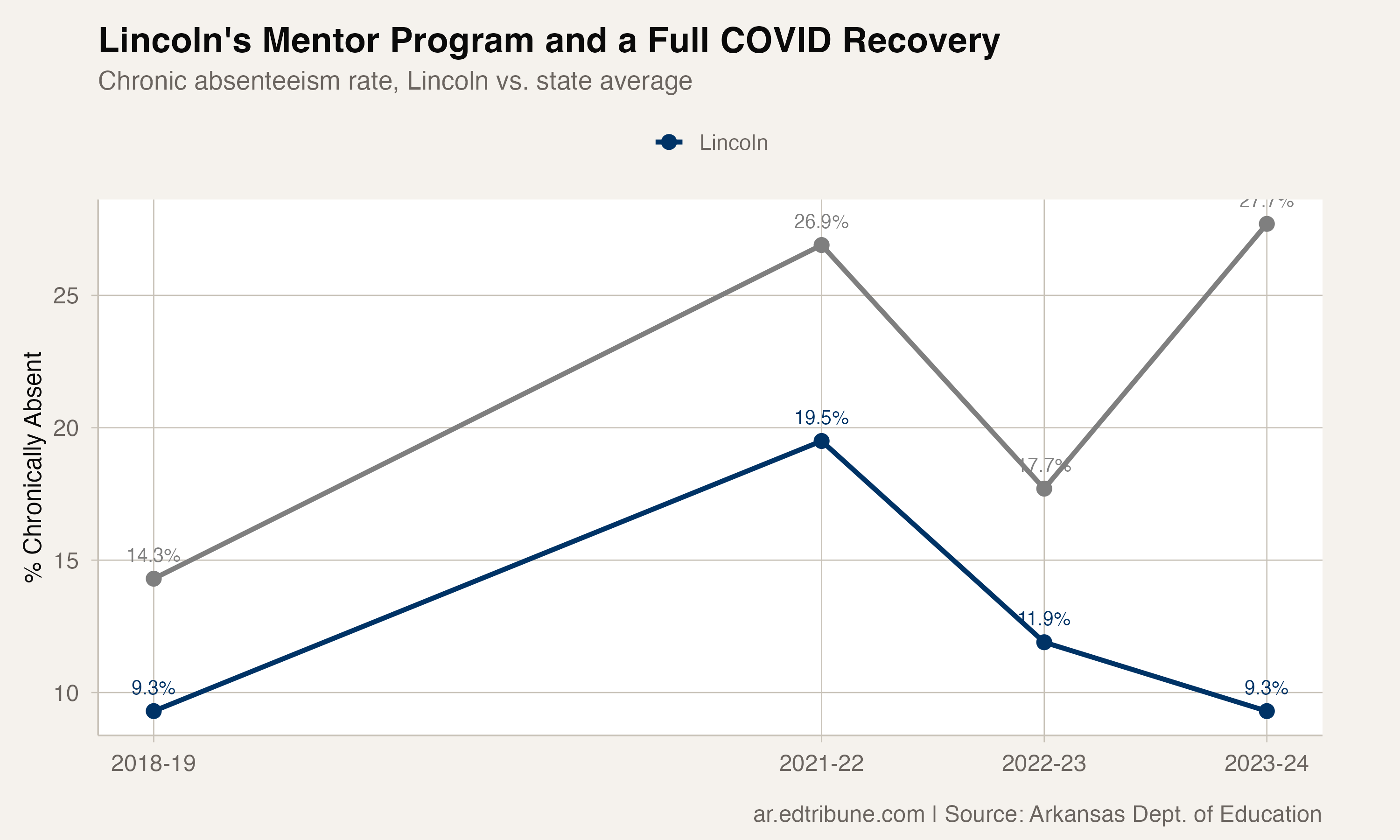
Lincoln School District↗ET, a roughly 600-student system in Washington County, posted a 9.3% chronic absenteeism rate in 2023-24, exactly matching its pre-COVID level from 2018-19. In a state where the average district saw chronic absence spike 10 percentage points in 2023-24, Lincoln returned to baseline.
The Full Recovery
Lincoln's four data points tell a clean story of spike and recovery.
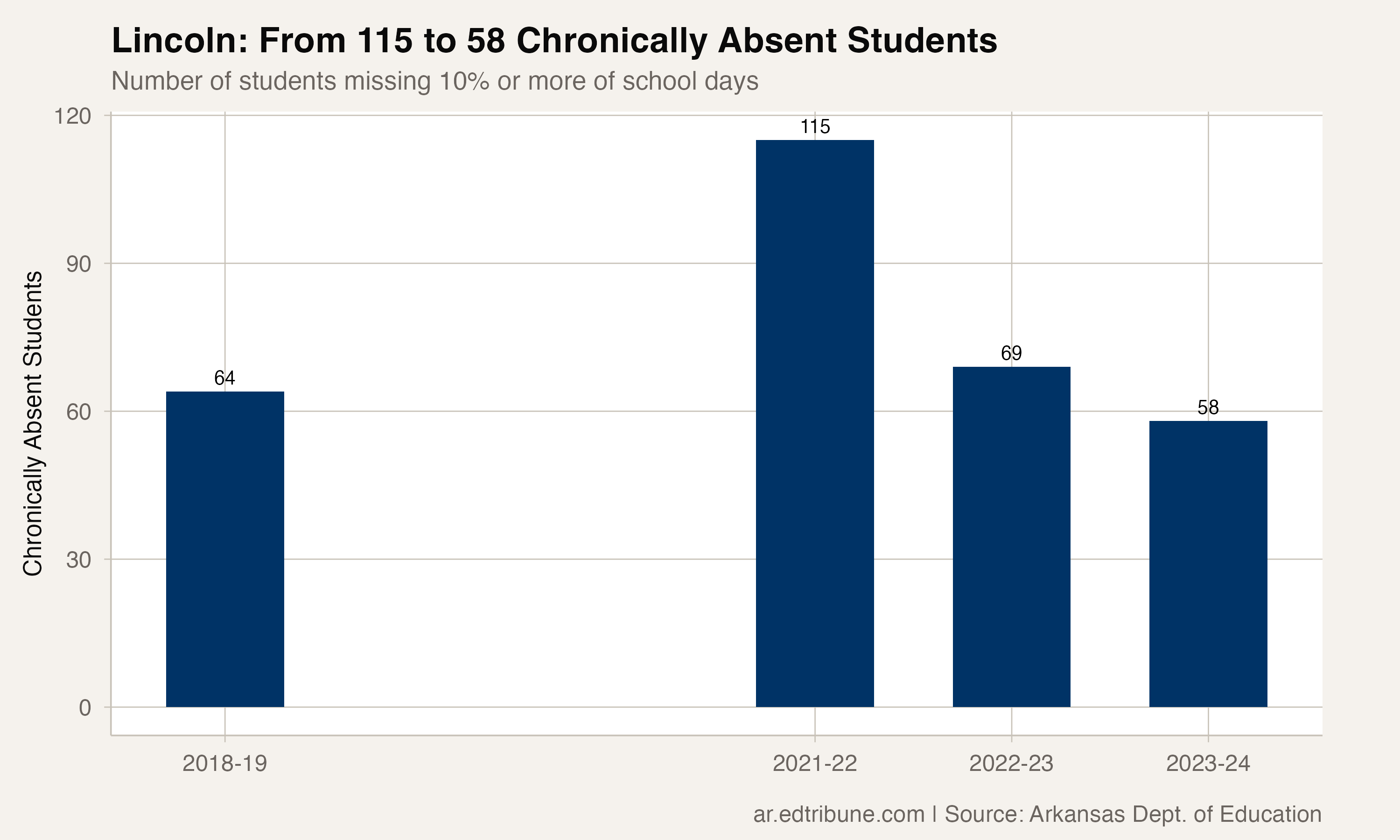
In 2018-19, 64 of 691 students were chronically absent, a 9.3% rate that sat comfortably below the state average of 14.3%. Then came COVID: by 2021-22, 115 of 591 students were chronically absent, a rate of 19.5%. The 2022-23 school year brought partial recovery to 11.9%, and 2023-24 completed it at 9.3%.
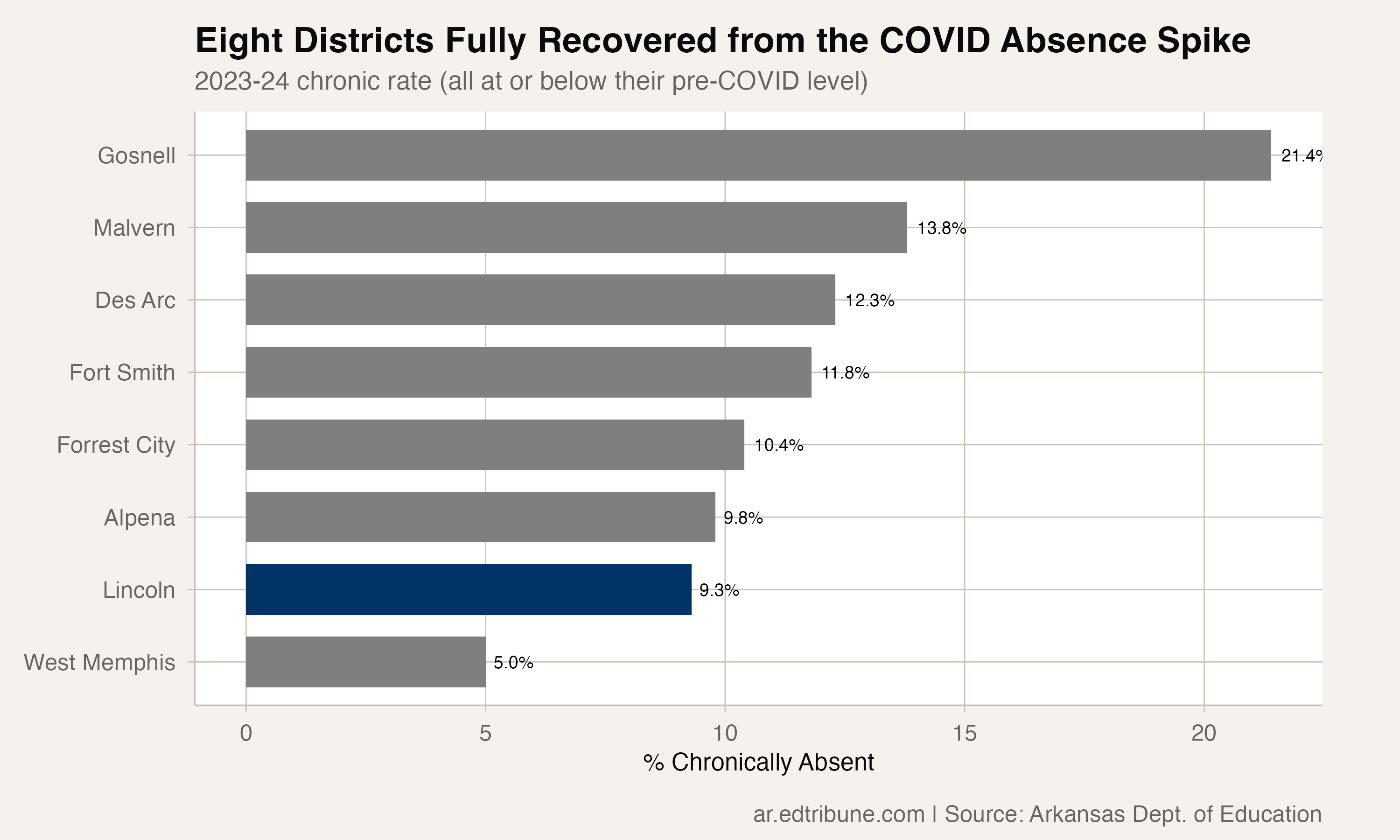
Lincoln is one of only eight Arkansas districts (with at least 200 students) to spike during the COVID era and fully return to their pre-COVID chronic absence rate by 2023-24.
The Mentor Program
The mentor model is built on a simple premise: every student in the school has an assigned adult (teacher, coach, counselor, or staff member) who checks in regularly. The check-in is not academic advising or disciplinary follow-up. It is a relationship.
When a student starts missing days, the mentor is the first line of response. They know the student. They know whether absences signal a transportation problem, a family crisis, or a choice to disengage. That knowledge turns intervention from bureaucratic to personal.
The Four-Day Week
Lincoln also operates on a four-day school week, a schedule that a growing number of small and rural Arkansas districts have adopted. Proponents argue the schedule reduces burnout for both students and staff, cuts transportation costs, and can improve attendance by reducing the number of days a student needs to show up.
Whether Lincoln's attendance recovery is primarily a mentor story, a scheduling story, or some combination of both is an open question. What is clear is the outcome: a small rural district that returned to pre-COVID attendance levels while the state moved the other direction.
Part of a Small Club
Only eight Arkansas districts with at least 200 students experienced a COVID-era spike and then returned to or below their pre-COVID chronic absence rate by 2023-24. Lincoln sits among the smallest in that group, alongside Des Arc and Forrest City.
Never Above 20%
There is another distinction worth noting: Lincoln's chronic rate never exceeded 20% in any measured year. Even at its COVID-era peak, the district's 19.5% rate stayed below the threshold. Lincoln is one of 33 Arkansas districts (with 200 or more students and three or more years of data) that never crossed the 20% line.
The mentor program, the four-day week, and a community that kept showing up through a crisis all played a role. For other small districts trying to rebuild attendance, Lincoln is worth studying.
Detailed code that reproduces the analysis and figures in this article is available exclusively to EdTribune subscribers.
Discussion
Sign in to join the discussion.
Loading comments...