Before the pandemic ever arrived in Logan County, Magazine School District had already made a decision that would shape its recovery: in 2018-19, the district switched to a continuous calendar, spreading the school year across 12 months with shorter, more frequent breaks instead of a single long summer.
The year-round schedule was designed to reduce the learning loss and family disengagement that comes with extended summer breaks. Whether by design or coincidence, it also positioned Magazine↗ET to recover from the COVID-era attendance crisis faster than almost any district in the state.
The Spike and the Recovery
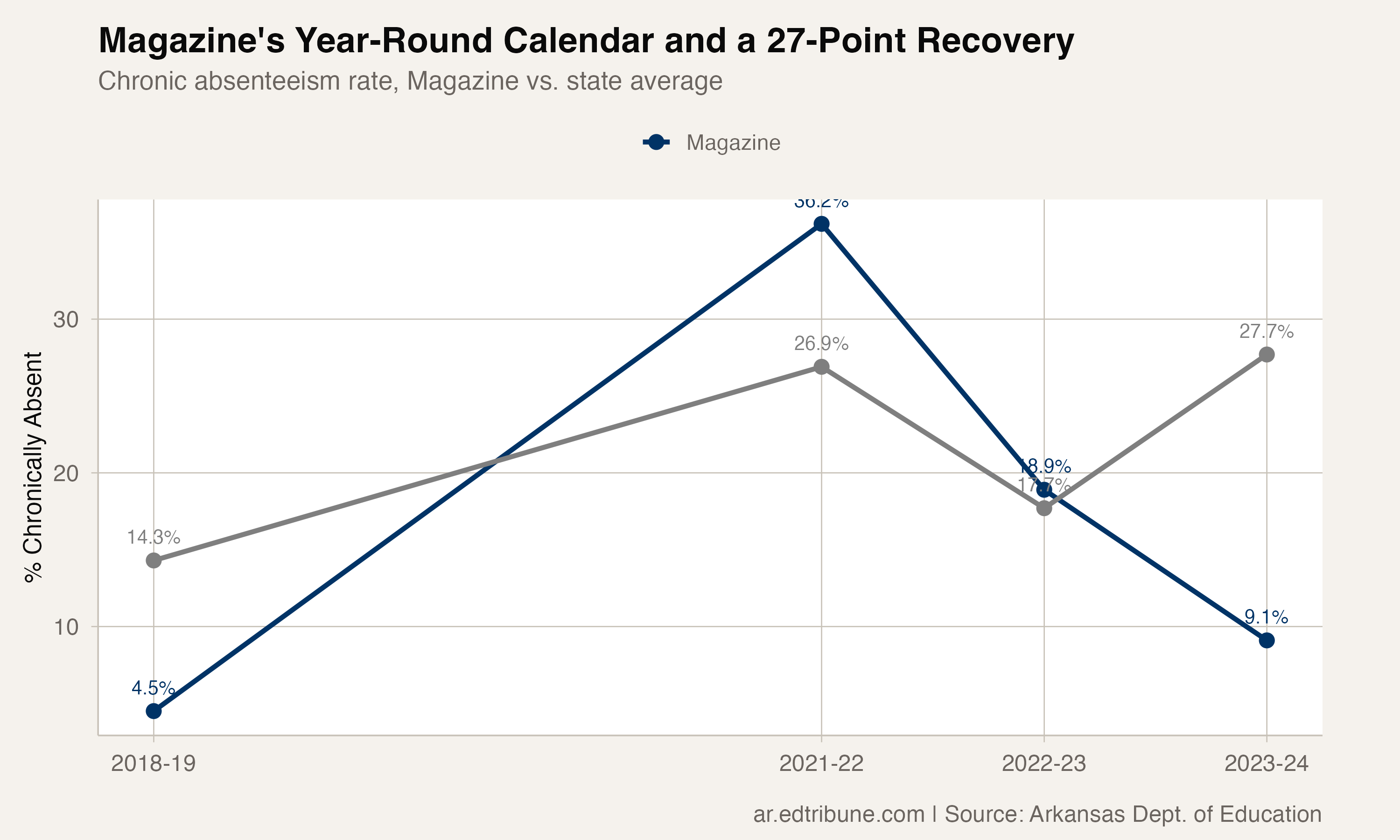
Magazine's chronic absenteeism rate tells a dramatic story in four data points.
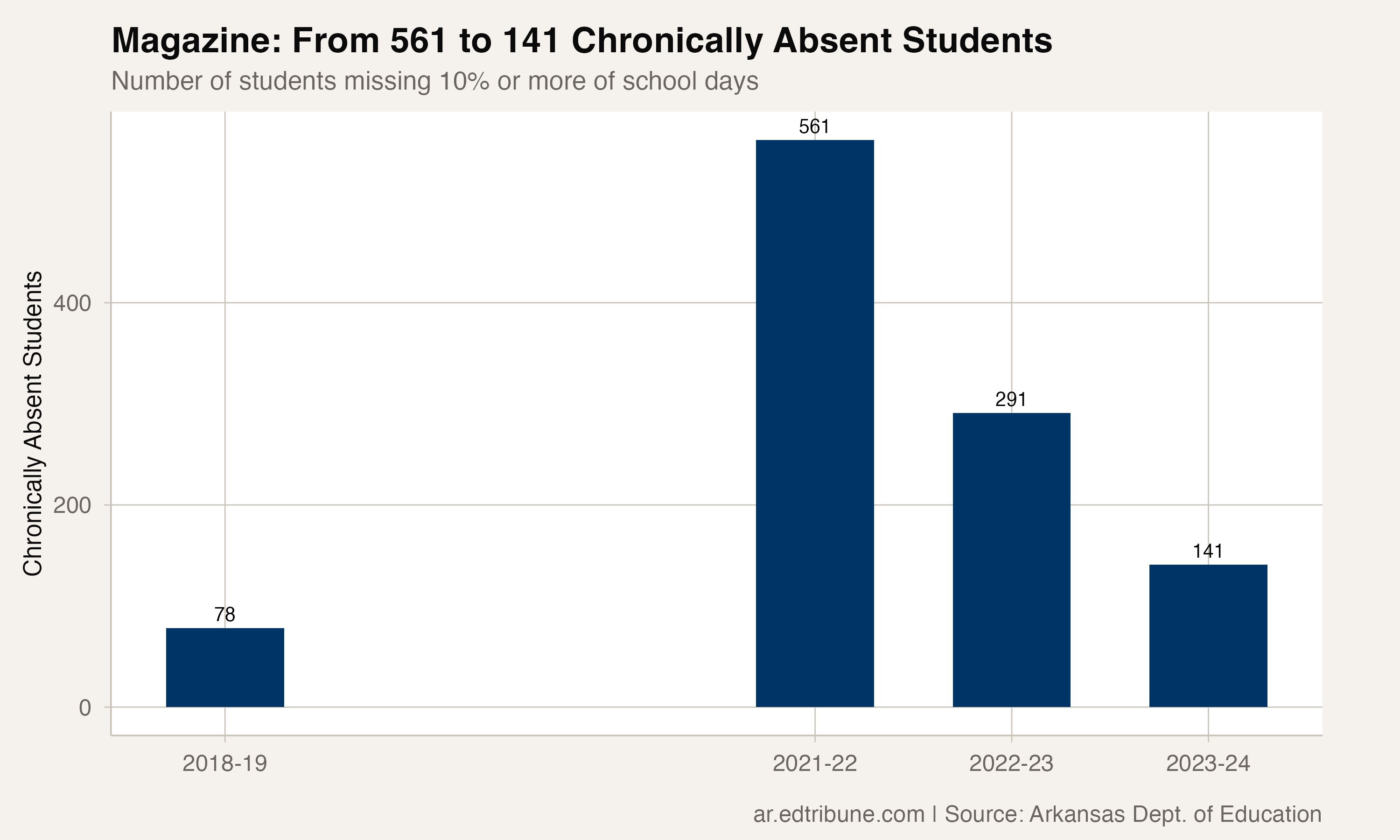
In 2018-19, before the pandemic, the district's chronic rate was just 4.5%. Only 78 of 1,720 students missed 10% or more of school days. That was well below the state average of 14.3%.
Then came COVID. By 2021-22, Magazine's rate had exploded to 36.2%, with 561 students chronically absent out of 1,550. The spike was nearly eight times the pre-COVID rate.
What happened next is the story. Magazine halved its chronic rate in 2022-23, dropping to 18.9%. Then it nearly halved it again in 2023-24, reaching 9.1%. The total recovery from the COVID peak: 27.1 percentage points, the fifth-largest of any district in Arkansas with at least 200 students.
A Recovery That Outpaced the State
While Magazine was slashing its chronic absence rate, the state was going the other direction. Arkansas's statewide rate dropped from 26.9% to 17.7% in 2022-23, a welcome improvement, but then reversed sharply to 27.7% in 2023-24, an all-time high.
Magazine did not participate in that reversal. The district's rate continued falling, from 18.9% to 9.1%, even as 87% of Arkansas districts got worse.
At 9.1%, Magazine's 2023-24 rate is less than one-third of the state average. The district is not yet back to its pre-COVID 4.5%, but it has closed most of the gap — and it has done so while the state moved further from its own baseline.
561 to 141
The raw numbers are equally striking. In 2021-22, 561 Magazine students were chronically absent. By 2023-24, that number had dropped to 141 — a reduction of 420 students in two years, even as enrollment held steady around 1,540.
High Poverty, Low Absence
Magazine is not a wealthy district testing an innovative schedule. It serves a high-poverty rural community — roughly 75% of students qualify for free or reduced-price lunch. Districts with similar poverty levels across Arkansas averaged chronic absence rates well above 20% in 2023-24.
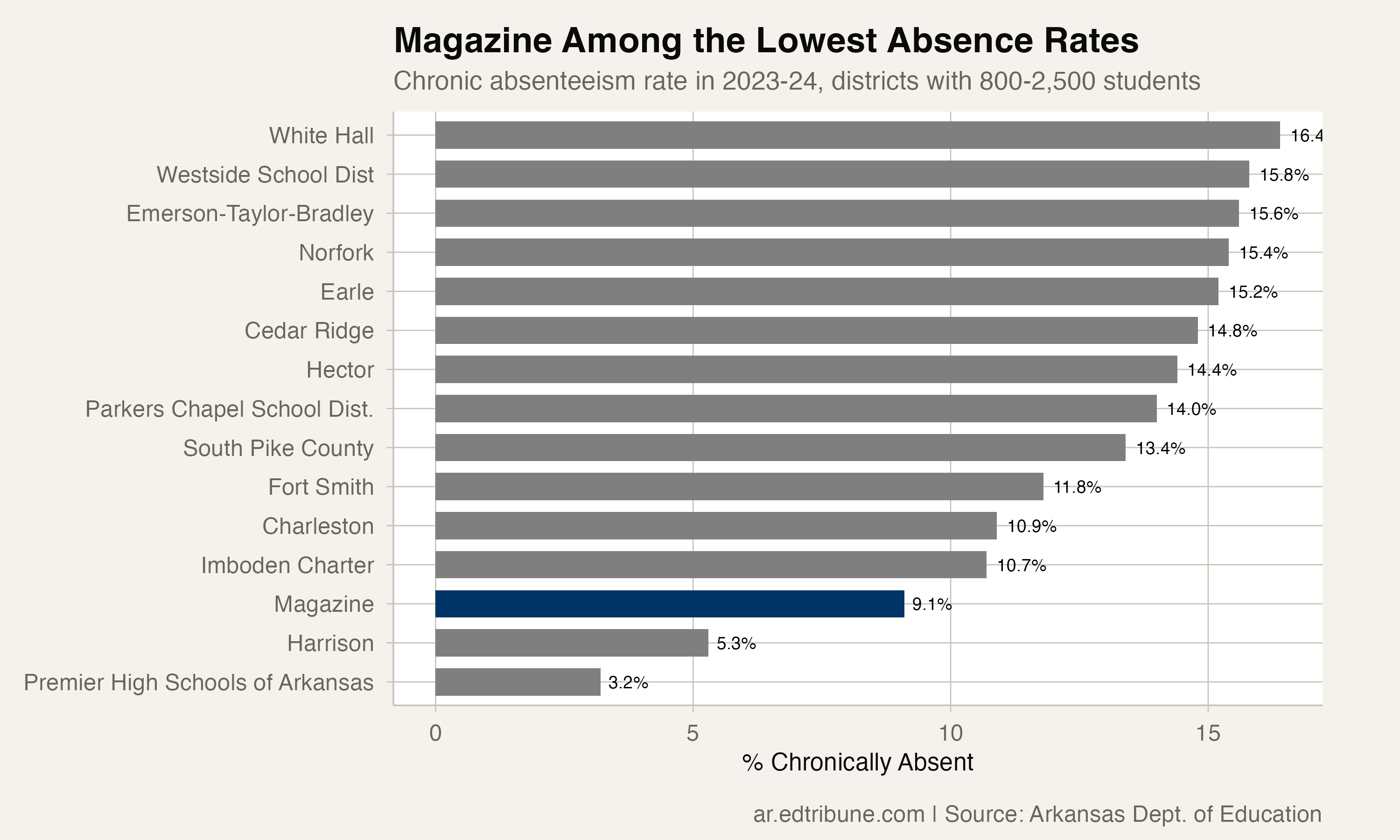
That makes Magazine's 9.1% rate all the more notable. Among mid-size districts (800 to 2,500 students), it posted one of the lowest chronic absence rates in the state.
The Calendar Question
The continuous calendar is the obvious variable. Year-round schedules eliminate the long summer break that research has identified as a driver of disengagement, particularly for low-income families. Students return to school more frequently, and the shorter breaks may reduce the re-acclimation period each time school resumes.
Whether Magazine's recovery is primarily a calendar story, or whether other interventions played a larger role, is a question only the district can answer. The data shows the outcome — a high-poverty rural district posting single-digit chronic absence in a year when the state hit a record high.
Detailed code that reproduces the analysis and figures in this article is available exclusively to EdTribune subscribers.
Discussion
Sign in to join the discussion.
Loading comments...