Correction (July 23, 2026): An earlier version of this article named Academics Plus and Responsive Education Solutions among the six charter-like entities in the group. Their chronic-absence rates rose above 20 percent, so they do not qualify. The two charter-like members are Hope Academy of Northwest Arkansas and Lisa Academy.
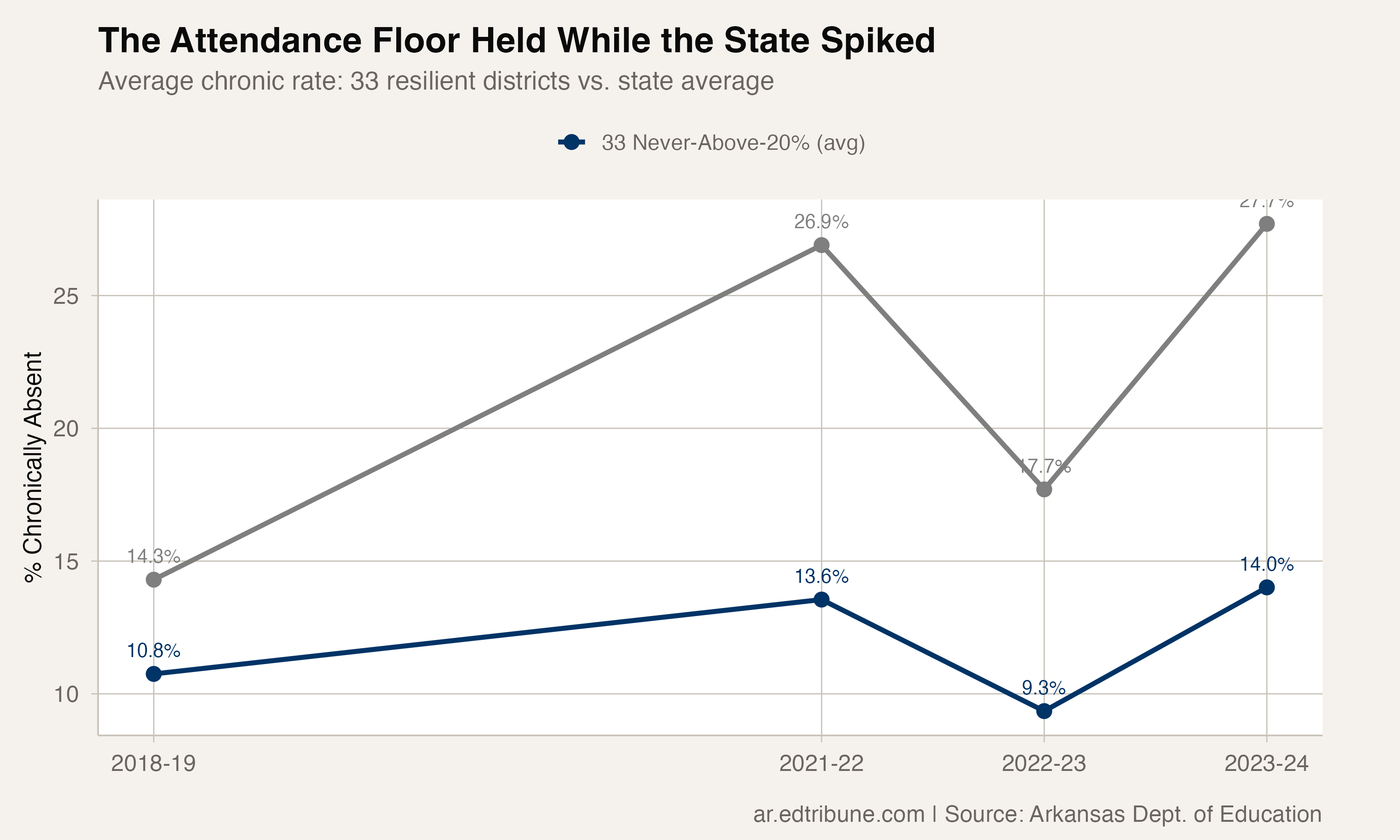
Arkansas's statewide chronic absence rate has swung wildly over the past five years: 14.3%, then 26.9%, down to 17.7%, back up to a record 27.7%. Depending on the year, you could tell a story of crisis or recovery. Neither version lasted.
But 33 districts barely moved. These 33, each with at least 200 students and three or more years of data, kept their chronic absenteeism rate below 20% every single year, including the COVID spike. The state lurched. They held.
The Attendance Floor
The concept is simple: if chronic absenteeism never exceeded 20%, then at least four out of every five students showed up consistently in every year on record. No matter what was happening statewide, these districts maintained a floor.
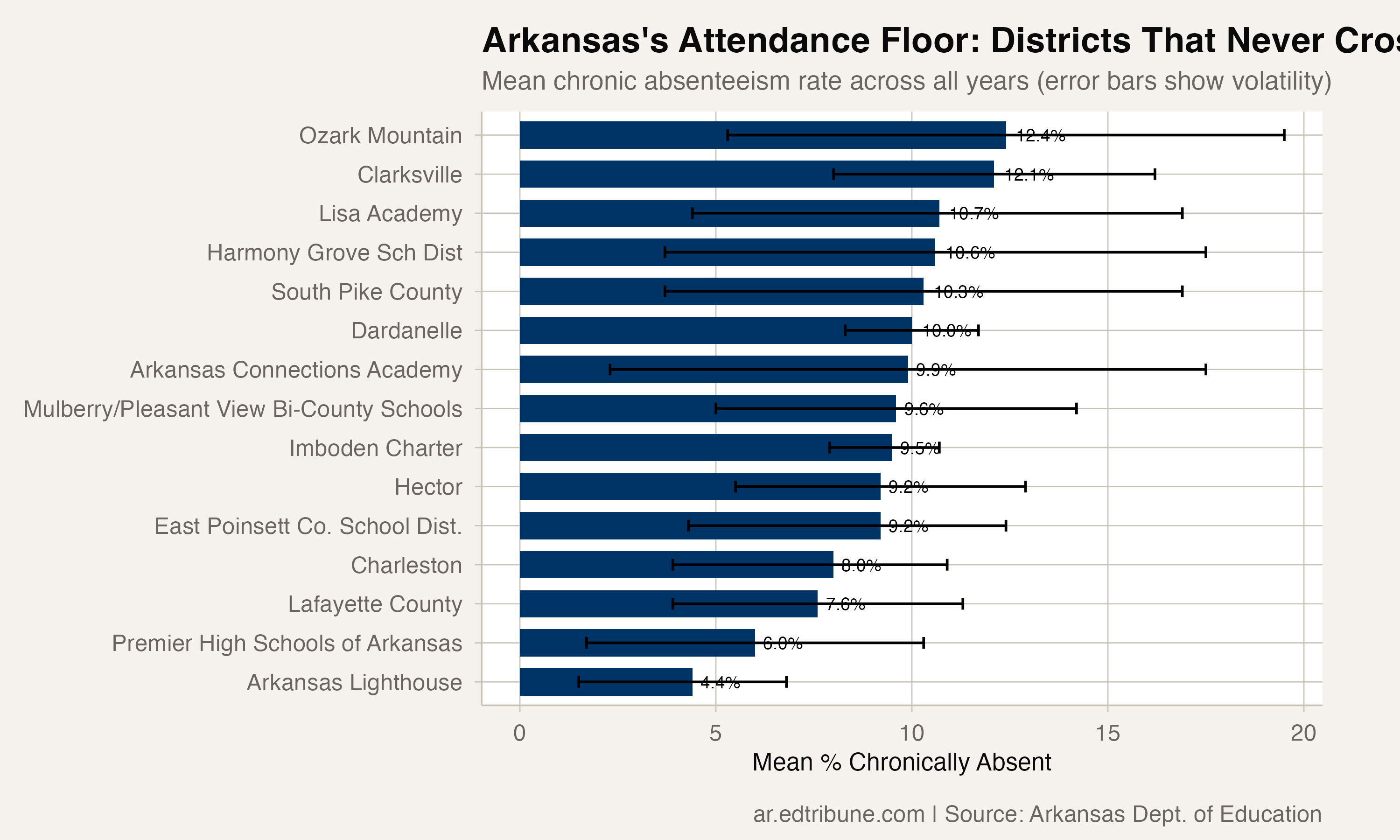
The best performers barely budge. Imboden Charter School District had the lowest volatility of any district in the group, with a standard deviation of just 1.6 percentage points across all years. Dardanelle (1.7 pp) and Forrest City (1.9 pp) were nearly as stable.
At the top of the group, Arkansas Lighthouse Charter Schools averaged 4.4% across all years, with a peak of just 6.8%. Premier High Schools averaged 6.0%. Lafayette County, a small traditional district, averaged 7.6%.
The Stability Gap
The contrast between the 33 and the rest of the state became especially sharp in 2023-24. When the statewide average jumped 10 points — from 17.7% to 27.7% — the average rate among these 33 districts remained well below the state line, continuing the divergent pattern that had been building since the pandemic.
Both Charters and Traditional Districts
The group includes six charter or charter-like entities: Arkansas Lighthouse, Premier High Schools, Imboden Charter, Arkansas Connections Academy, Hope Academy of Northwest Arkansas, and Lisa Academy. Their alternative structures — sometimes specialized enrollment, different scheduling, or unique educational models — offer one set of explanations for attendance stability.
But the other 27 are traditional public districts. Charleston, Hector, East Poinsett County, Dardanelle, Forrest City, Mulberry/Pleasant View — these are standard school systems serving geographic attendance zones, many in rural communities. Their presence in this group is arguably more instructive, because their attendance stability cannot be attributed to selective enrollment or structural advantages.
10 Never Crossed 15%
Within the 33, an even more exclusive subset exists: 10 districts never exceeded 15% chronic absence in any year. These districts maintained a rate that ensured fewer than one in seven students was chronically absent, even during the COVID era.
Size and Rate
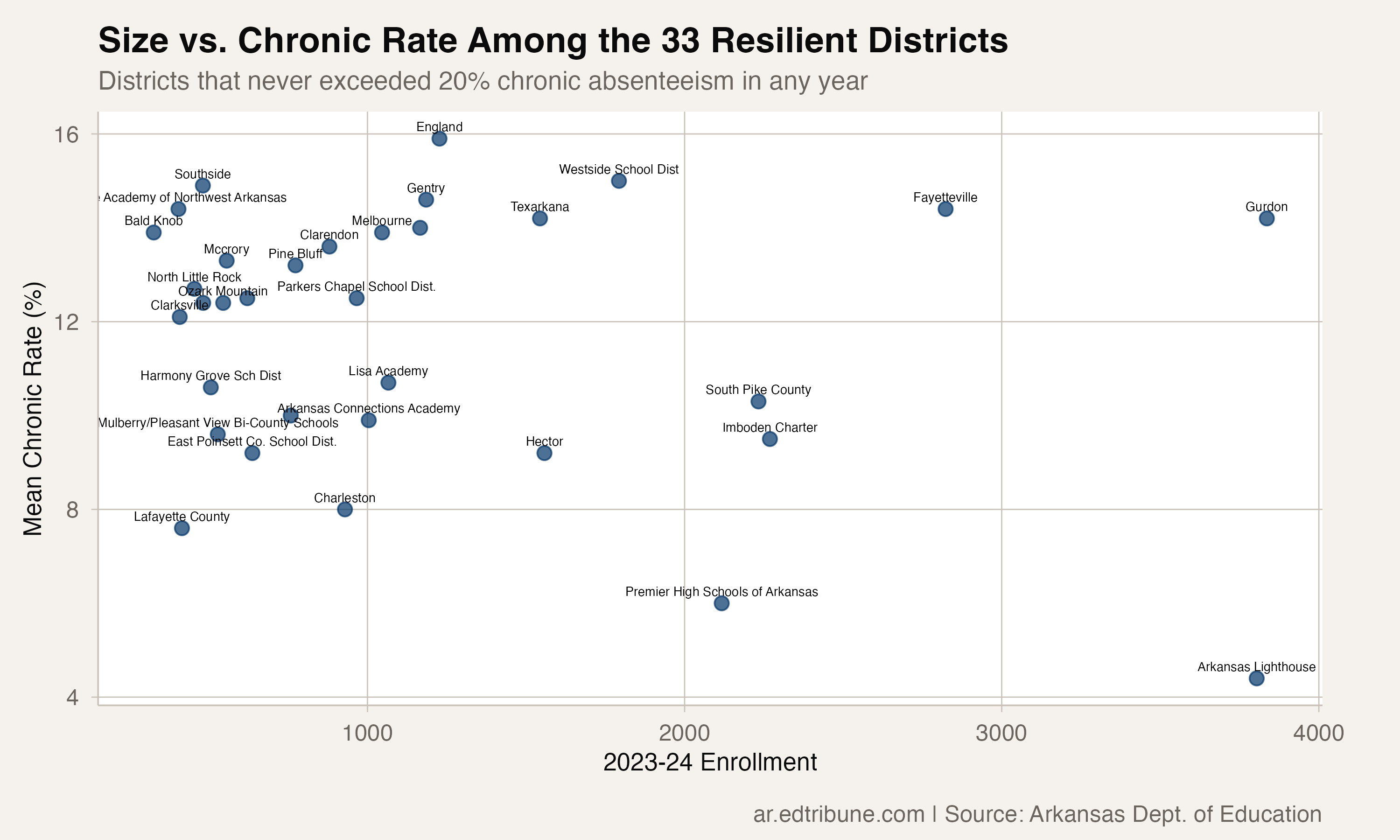
The 33 districts range from roughly 200 to nearly 4,000 students. There is no strong pattern linking size to rate — small districts and larger ones both appear at various rate levels. What distinguishes the group is not size but consistency.
The Question Worth Asking
The policy question is not just "what drives recovery?" — it is also "what prevents the spike in the first place?" These 33 districts suggest that some communities, some school cultures, or some operational practices create a resilience that others lack.
When Arkansas pledges to halve chronic absenteeism, these districts are not the ones that need halving. They are the ones that might hold the answers for the districts that do.
Detailed code that reproduces the analysis and figures in this article is available exclusively to EdTribune subscribers.
Discussion
Sign in to join the discussion.
Loading comments...