Correction (July 23, 2026): An earlier version of this article said Clarksville improved by 3.2 points, pairing it with Flippin as one of the two smallest improvements. Clarksville improved 6.5 points. The second-smallest improvement belongs to Forrest City, at 4.6 points.
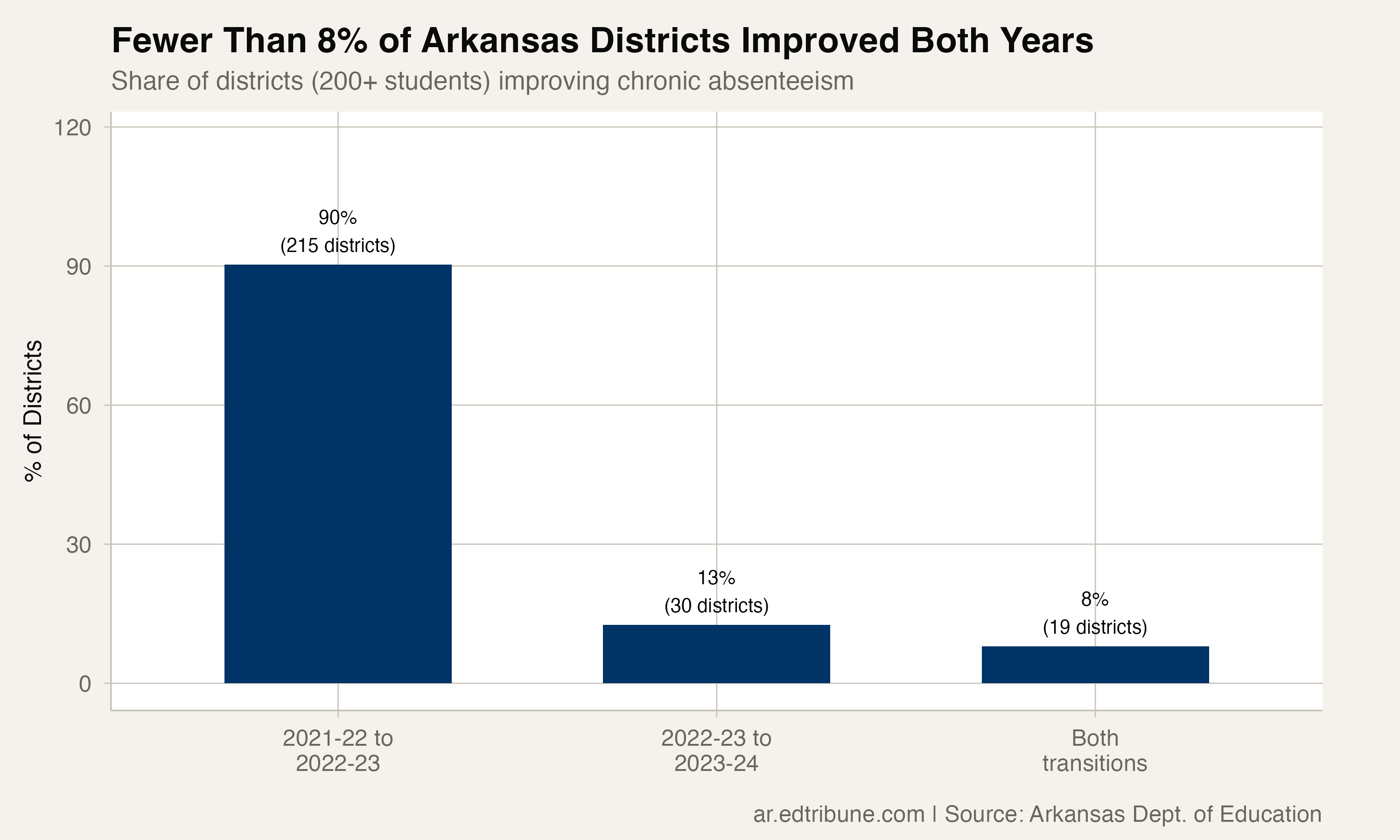
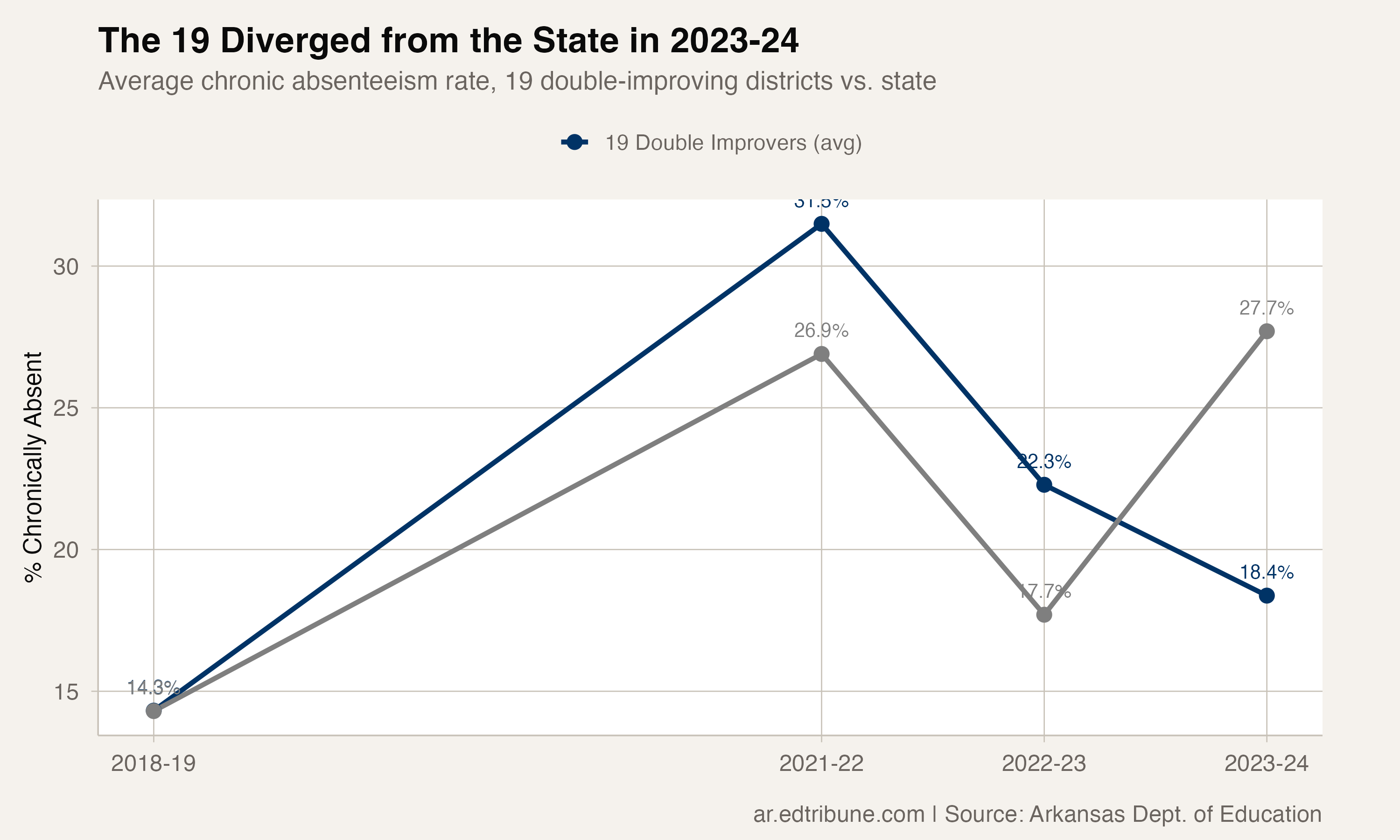
In 2022-23, most Arkansas districts improved on chronic absenteeism. The statewide rate fell from 26.9% to 17.7%, and 215 of 238 districts with data moved in the right direction. Recovery seemed underway.
Then 2023-24 arrived, and nearly everything reversed. The state rate jumped to 27.7% — an all-time high. Only 30 districts improved. The other 208 got worse.
Just 19 districts improved in both years. Out of 238 districts with at least 200 students and data for all three years, fewer than 8% managed to swim against the current twice.
Not Flukes
If improving twice in a row were random — if some districts just got lucky — you would expect the 19 to cluster around small enrollment numbers, where a handful of students can swing the rate. They do not.
The group includes Little Rock School District↗ET (4,015 students), Alpena↗ET (3,093), Hoxie↗ET (3,533), and Malvern↗ET (2,514). It also includes West Memphis↗ET (778) and Des Arc (226). The size range spans from 226 to 4,015.
Geographically, the 19 come from across the state: the Delta (West Memphis, Earle, Forrest City), the Ozarks (Alpena, Flippin, Yellville-Summit), the River Valley (Magazine, Paris, Booneville, Clarksville), the state capital (Little Rock), and central Arkansas (Malvern, Pine Bluff). No single region explains the pattern.
The Magnitude
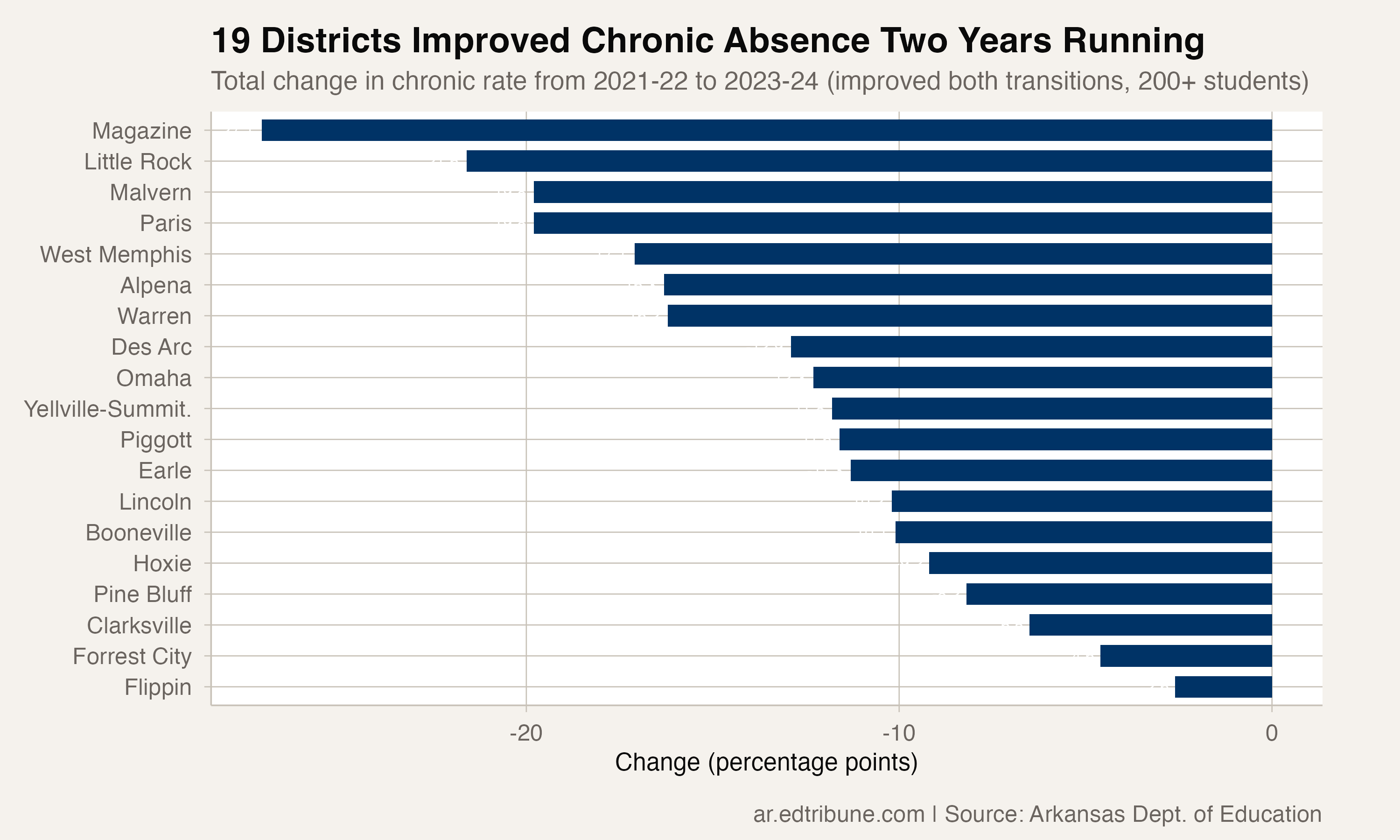
The total improvement from 2021-22 to 2023-24 ranges widely. Magazine↗ET led the group with a 27.1 percentage-point drop, from 36.2% to 9.1%. Little Rock followed with 21.6 points, then Malvern with 19.8, Paris with 19.8, and West Memphis with 17.1.
At the other end, Flippin improved by 2.6 points and Forrest City by 4.6 — modest but consistent, and enough to qualify in a year when the median Arkansas district got 11.7 points worse.
The Divergence
The average chronic rate across the 19 districts tells the divergence story clearly. In 2021-22, the group averaged rates broadly similar to the state. By 2023-24, the gap had widened dramatically — these 19 districts continued improving while the state reversed course.
Seven Fully Recovered
Of the 19 districts with pre-COVID data, seven have fully returned to or improved past their 2018-19 chronic absence rate. That means they not only undid the COVID-era spike — they are doing better than before the pandemic on attendance.
The other 12 are still above their pre-COVID baselines but moving in the right direction. Given that most Arkansas districts are further from their baselines now than they were two years ago, even incomplete recovery with sustained momentum is notable.
What They Share
The 19 districts do not share an obvious demographic or structural profile. They include high-poverty and moderate-poverty districts. They include charter schools and traditional public schools. They include districts with continuous calendars, four-day weeks, and standard schedules.
What they share is the outcome: two consecutive years of improvement during the worst attendance period in Arkansas history. In a state that just pledged to halve chronic absenteeism over five years, these 19 districts are the proof that sustained progress is possible — and the starting point for understanding how.
Detailed code that reproduces the analysis and figures in this article is available exclusively to EdTribune subscribers.
Discussion
Sign in to join the discussion.
Loading comments...