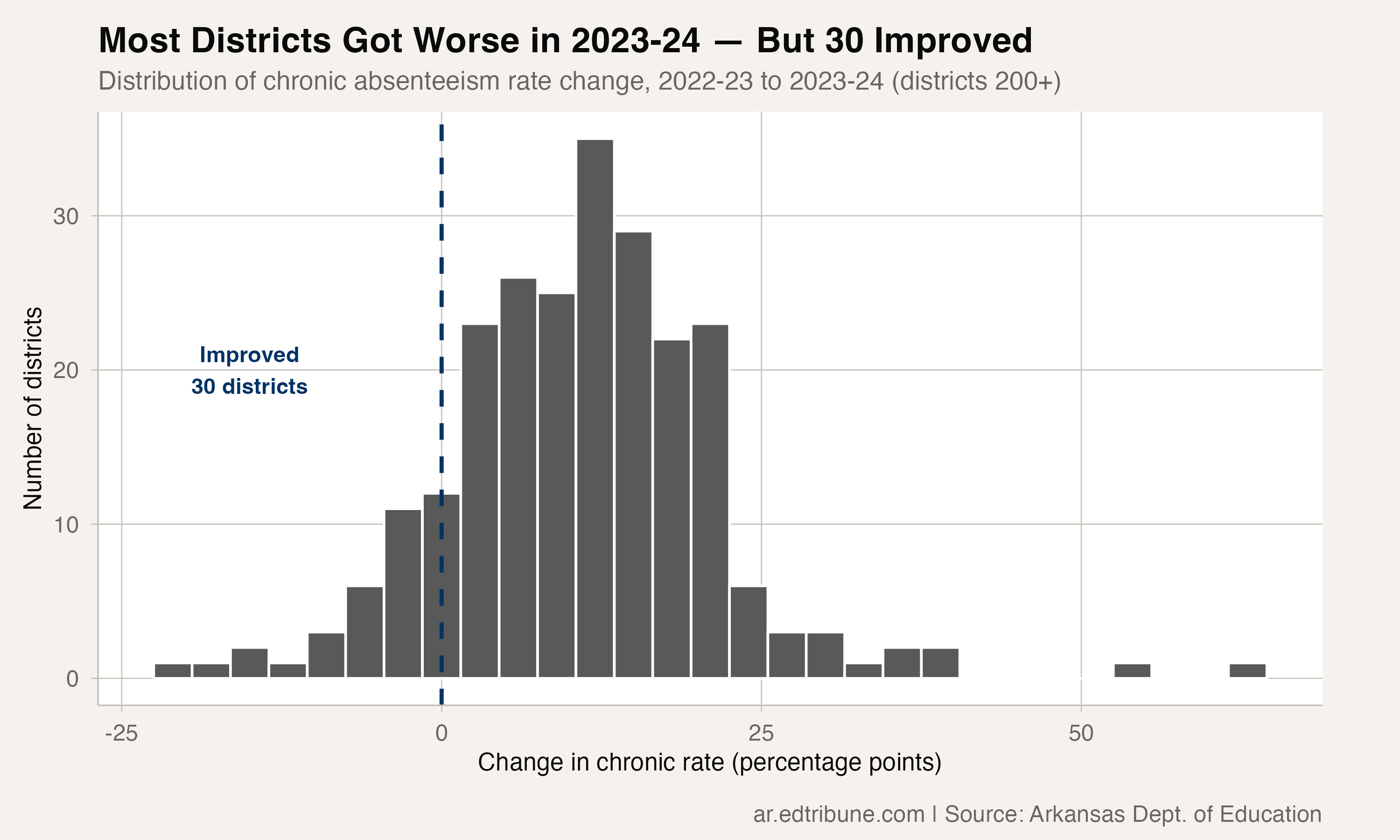
Of 240 Arkansas districts reporting chronic absenteeism data in 2023-24, 208 got worse. One was unchanged. And 30 improved.
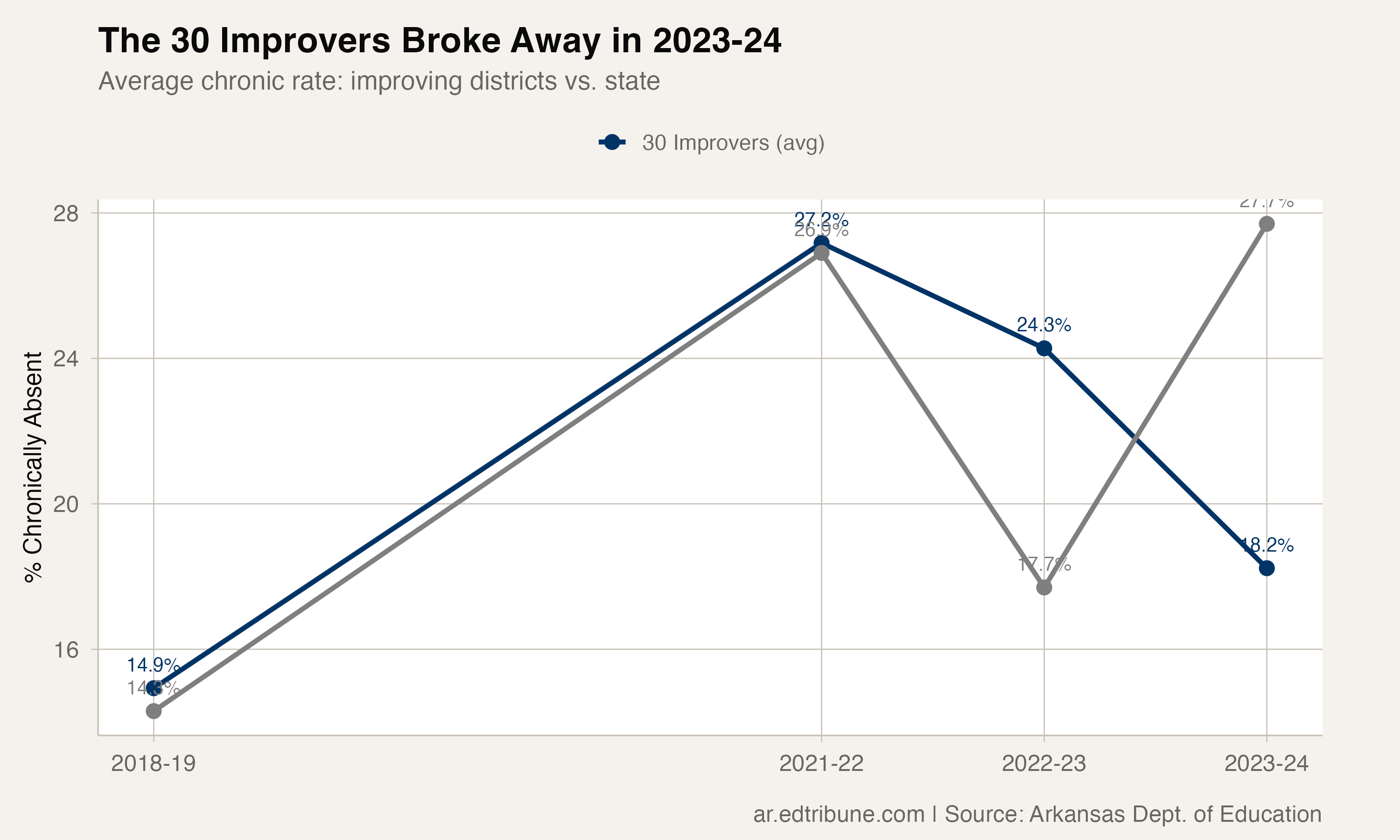
The statewide rate jumped from 17.7% to 27.7% that year, a 10-point reversal that erased nearly all the gains from 2022-23. More than one in four students missed 10% or more of school days. It was the worst year on record.
Those 30 districts, roughly 13% of the total, went the other direction. All had at least 200 students. While the state hit a record, they got better.
The Scale of the Reversal
To understand what the 30 achieved, consider what happened to everyone else. The median Arkansas district saw its chronic absence rate worsen by 11.6 percentage points in a single year. Some districts saw increases of 20 or 30 points. The statewide rate hadn't just drifted up — it exploded.
Against that backdrop, any improvement at all is unusual. An improvement of 5 or 10 points, while peers are moving 10 or 15 the other direction, is exceptional.
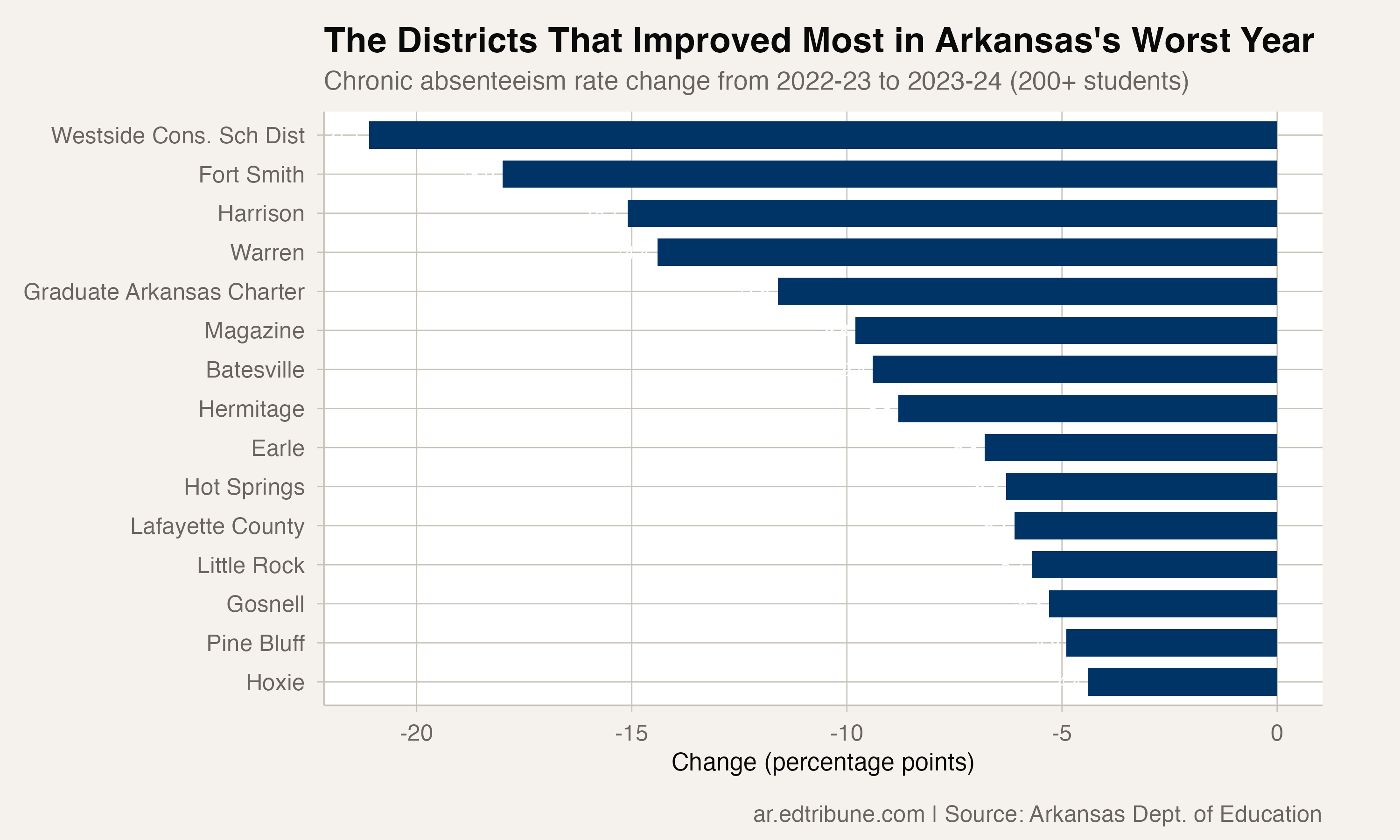
The improvements among the 30 ranged from a fraction of a point to more than 20 points. The largest single-year improvements came from districts that had been in crisis the year before and staged dramatic turnarounds.
Not a Regional Story
The 30 come from every part of Arkansas. Delta districts sit alongside Ozark hill-country systems. Suburban districts border rural ones. The capital region is represented. So is the northwest corridor.
If the improvement were driven by geography — economic conditions in one part of the state, or a regional initiative — the 30 would cluster. They do not. Whatever explains these outcomes is operating at the district level, not the regional level.
12 Below Pre-COVID
Of the 30 improving districts, 12 have now returned to or fallen below their pre-COVID chronic absence rate from 2018-19. That means they did not just improve year-over-year — they have fully recovered from the pandemic-era disruption and are performing better than their own historical baseline.
The other 18 are still above pre-COVID levels but moving in the right direction — a meaningful distinction in a state where the vast majority of districts are further from their baselines now than they were a year ago.
The Divergence
The average chronic rate among the 30 improving districts had tracked broadly with the state through the COVID era. But in 2023-24, the lines diverged sharply. The state's rate jumped; the 30 districts' average continued declining.
The Policy Question
Arkansas recently joined 13 states pledging to halve chronic absenteeism over five years. The 2023-24 data makes that pledge look daunting — the state is moving in the wrong direction, and fast.
But the 30 districts offer a counterpoint. If 13% of districts can improve during the worst year on record, the question for policymakers is what separates them from the 87% that could not.
Some of the 30 run mentor programs. Some operate four-day weeks. Some are charter schools with nontraditional structures. Most are just traditional districts that, for reasons not yet studied, held the line when their neighbors could not.
Arkansas has pledged to halve chronic absenteeism in five years. The 30 districts that improved during the worst year on record are the obvious place to start looking for how.
Detailed code that reproduces the analysis and figures in this article is available exclusively to EdTribune subscribers.
Discussion
Sign in to join the discussion.
Loading comments...