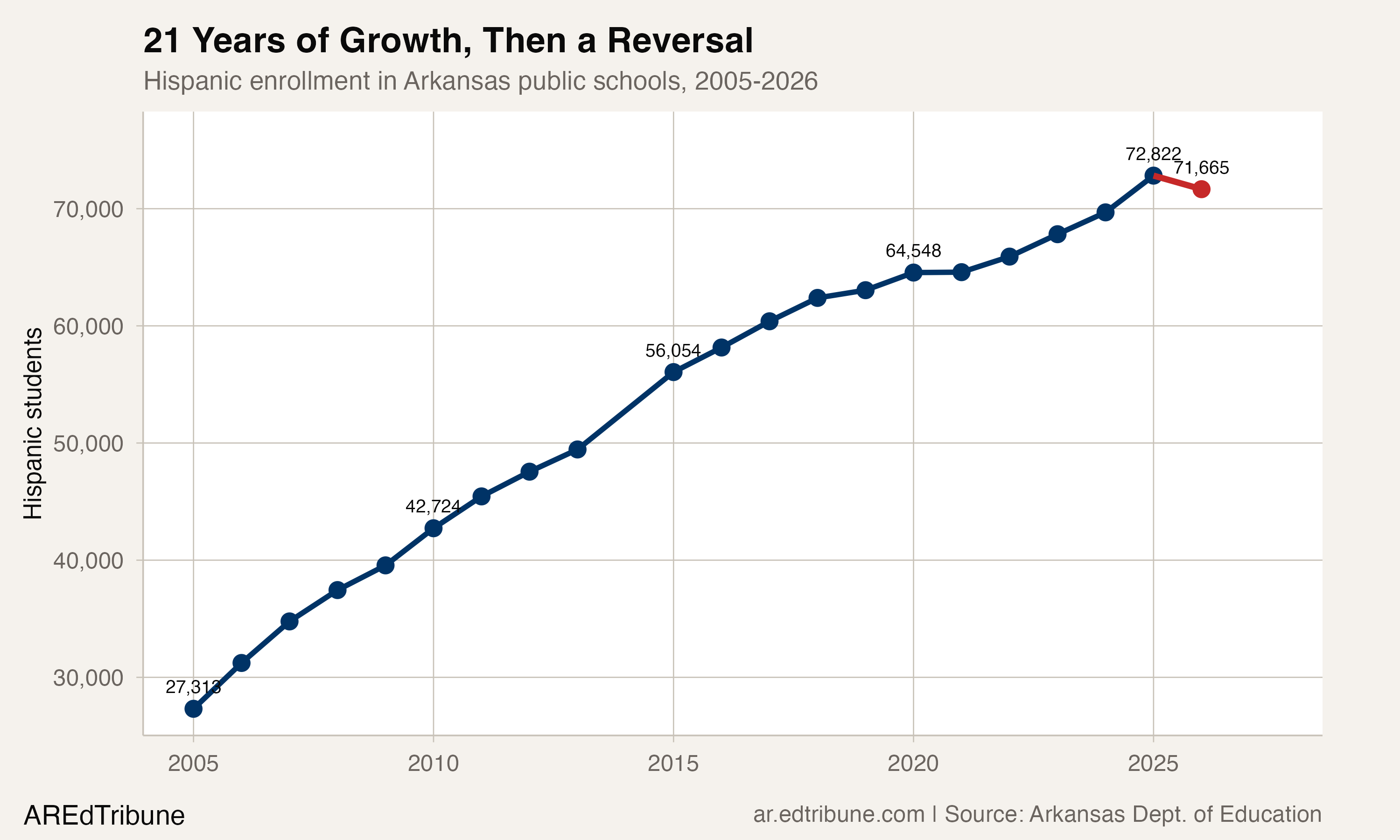
For 20 consecutive years, one line on Arkansas's enrollment chart only moved in one direction. Hispanic student enrollment grew every single year from 2005 through 2025 (with 2014 missing from the dataset due to an ADE encoding issue), rising from 27,313 to 72,822, a 2.7-fold increase that reshaped schools across the state. In 2025-26, that line turned down. Hispanic enrollment fell by 1,157 students to 71,665, a 1.6% decline that marks the first reversal in at least two decades of available data.
The drop is modest in percentage terms. But it arrives after a year in which Hispanic enrollment had surged by 3,136 students, the largest single-year gain since 2010. A swing of more than 4,200 students in a single year -- from the strongest growth to the first decline -- is not a gradual trend shift.
The NWA epicenter
Nearly half of the statewide Hispanic decline is concentrated in five Northwest Arkansas districts tied to the region's poultry and food-processing economy. Springdale↗ET lost 244 Hispanic students, Rogers↗ET lost 217, and Siloam Springs↗ET lost 70. Together with De Queen↗ET (-24) and Green Forest (-6), these five districts account for 561 of the 1,157-student statewide decline, or 48.5%.
Springdale and Rogers are home to Tyson Foods' global headquarters and some of the largest poultry processing operations in the country. Both districts crossed 50% Hispanic enrollment in 2024-25: Rogers at 50.0% and Springdale at 49.8%. In 2025-26, both ticked slightly downward in absolute numbers even as their Hispanic shares held roughly steady, because total enrollment fell even faster.
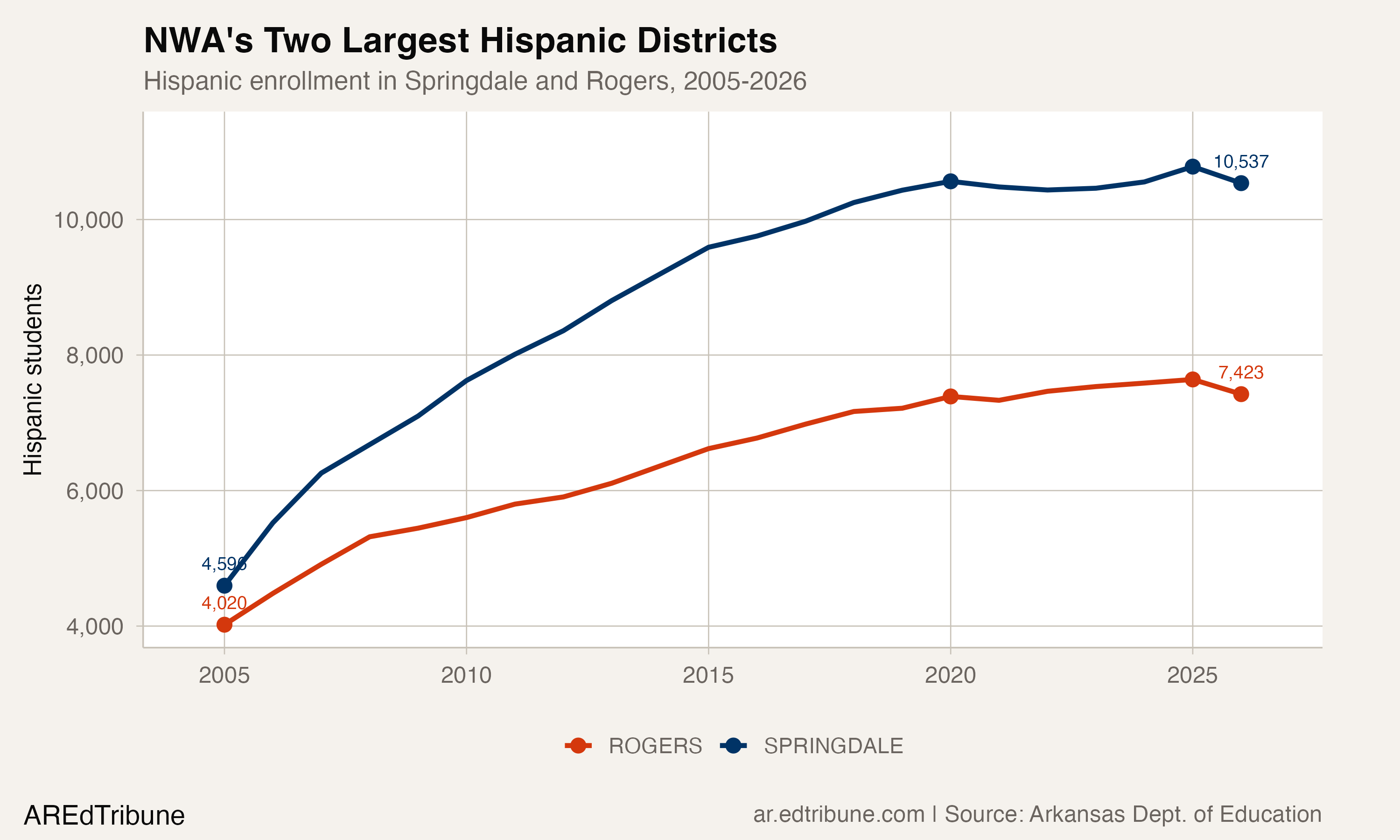
Springdale lost 559 students overall in 2025-26, a 2.6% decline. Of that loss, 244 were Hispanic. Rogers lost 338 total students. The Hispanic decline in these districts is not happening in isolation; it is layered on top of broader enrollment erosion affecting every demographic group.
A statewide pattern, not a regional one
The NWA corridor tells the most vivid story, but the decline extends far beyond it. Statewide, 139 of 257 districts lost Hispanic students in 2025-26, compared to 93 that gained. Little Rock↗ET lost 196 Hispanic students despite being more than 200 miles from Northwest Arkansas. Fort Smith↗ET, the state's third-largest Hispanic enrollment center at 38.2%, lost 66.
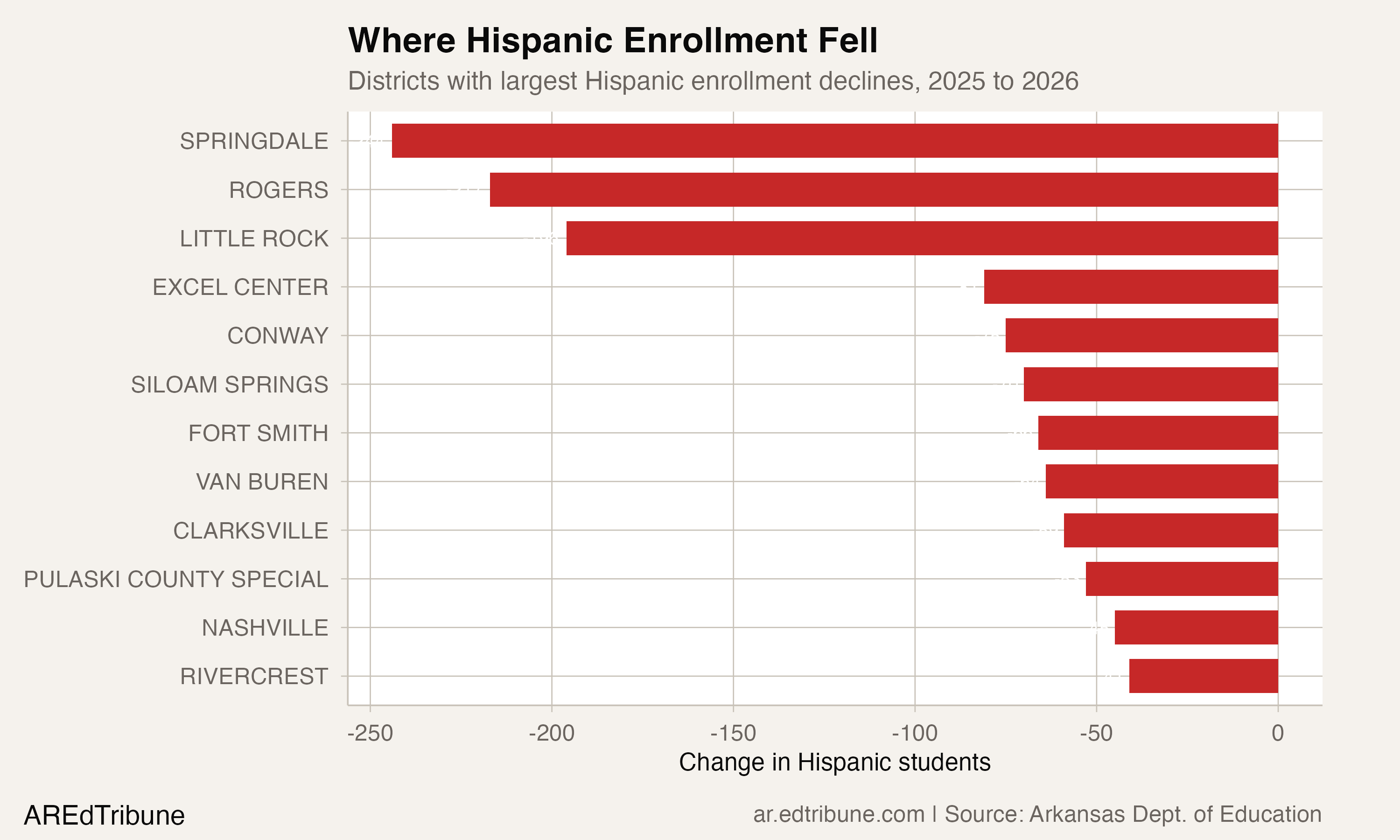
The breadth matters. If only Springdale and Rogers had lost Hispanic students while the rest of the state continued growing, the explanation might be local: housing costs or inter-district transfers. With 139 districts declining simultaneously, something systemic is at work.
Two forces, one reversal
The most likely driver is a combination of immigration enforcement and the LEARNS Act's universal voucher expansion, operating on different populations through different mechanisms.
Benton County, which encompasses Rogers and much of NWA's poultry corridor, signed a 287(g) agreement with ICE that produced more than 450 immigration arrests at the county jail from January through mid-October 2025. That single county accounted for more than 4% of all 287(g) arrests nationwide. The program operates through routine police stops: people booked into the jail on any charge, including traffic violations, are screened for immigration status.
The chilling effect on school enrollment is difficult to measure directly but well-documented qualitatively. Mireya Reith, executive director of Arkansas United, told the University of Arkansas's Razorback Reporter:
"People are scared to go to work, don't want to send their kids to school or leave their houses. That's how you see the effect on the local community: just fear."
Springdale's police chief has resisted formal ICE partnerships, but the proximity of Benton County's aggressive enforcement has still shaped behavior across the metro area. ICE arrested more than 2,600 people statewide through mid-October 2025.
The LEARNS Act's Education Freedom Account program, which became universally eligible in 2025-26, adds a second pressure. Participation jumped from 14,256 students in 2024-25 to 46,578 in 2025-26, with each family receiving roughly $6,700 in state funding for private school tuition or homeschool expenses. The total statewide enrollment loss of 8,916 students in 2025-26 is the steepest single-year decline in at least 20 years, and reporting from Arkansas Times notes that all but two of the state's 12 largest districts lost enrollment.
These two forces likely affect different subsets of the Hispanic population: immigration enforcement pressures undocumented families and those in mixed-status households, while the EFA program draws families of all backgrounds toward private alternatives. Enrollment data cannot distinguish between a family that left the state, a family that stopped sending children to school, and a family that used EFA funds for private school.
Within a broader demographic shift
The Hispanic decline is one piece of a year in which every major racial group except Asian students lost enrollment. White students fell by 7,863, accounting for the largest share of the 8,916-student total loss. Black students declined by 1,593. Only Asian enrollment grew, by 327.
One additional factor worth noting: multiracial enrollment has grown steadily, reaching 24,908 in 2025-26, up from 14,876 six years earlier. Some students previously classified as Hispanic may now be reported as multiracial, though this reclassification pattern has been consistent for years and did not prevent Hispanic growth in prior years.
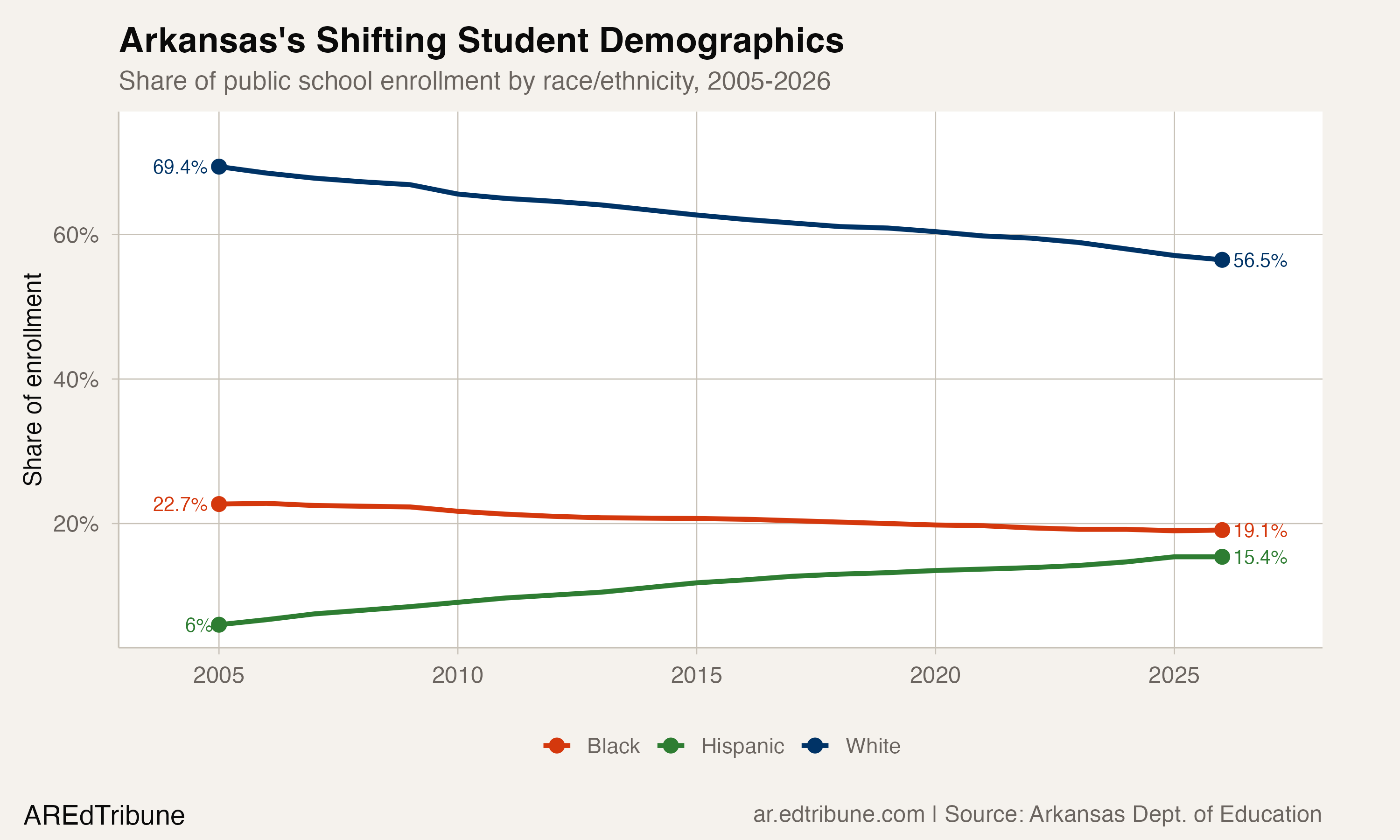
The result is that Hispanic students' share of enrollment held perfectly flat at 15.4%, unchanged from 2024-25. In a year when every group was shrinking, Hispanic students shrank at roughly the same rate as the total. The demographic composition story is essentially frozen: white students still constitute 56.5% of the state's public school population (down from 69.4% in 2005), Black students hold at 19.1%, and Hispanic students at 15.4%.
What the 2021 near-miss suggests
This is not the first time Hispanic growth in Arkansas slowed to nearly zero. In 2020-21, the COVID year, Hispanic enrollment grew by just 34 students statewide, essentially flat. But the following years brought a rebound: +1,328 in 2022, +1,912 in 2023, +1,864 in 2024, and then the surge of +3,136 in 2025.
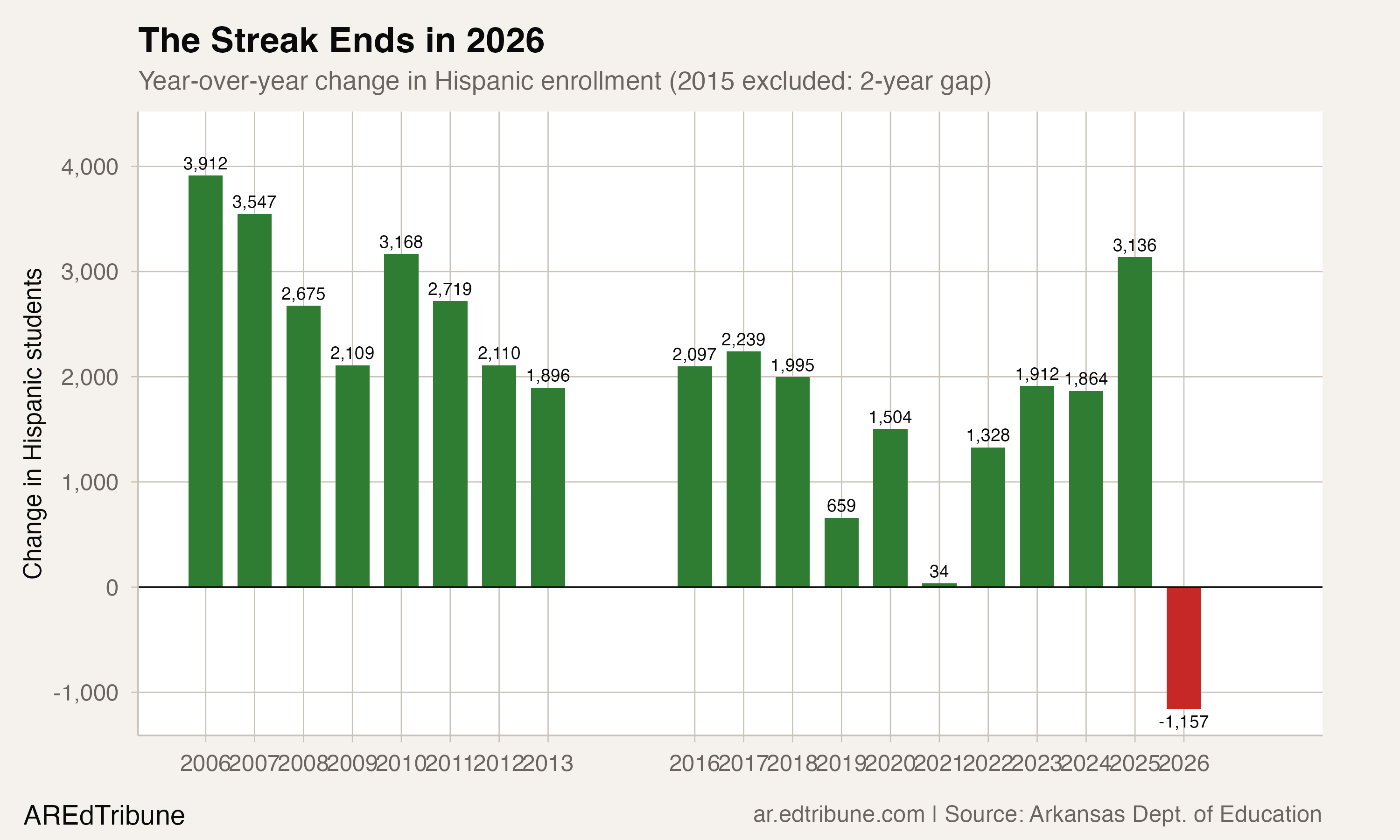
The COVID near-miss is instructive because it showed that even a global pandemic only paused Hispanic enrollment growth. It did not reverse it. The 2026 reversal, by contrast, is the first actual negative number in the dataset. Whether the pattern follows the COVID trajectory (a one-year stall followed by recovery) or marks a structural break depends on factors the enrollment data cannot capture: how long current immigration enforcement policies persist, and whether families who have left public schools come back.
What comes next
Arkansas added 45,509 Hispanic students between 2005 and 2025, an average of more than 2,000 per year. That growth reshaped districts like Springdale, where Hispanic students went from 31.8% to 49.8% of enrollment, and Rogers, where they crossed the majority threshold. It drove demand for bilingual teachers and reshaped school budgets in a state that was 69.4% white two decades ago.
One year of decline does not erase that. But the swing from +3,136 to -1,157 means Arkansas educators will be watching the 2026-27 numbers closely to learn whether 2026 broke the trend or just interrupted it.
Detailed code that reproduces the analysis and figures in this article is available exclusively to EdTribune subscribers.
Discussion
Sign in to join the discussion.
Loading comments...