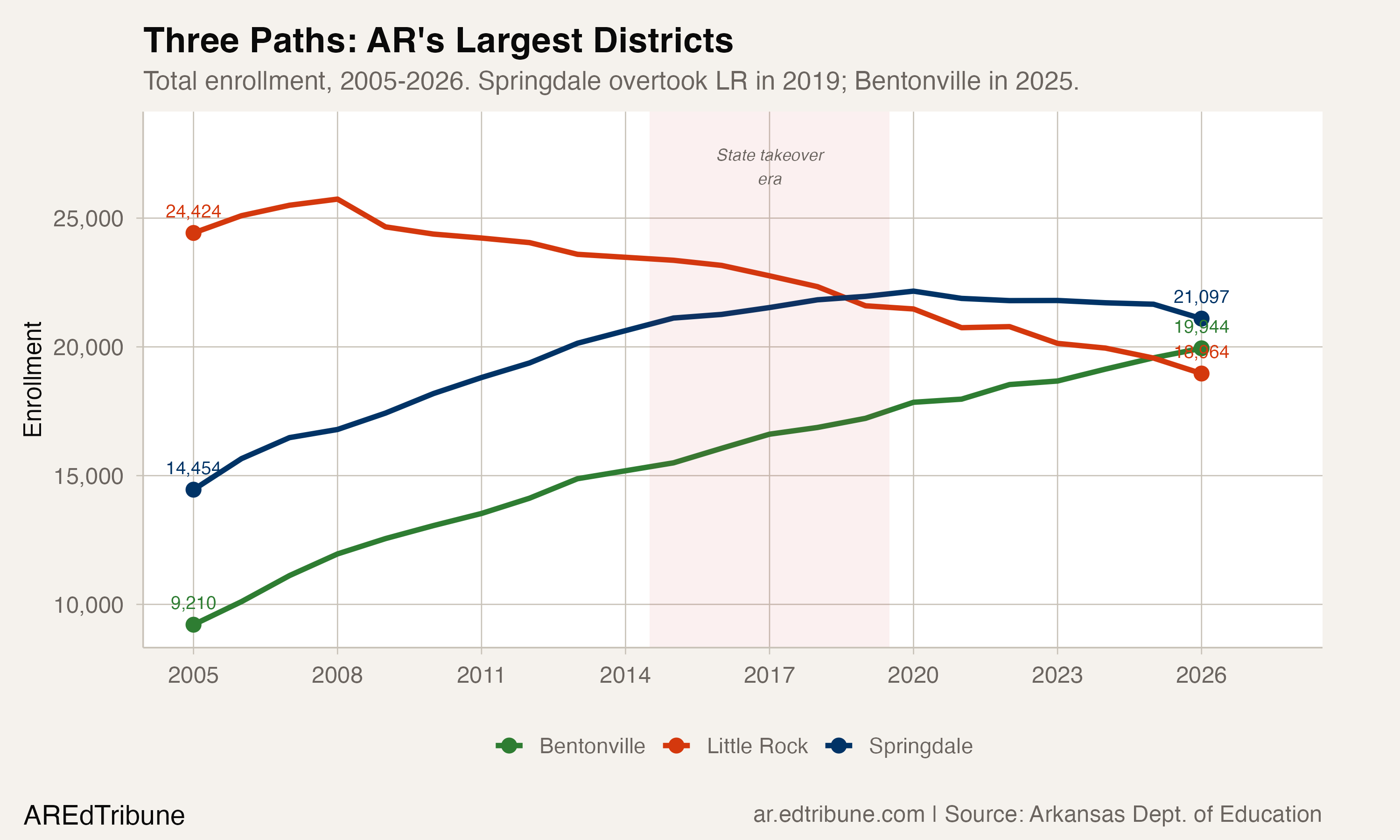
Through at least 14 consecutive years of data, Little Rock↗ET enrolled more students than any other district in Arkansas. That ended in 2019, when Springdale↗ET passed it. In 2025, Bentonville↗ET did the same. The state's capital city district, once unchallenged at the top, now sits third, 2,133 students behind Springdale and 980 behind Bentonville. Little Rock enrolled 18,964 students in 2025-26, down 26.3% from its 2008 peak of 25,738.
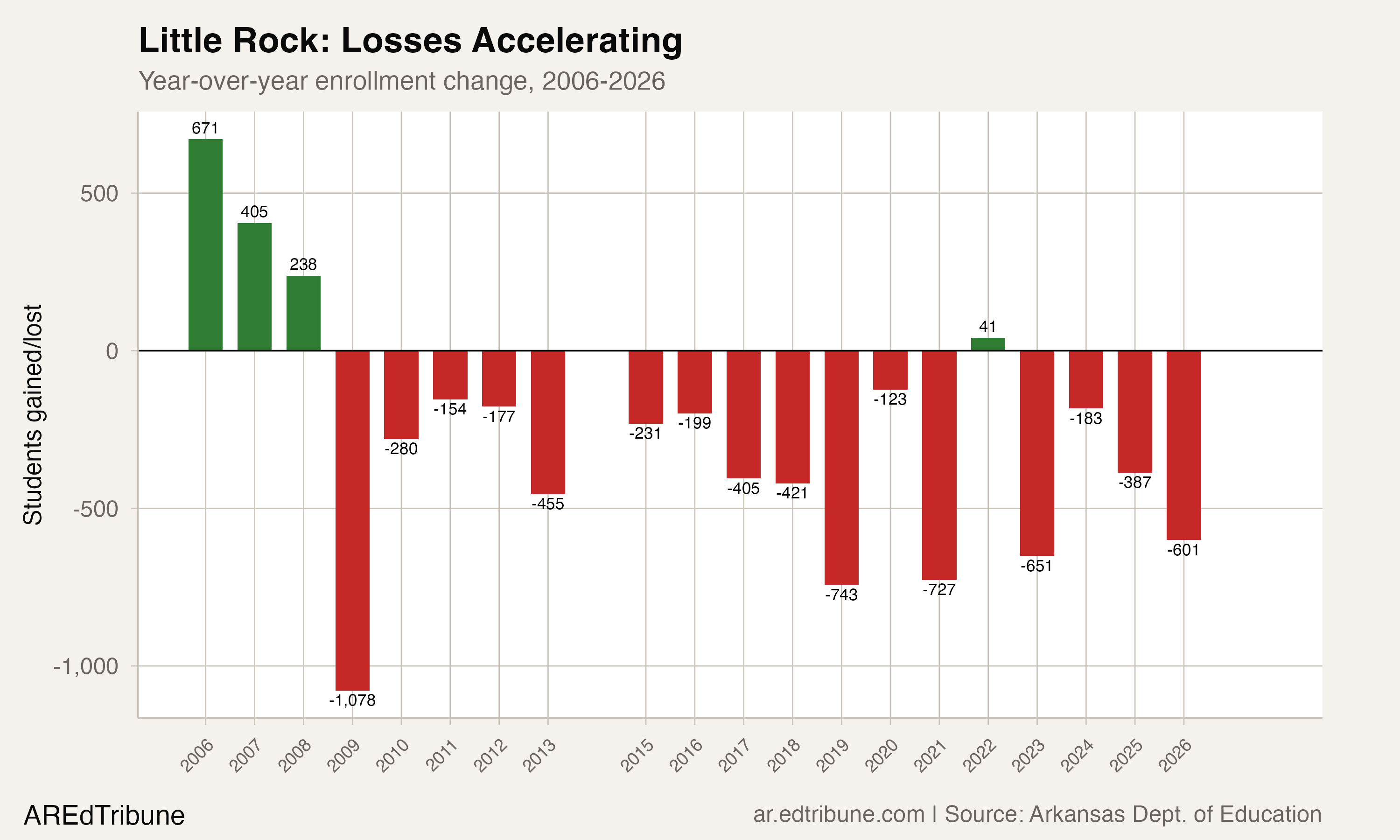
The 2025-26 loss of 601 students caps a three-year acceleration: the district lost 183 students in 2023-24, 387 in 2024-25, and 601 in 2025-26. Sixteen of the last 20 year-over-year transitions have been losses. Three of the four growth years occurred before 2009; the fourth was a negligible +41 in 2021-22.
Two Arkansases
The crossover at the top of the state's rankings reflects a deeper geographic divergence. Northwest Arkansas, anchored by Walmart's headquarters in Bentonville and a cluster of corporate campuses, has been one of the fastest-growing metro areas in the country. The region's population grew by more than 50,000 between 2020 and 2024, with Benton County adding 9,318 residents in a single year.
That population growth translates directly into school enrollment. Bentonville has more than doubled since 2004-05, growing from 9,210 to 19,944 students, a 116.5% increase. Springdale grew 46.0% over the same period, from 14,454 to 21,097. Little Rock's trajectory is the mirror image: down 5,460 from its 2004-05 level of 24,424, a 22.4% loss.
The gap at the 2026 endpoint tells the story. Springdale now enrolls 2,133 more students than Little Rock. Bentonville enrolls 980 more. Neither gap existed a decade ago. Little Rock held a 10,000-student lead over Springdale as recently as 2005.
Where the losses are deepest
The decline is not limited to one demographic group. Black enrollment, which has historically made up the majority of Little Rock's student body, fell from 16,738 in 2004-05 to 10,909 in 2025-26, a loss of 5,829 students (34.8%). White enrollment dropped from 5,968 to 3,410, a 42.9% decline. The only group that grew was Hispanic students, up from 1,226 to 3,326, a 171.3% increase. But that gain of 2,100 students replaced roughly a quarter of the 8,387 lost by Black and white students combined.
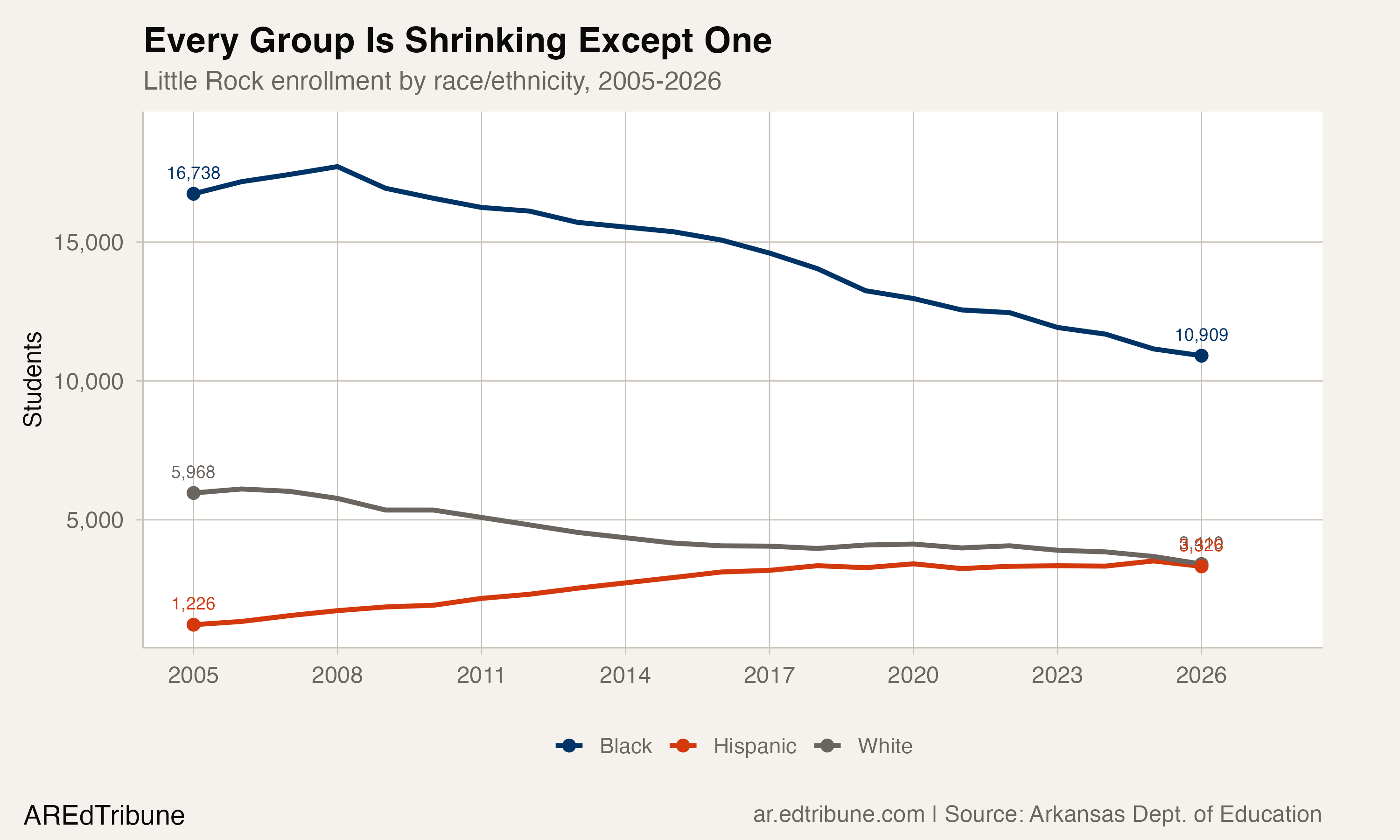
The composition has shifted accordingly. Black students made up 68.6% of enrollment in 2005 and 57.5% in 2026. White students dropped from 24.4% to 18.0%. Hispanic students rose from 5.0% to 17.5%, approaching the white share.
The state takeover and its aftermath
The steepest period of decline overlaps with a period of institutional disruption. On January 28, 2015, the Arkansas State Board of Education voted 5-4 to take over the Little Rock School District, immediately dissolving the elected school board. The takeover, officially justified by low-performing schools, lasted until 2019 when local control was partially restored.
During the four years from 2014-15 to 2018-19, the district lost 1,768 students, an average of 442 per year. That rate was steeper than the preceding period (2008-2013 averaged 429 lost per year) but not by much. The losses predated the takeover and continued after it. The enrollment data does not show a sharp discontinuity at either the takeover's beginning or its end.
What the data does show is that the losses never stopped. The post-takeover period, from 2018-19 to 2025-26, produced an additional 2,631 lost students, averaging 376 per year. The pace slowed slightly after the board was restored, but the direction held.
8,471 more students in LR-area charters
One factor shaping the landscape is the growth of charter schools in the Little Rock metro area. In 2004-05, charter-like entities in Pulaski County enrolled 474 students. By 2025-26, that figure had reached 8,945, a gain of 8,471.
LISA Academy↗ET, which opened in 2004 with 163 students, has expanded to 4,320 students across multiple campuses, making it the largest charter operator in the Little Rock area. Academics Plus↗ET grew from 311 to 2,001 over the same period. eStem Public Charter School↗ET peaked at 3,202 in 2019-20 before declining to 2,018 in 2025-26.
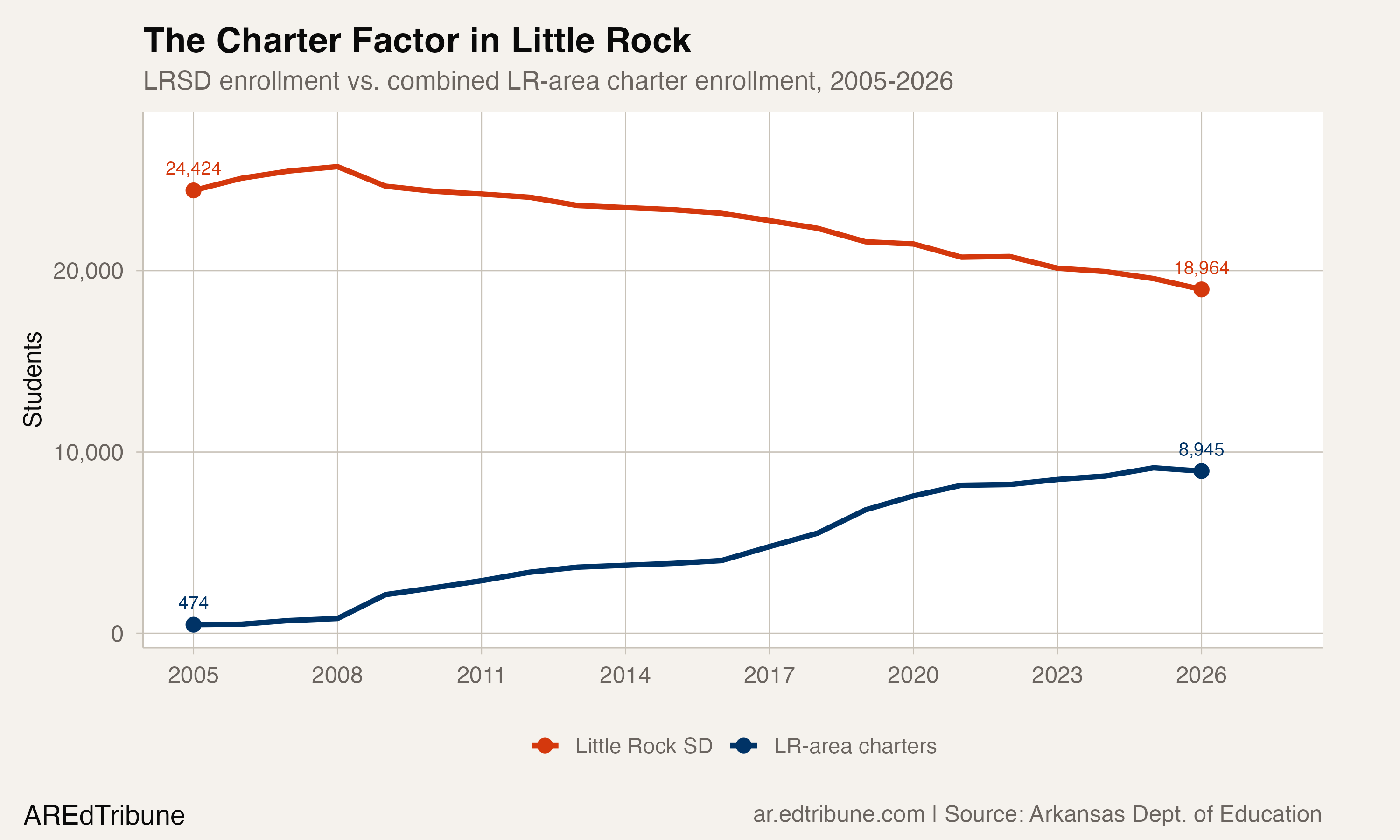
The charter growth of 8,471 students exceeds Little Rock's total enrollment loss of 5,460 since 2005, but attributing the entire decline to charter competition would be an overreach. The district also lost students to demographic change and to families leaving Little Rock altogether. Census data cited by district officials indicates the eastern part of Little Rock has experienced significant loss of school-age children as families relocated. The Pulaski County Special School District↗ET, which surrounds Little Rock, fell from 16,592 to 11,511 between 2014-15 and 2025-26, suggesting metro-wide population loss beyond what charter competition alone explains.
The LEARNS Act, signed in March 2023, added another channel. The law created universal Education Freedom Accounts that allow families to spend public funds on private school tuition. In its first year, fewer than 5% of participants had previously been enrolled in public schools, limiting the initial enrollment impact. But the program became universal in 2025-26, and statewide public school enrollment fell by 8,916 students, the steepest decline in 20 years.
What reporting suggests
"Since 2015, when we received $63,936,734 in state foundation funding, we have seen a decline to $38,479,428 in the same funding in 2024." — Arkansas Times, Nov. 2024
That $25.5 million loss in foundation funding over a decade reflects a formula that follows students. When a district loses enrollment, it loses money, even if its buildings and fixed costs remain. Little Rock now operates buildings with capacity for roughly 23,000 students while enrolling 18,964. Carver Elementary, in east Little Rock, was spending $16,886 per student while serving 232 students in a building designed for 634. The district board voted in late 2024 to consolidate and close schools, merging Carver into Washington Elementary and dispersing Brady Elementary students across six other schools.
"I think that these numbers are going to level off in the next couple of years, but I hope they do, quite frankly." — April Reisma, Arkansas Education Association president, KATV, Sept. 2025
A shrinking share of the state
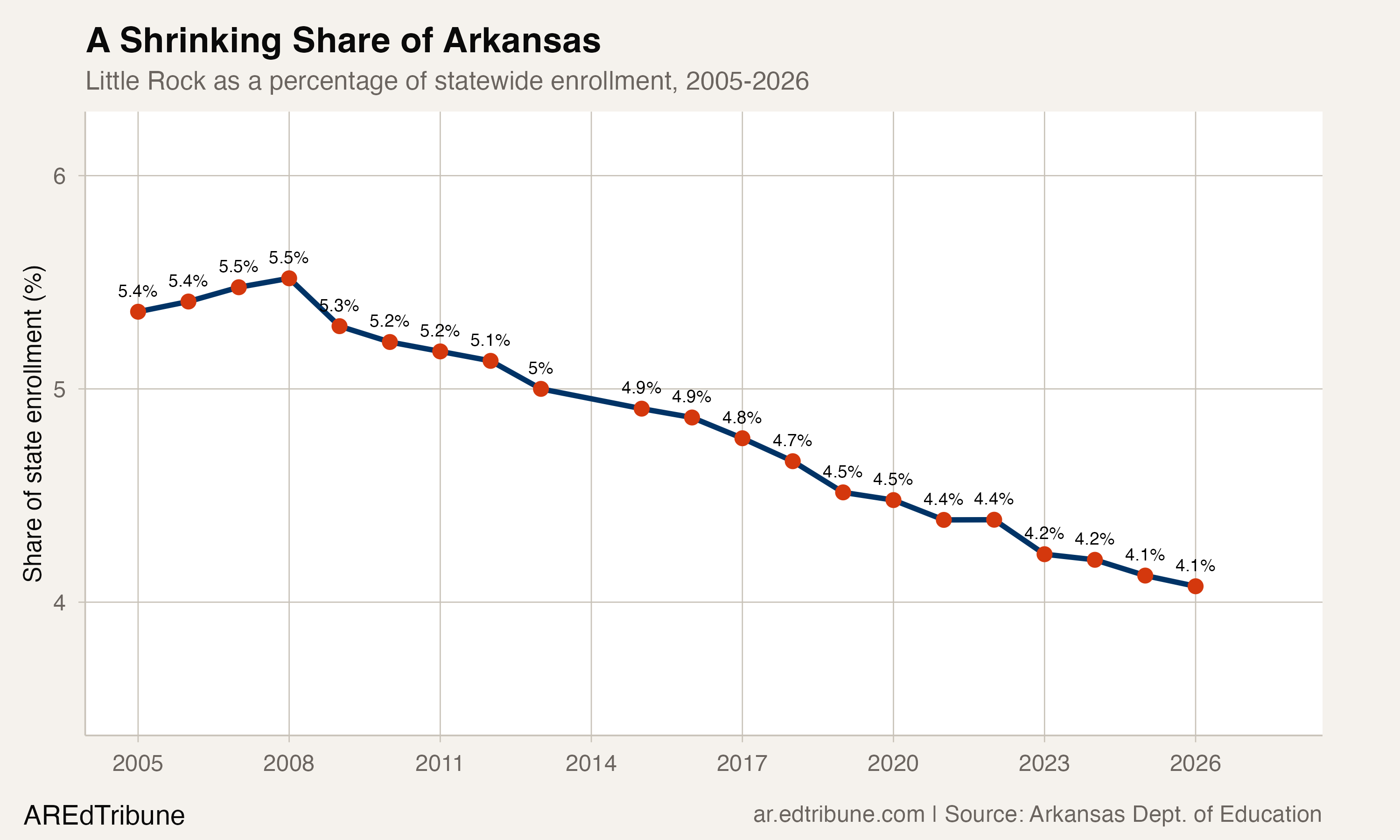
Little Rock accounted for 5.5% of Arkansas enrollment at its 2008 peak. In 2025-26, that share fell to 4.1%. The decline reflects both the district losing students and statewide enrollment growth that Little Rock did not participate in. Arkansas added nearly 24,000 students between 2005 and 2020, with growth concentrated heavily in the northwest corner. Little Rock, the state's largest city, contributed nothing to it.
The 2025-26 acceleration -- 601 students lost after years of losing 200-400 per year -- could be a one-year anomaly tied to the LEARNS Act rollout or the beginning of a steeper trajectory. The district is navigating school consolidation, charter competition, and voucher expansion all at once. Each of those forces has its own timeline, and none of them is reversing.
Detailed code that reproduces the analysis and figures in this article is available exclusively to EdTribune subscribers.
Discussion
Sign in to join the discussion.
Loading comments...