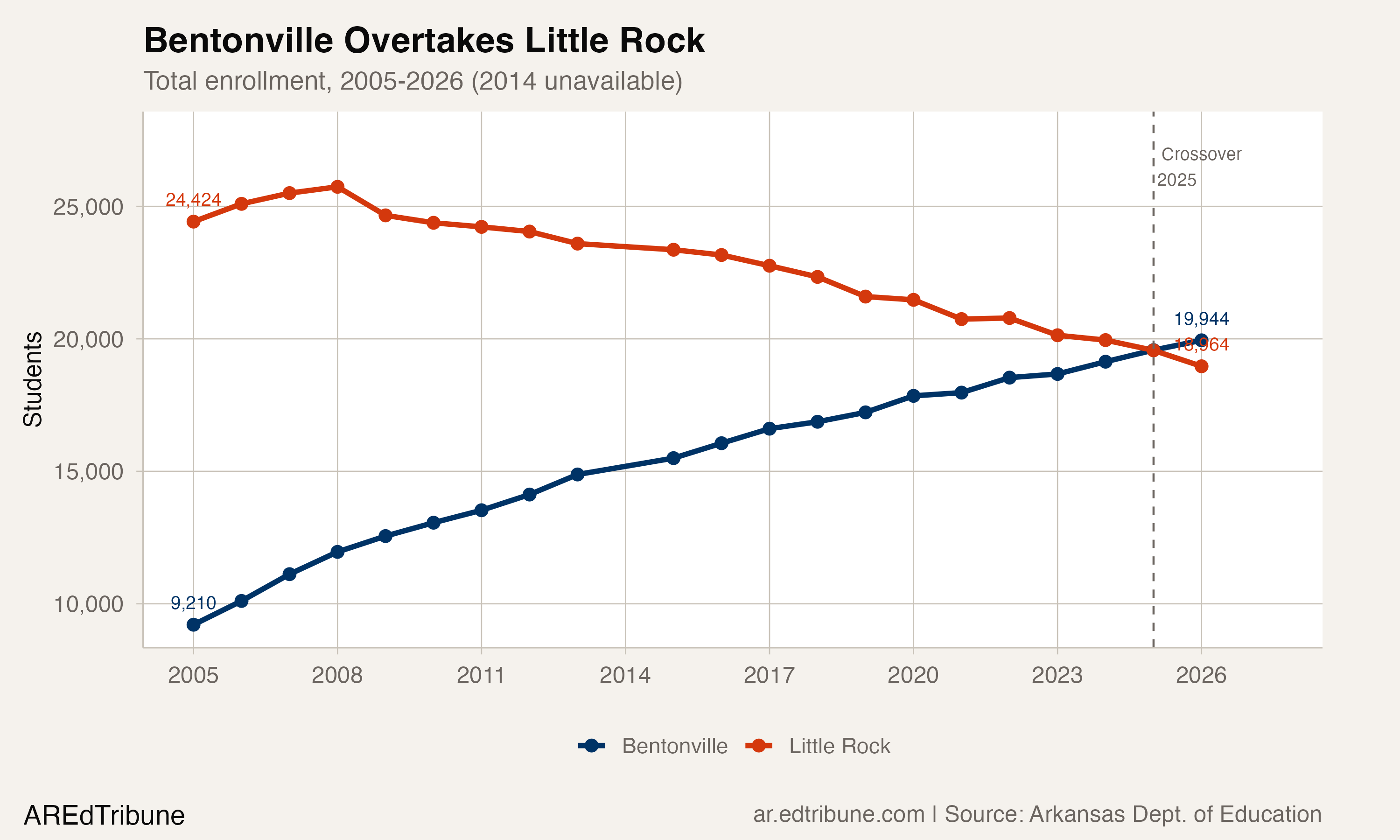
In 2004-05, Little Rock↗ET enrolled 24,424 students. Bentonville↗ET enrolled 9,210. The capital city's school district was nearly three times the size of the small northwest Arkansas district anchored by Walmart's hometown.
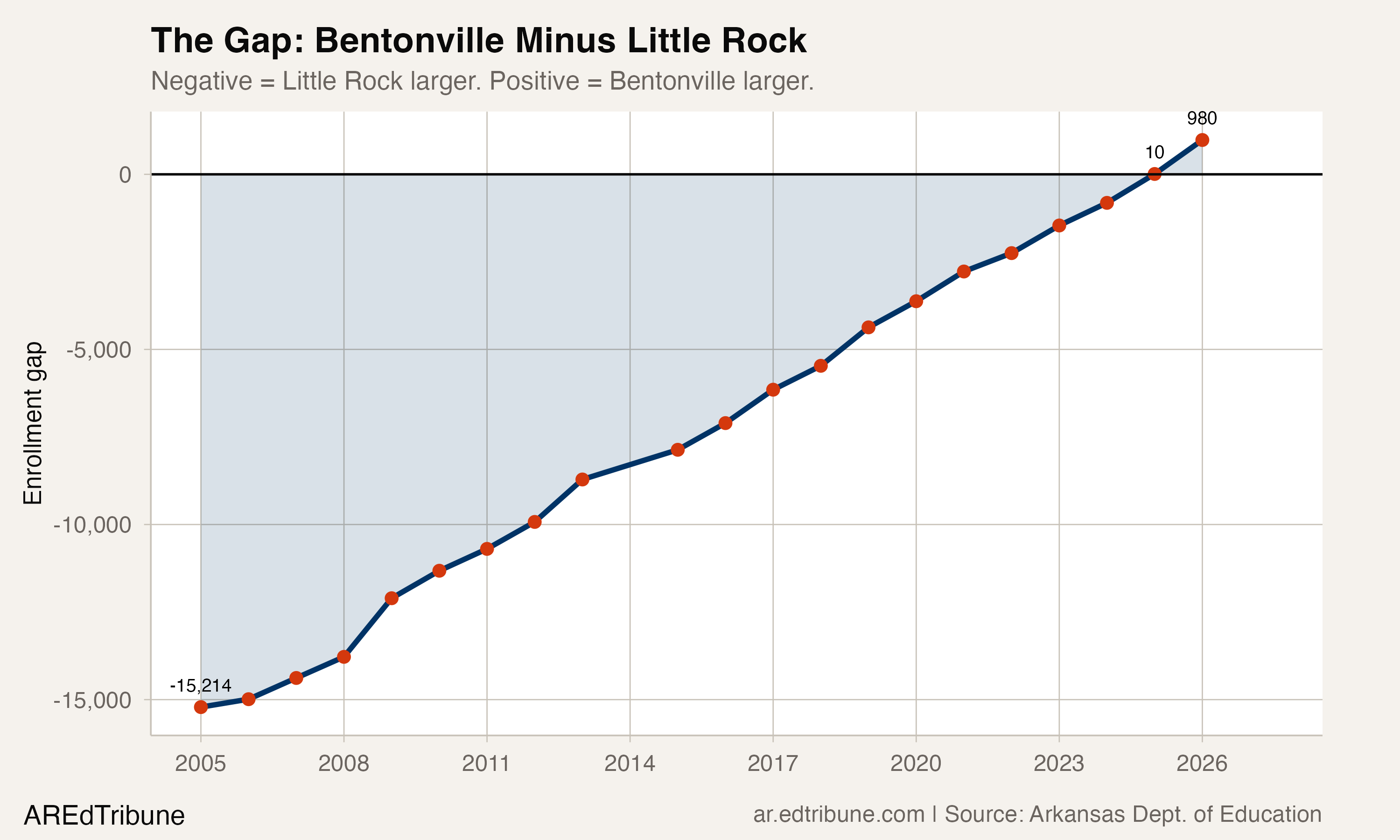
Twenty years later, Bentonville has 19,944 students. Little Rock has 18,964. The crossover happened in 2024-25, when Bentonville edged ahead by just 10 students. In 2025-26 the gap widened to 980, and the trend lines show no sign of converging again.
The swap is not just a trivia item. The state's economic center of gravity has shifted 200 miles northwest, and its public school enrollment is following.
Twenty years, zero exceptions
Bentonville grew in every single year of available data from 2005-06 through 2025-26, a 20-year consecutive growth streak unmatched by any other Arkansas district. The gains range from 122 students (during COVID in 2020-21) to 1,011 (in 2006-07), but they never turned negative. Cumulatively, Bentonville added 10,734 students, a 116.5% increase.
Little Rock's trajectory is the mirror image. The district peaked at 25,738 students in 2007-08, then began a decline that has continued in 16 of the 17 subsequent years. The single exception: a 41-student gain in 2021-22, likely a post-COVID bounce. Since that peak, Little Rock has lost 6,774 students, a 26.3% decline.
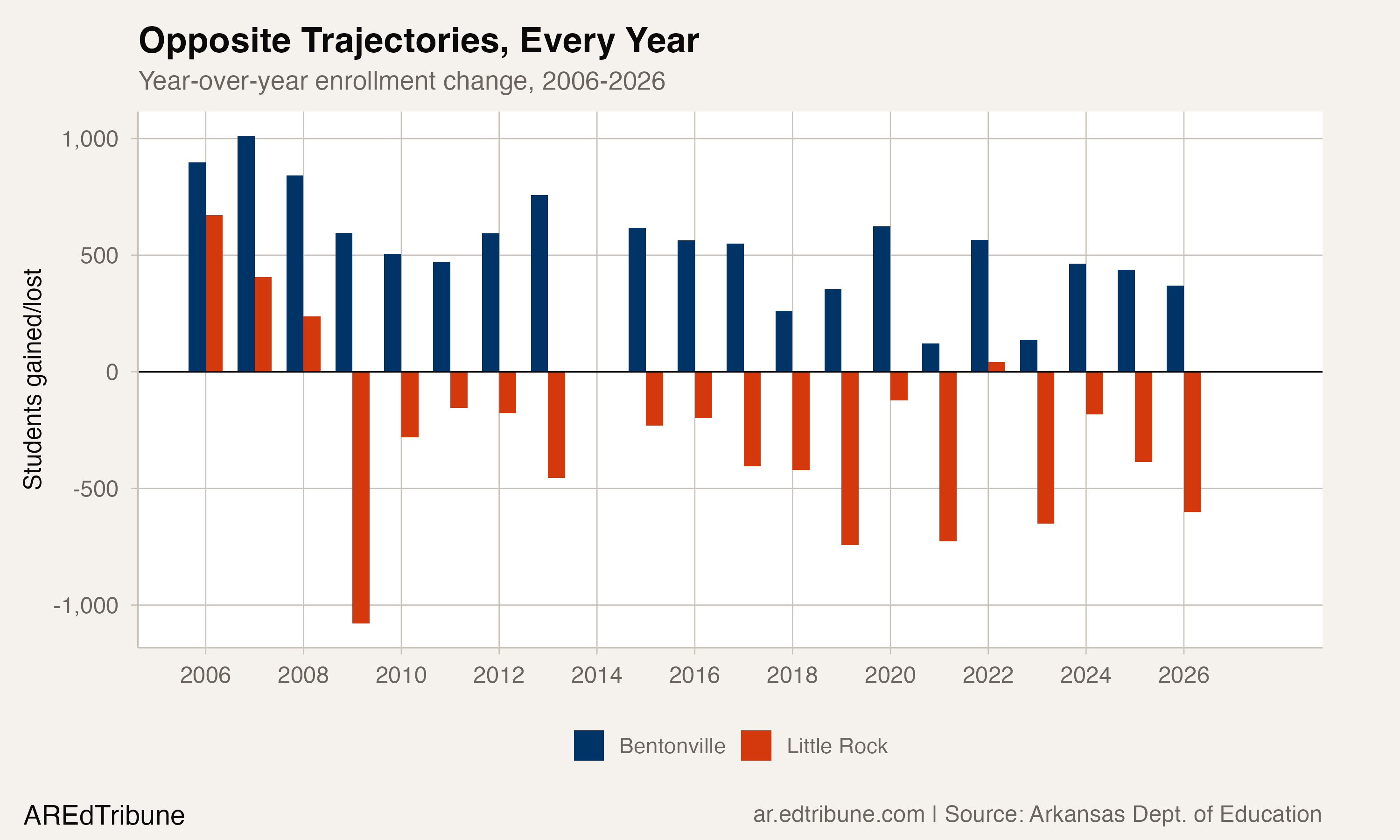
The year-over-year chart makes the asymmetry plain. In every year of the dataset, Bentonville's bar points up. In every year since 2008-09, Little Rock's points down, with that one fleeting exception.
From sixth-largest to second
Bentonville was the state's sixth-largest district in 2005. It climbed to fifth by 2012, fourth by 2013, third by 2017, and second by 2025. Little Rock, meanwhile, held the top spot through 2018, then fell to second (behind Springdale↗ET) in 2019 and to third by 2025.
The 15,214-student gap that separated them in 2005 closed at a remarkably steady pace, roughly 800 students per year, as Bentonville's gains and Little Rock's losses compounded.
The Walmart factor
Bentonville's growth is inseparable from the corporate expansion in Benton County. Walmart opened a 350-acre global headquarters campus in January 2025, designed around a large Bentonville-based corporate workforce. Tyson Foods in Springdale and J.B. Hunt Transport in Lowell add additional corporate mass.
The population data confirms the pull. Benton County added 9,318 residents in the most recent census estimate, reaching 321,566 people with 3.0% growth, ranking 76th among the nation's 3,144 counties for growth rate. The broader Northwest Arkansas metro (Fayetteville-Springdale-Rogers) grew 2.3% to 605,615, making it the 22nd-fastest-growing metro in the country.
That population growth translates directly into student enrollment. Consulting projections reported by the Northwest Arkansas Democrat-Gazette project another 3,000 students in Bentonville over the next decade.
Bentonville's demographics have shifted as it grew. In 2010, the district was 77.3% white. By 2025-26, that share had fallen to 66.3%, as Asian enrollment nearly quadrupled from 499 to 2,027 students (3.8% to 10.2% of the district) and Hispanic enrollment grew from 1,414 to 2,573 (10.8% to 12.9%). The corporate economy is drawing a workforce that looks nothing like the district's historical base.
Little Rock: consolidation as strategy
Little Rock's enrollment decline has become a fiscal problem that demands structural responses. The district lost $12 million in state aid over the last two fiscal years as per-pupil state foundation funding followed students out the door.
In December 2024, the Little Rock School District board voted to close and consolidate schools, including proposals to close Brady Elementary and merge Carver STEAM Magnet Elementary with Booker T. Washington Elementary. One parent told KATV that her child would be attending a fourth school as a result of repeated consolidations:
"Now we are talking about Carver merging with Washington which will now be the fourth school that she has to attend." -- KATV, November 2024
The number of Little Rock campuses has fallen from 40 in 2017-18 to 31 in 2025-26. The district's board is shrinking from nine to seven members, a change triggered by declining enrollment under new state legislation.
The state's Education Freedom Account voucher program, created by the LEARNS Act signed in March 2023, expanded to all students by 2025-26 and now covers nearly 47,000 participants statewide. Not all of those students left public schools (statewide reporting suggests under 20% of new recipients transferred from public schools), but the program creates a new competitive dynamic. Little Rock, with its concentration of private school options, is more exposed to voucher attrition than rural districts with fewer alternatives. Birth rate declines and Pulaski County's near-zero population growth (0.1%) compound the problem. Neither explanation alone accounts for a 26.3% decline from peak, but together they describe a district losing students to both demographics and policy-driven competition.
Two Arkansases, side by side
The demographic profiles of the two districts could hardly be more different.
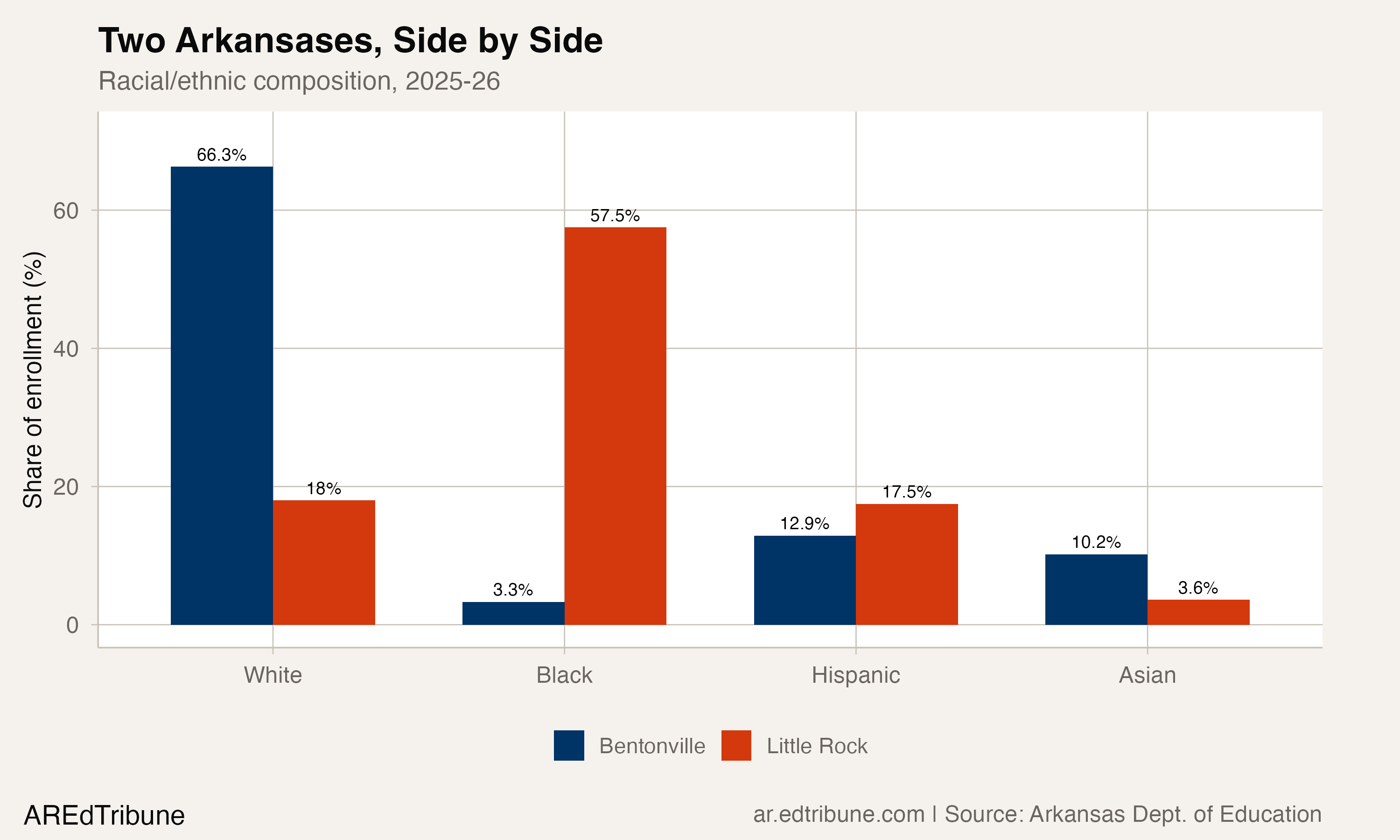
Little Rock is 57.5% Black, 18.0% white, and 17.5% Hispanic. Bentonville is 66.3% white, 12.9% Hispanic, and 10.2% Asian, with only 3.3% Black enrollment. The crossover is not just a story about size. It is a story about which Arkansas is growing: a majority-white, corporate-economy, high-growth corridor in the northwest, while the capital-city district that anchored the state's educational identity for generations contracts year after year.
The bigger picture: NWA's rising share
Bentonville is the fastest-growing member of a four-district cluster, but it is not the only one. Springdale remains the state's largest district at 21,097 students, having grown 46.0% since 2005. Rogers↗ET is at 14,943 (+16.8%), and Fayetteville↗ET is at 10,171 (+23.9%).
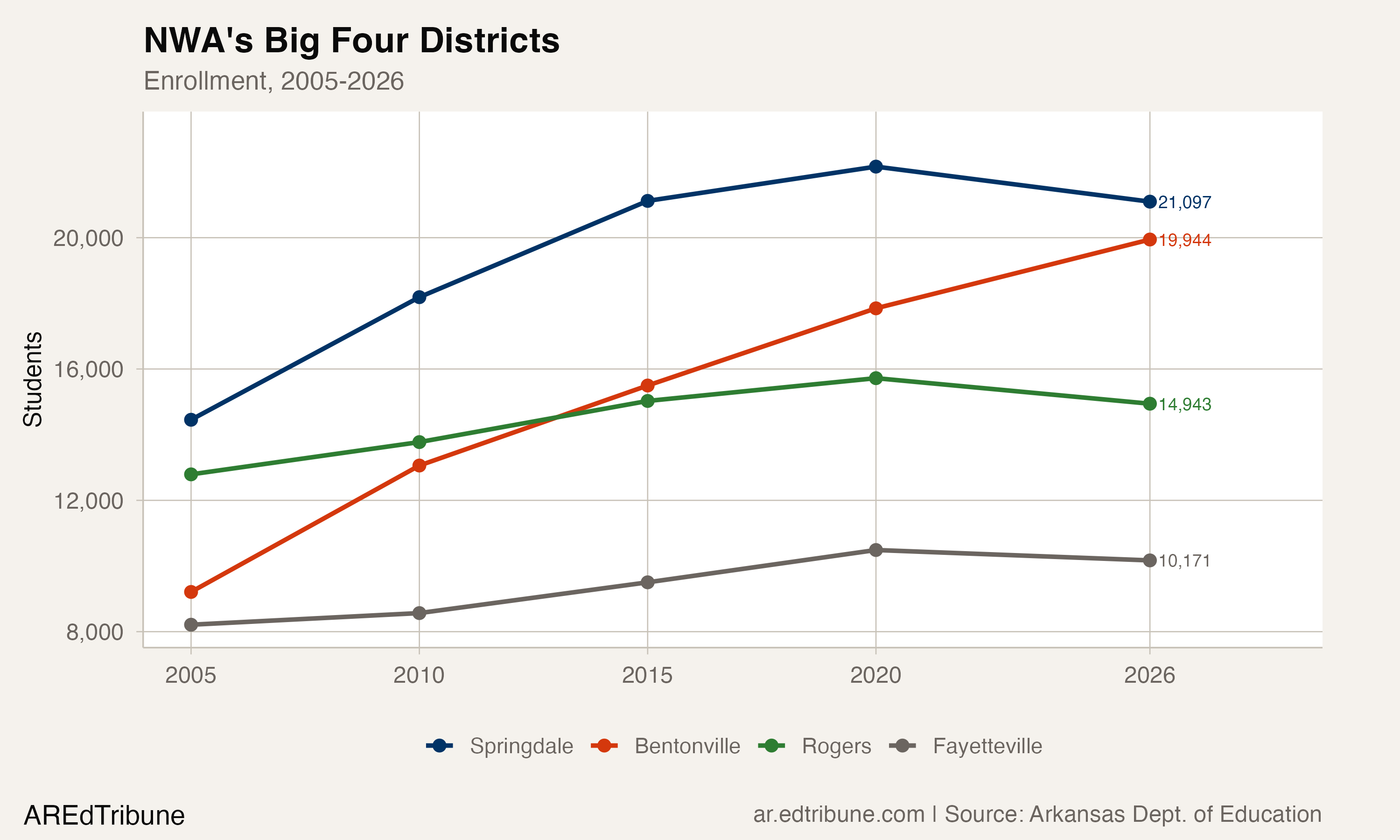
Together, these four districts enrolled 66,155 students in 2025-26, up from 44,667 in 2004-05, an increase of 21,488 students (48.1%). Their combined share of statewide enrollment has risen from 9.8% to 14.2%. One in seven Arkansas public school students now attends school in the NWA corridor.
The NWA cluster's growth did plateau in recent years (peaking at 66,666 in 2024-25 before slipping by 511 in 2025-26), suggesting even this economic engine may not be immune to the statewide forces pulling enrollment down. Springdale, the largest of the four, lost 559 students in 2025-26. Bentonville was the only one of the four to add a significant number.
What the state rank obscures
The crossover between Bentonville and Little Rock is a milestone, but it also masks a larger structural truth: both districts are now smaller than they might have been. Arkansas's total public school enrollment in 2025-26 fell to 465,421, the lowest level in 20 years and a single-year drop of 8,916 students. The state's shrinking total means even growth districts like Bentonville are swimming against a statewide current.
Little Rock's challenge is acute. Declining enrollment means declining state foundation funding, which means school closures, which can accelerate enrollment loss as families seek stability elsewhere. The district needs to stabilize around a smaller, more concentrated footprint before the cycle becomes self-reinforcing.
Bentonville faces the opposite problem: whether its school construction pipeline can keep pace with corporate-driven population growth, and whether rapid diversification will require instructional investments its current funding structure doesn't anticipate.
The two trajectories are one story, not two. The same economic forces that pull families to Benton County pull them away from Pulaski County. Arkansas is not just losing students. It is redistributing them.
Detailed code that reproduces the analysis and figures in this article is available exclusively to EdTribune subscribers.
Discussion
Sign in to join the discussion.
Loading comments...