Arkansas Connections Academy↗ET added 1,205 students in 2025-26. No other district in Arkansas came close. The next-largest gain belonged to Bentonville↗ET, at 369.
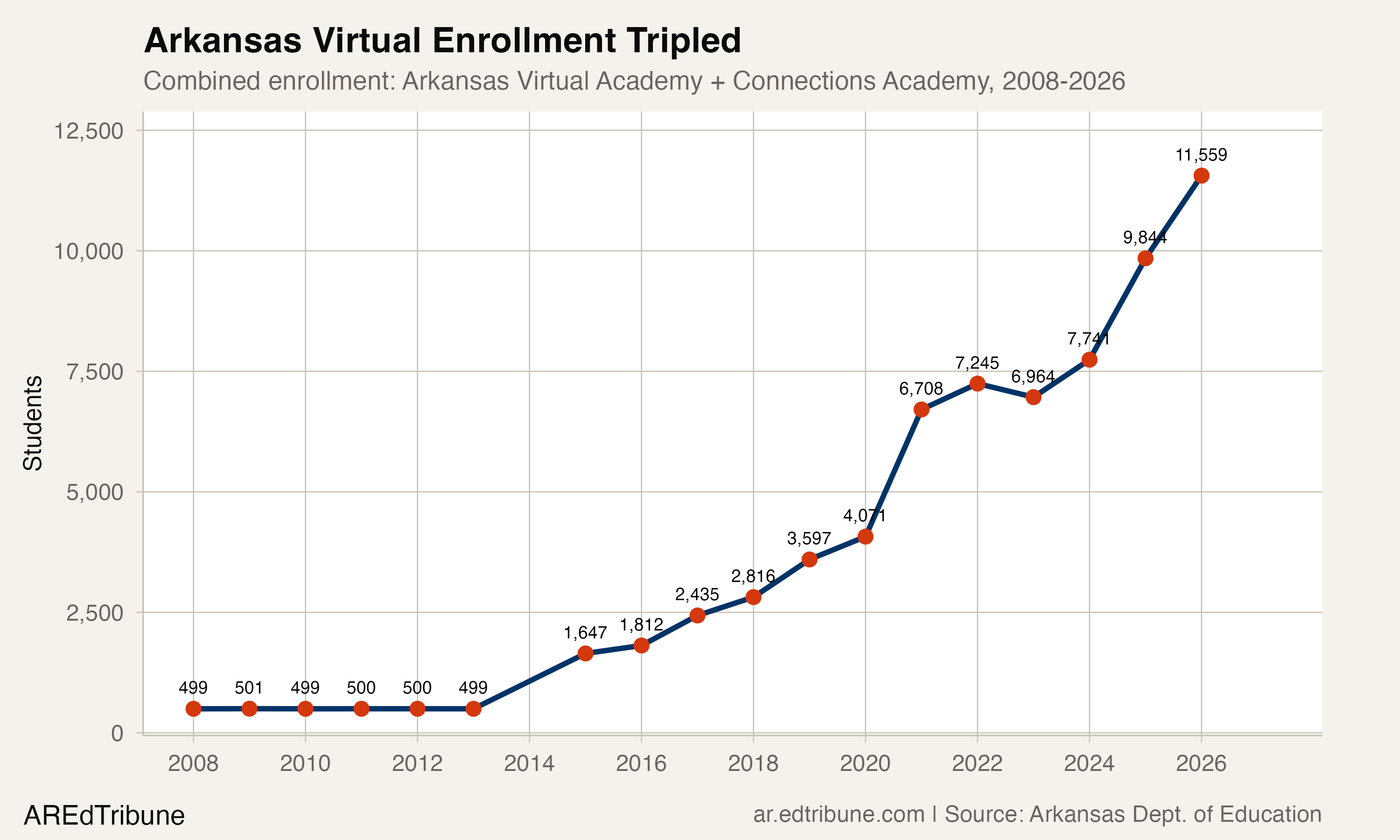
The state's two fully virtual public schools, Connections Academy and Arkansas Virtual Academy↗ET, together enrolled 11,559 students in 2025-26, up from 4,071 in 2019-20. That 184% increase happened while total public enrollment fell by 14,011. Strip out the virtual sector, and the non-virtual system lost 21,499 students, a 4.5% decline that the headline statewide number understates by a third.
Two schools, 2.5% of the state
Virtual schooling in Arkansas is functionally a two-provider market. Arkansas Virtual Academy, operated by Stride Inc. (formerly K12 Inc.), has been enrolling students since 2008, when it served 499 students, about 0.1% of the state. Connections Academy, a Pearson subsidiary, opened in 2017 with 343 students and has grown every year since except 2023.
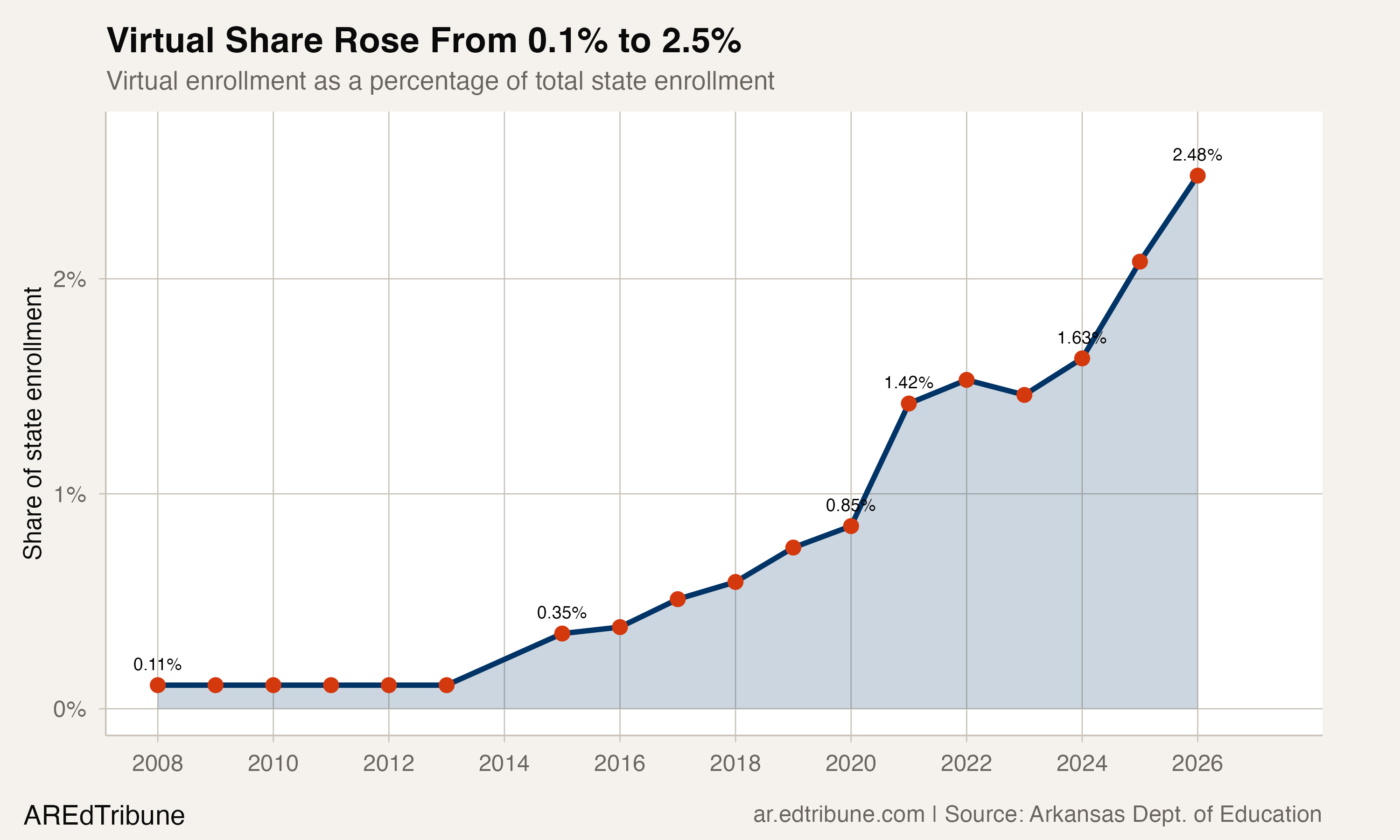
Together, the two schools' share of state enrollment rose from 0.1% to 2.5% over 18 years, with most of that growth compressed into the last six. In 2020, they held 0.85% of statewide enrollment. By 2026, that share nearly tripled.
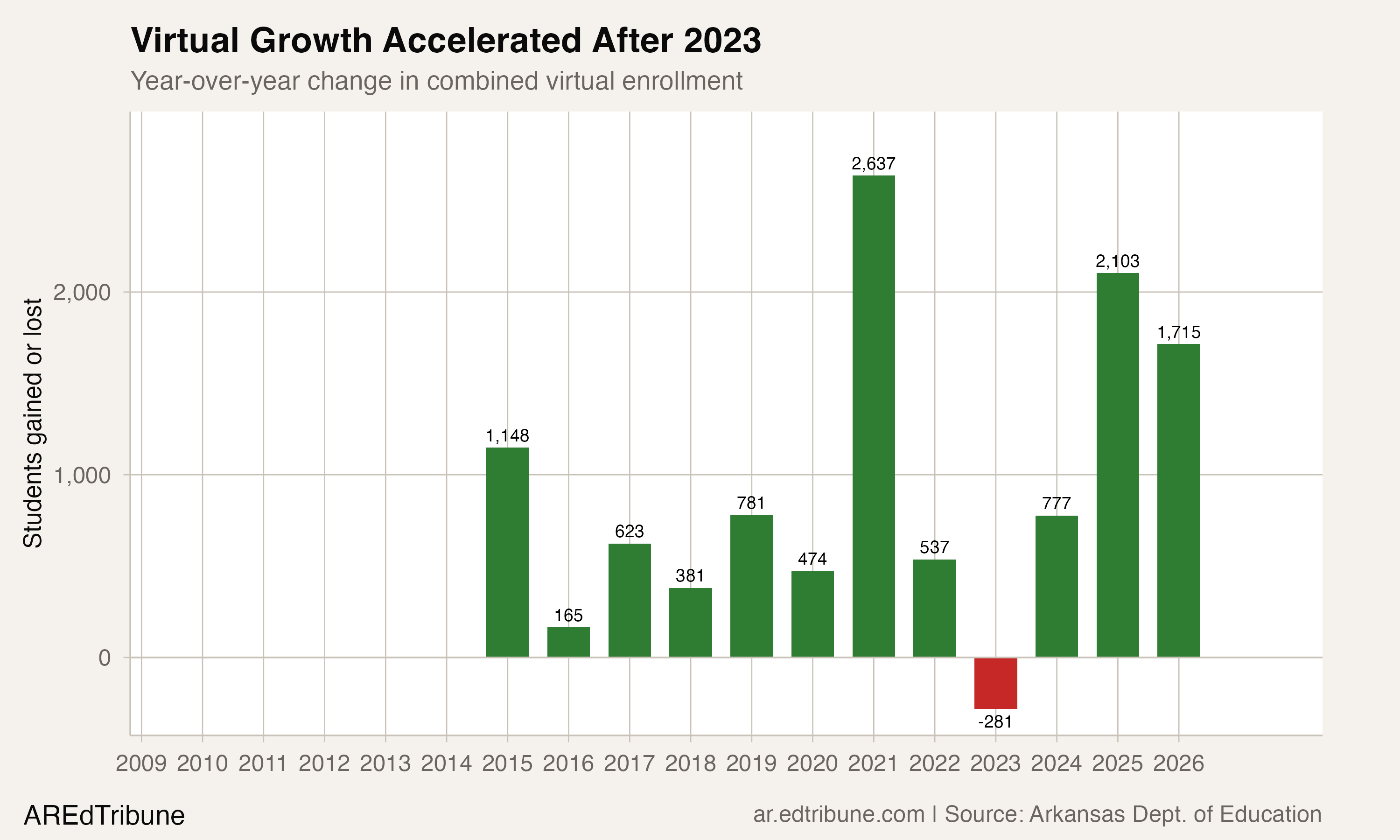
The growth came in two waves. The first was the pandemic: virtual enrollment surged by 2,637 students in 2020-21, a 64.8% single-year jump. But unlike most states, Arkansas virtual schools did not give that enrollment back. After a brief dip of 281 students in 2022-23, the second wave began: +777 in 2023-24, +2,103 in 2024-25, +1,715 in 2025-26.
The one-student crossover
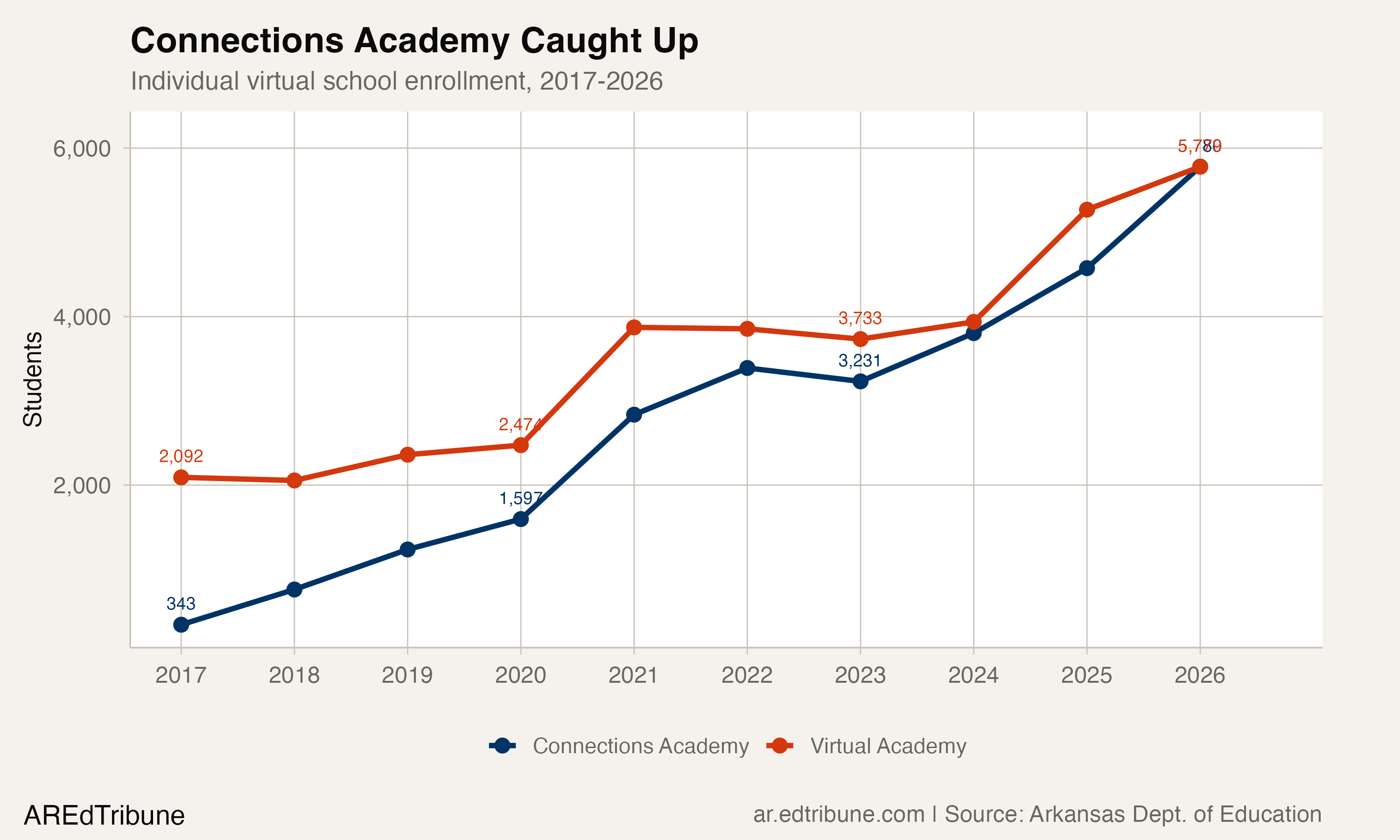
For nine years, Arkansas Virtual Academy was the larger of the two. In 2026, Connections Academy pulled ahead by a single student: 5,780 to 5,779. From its 2017 launch at 343 students, Connections grew at an annualized rate of 37% over nine years, outpacing Virtual Academy's 12%. Connections Academy's enrollment cap stands at 7,000, leaving roughly 1,220 seats of headroom.
Where the growth came from
Only 65 of Arkansas's 258 matched districts gained students between 2024-25 and 2025-26. The two virtual schools accounted for 1,715 of the 4,035 total students gained across all growing districts, or 42.5%. The remaining 192 districts that lost students included every one of the state's 12 largest traditional districts except Bentonville and Fayetteville.
This matters for how to read statewide trends. Arkansas's total enrollment fell by 8,916 in 2025-26 to 465,421, the lowest since 2006-07. But virtual schools absorbed 1,715 new students on net. The non-virtual system's loss was 10,631, nearly 20% larger than the headline figure.
A choice landscape in flux
The timing of the second growth wave, beginning in 2023-24, coincides with a broader expansion of school choice in Arkansas. The LEARNS Act, signed in 2023, created the Education Freedom Account program, which provides roughly 90% of per-student state funding for families who choose private schools or homeschooling. The program grew from 5,548 participants in its first year to 46,578 in 2025-26, the first year of universal eligibility.
EFA recipients are not attending virtual public schools. The two programs pull from different parts of the education market. But they share a context: Arkansas families have more exit options from their assigned district than at any point in the state's history.
Rogers↗ET School District Superintendent Jeff Perry told KUAF that demographic forces compound the choice dynamics:
"The median price of a house now is exponentially more than it was four years ago."
Perry noted that Rogers, with roughly 52% Hispanic students, has also seen fewer new arrivals replacing departing families. Bentonville Superintendent Debbie Jones warned in the same report that the EFA program "does have a financial impact on school districts," with each departing student representing approximately $8,000 in state funding.
A whiter student body
Virtual schools in Arkansas skew white. In 2025-26, 67.0% of virtual students are white, compared to 56.5% statewide. Black students make up 15.2% of virtual enrollment versus 19.1% statewide. Hispanic students are most underrepresented: 8.4% versus 15.4% statewide, roughly half the rate.
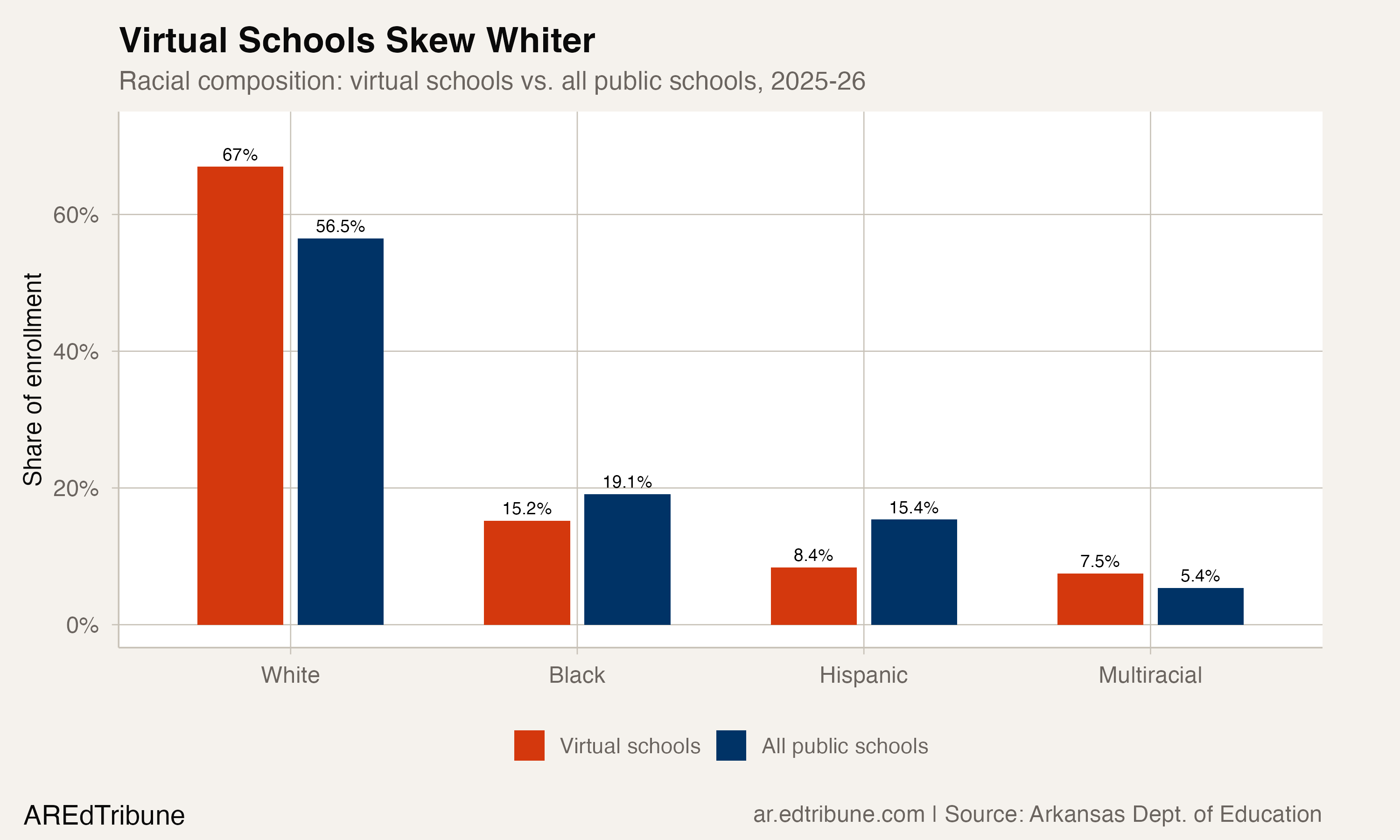
The gap is not unusual for virtual schools nationally. Language barriers and the intensive parental involvement that virtual schooling requires both correlate with income and race. But in a state where the traditional system is becoming more diverse while the fastest-growing sector skews whiter, the divergence bears watching.
What enrollment data cannot show
The data cannot distinguish how many virtual enrollees would have attended a traditional public school otherwise, and how many were previously homeschooled, in private school, or new to the state. Arkansas Education Association president April Reisma cautioned KUAF that even modest enrollment shifts compound:
"Even though it does seem like it's a small percentage, it really does hit some of our districts...giving them more damage than other districts."
The 3% threshold
If the two virtual schools maintain their current growth rate, they will cross 3% of state enrollment by 2027-28, enrolling roughly 14,000 students. Connections Academy's 7,000-student cap is the most immediate constraint. Whether the state raises that cap, or a third virtual provider enters the market, will shape the trajectory. Arkansas Virtual Academy operates under Stride Inc., a publicly traded company that runs similar schools in more than 30 states and has no announced enrollment ceiling in Arkansas.
For the 192 districts that lost students in 2025-26, the question is not whether virtual schools are growing. The question is how much of that growth comes from families who would not have enrolled locally regardless, and how much represents a permanent exit channel.
Detailed code that reproduces the analysis and figures in this article is available exclusively to EdTribune subscribers.
Discussion
Sign in to join the discussion.
Loading comments...