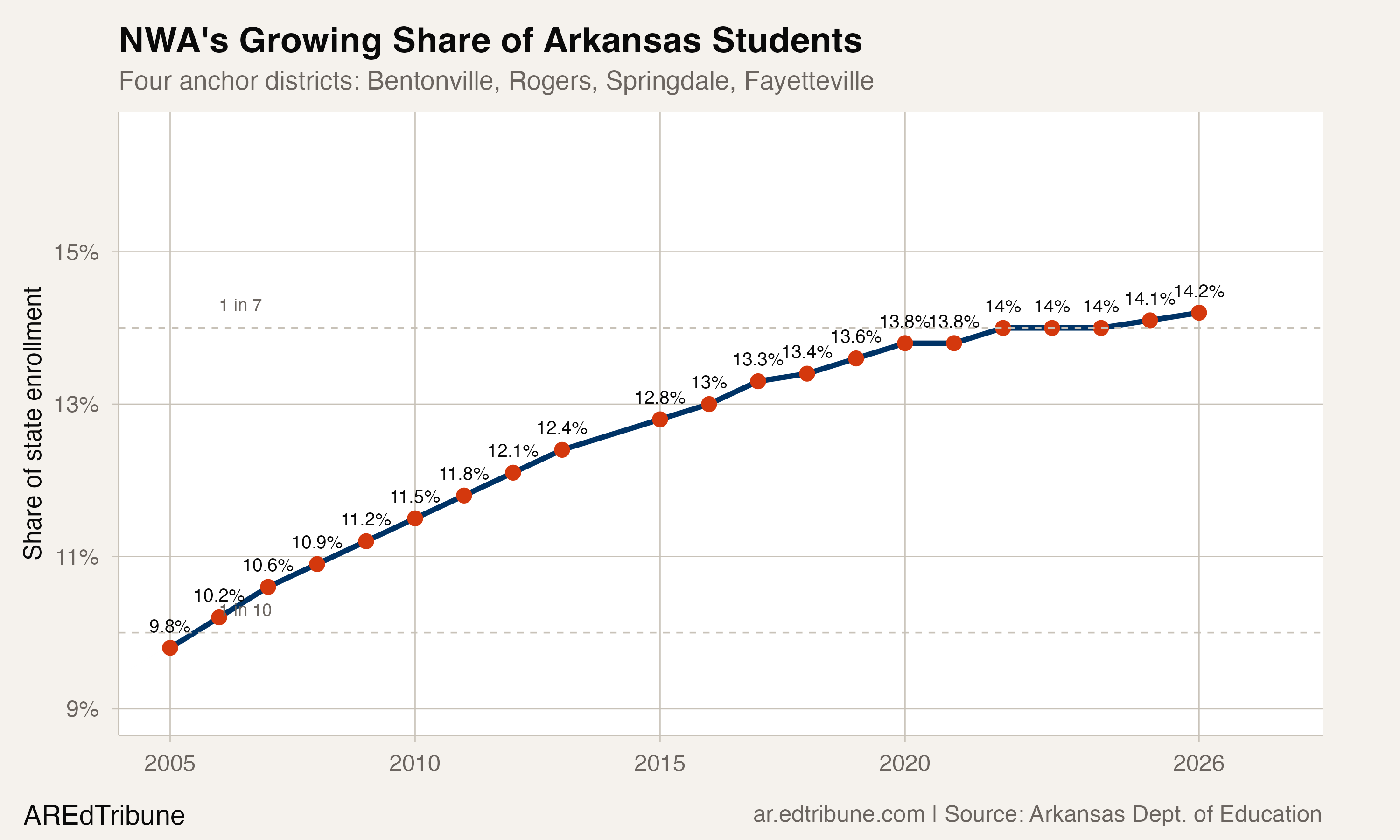
In 2005, the four anchor districts of Northwest Arkansas enrolled 44,667 students, about one in every 10 in the state. By 2025-26, Bentonville↗ET, Rogers↗ET, Springdale↗ET, and Fayetteville↗ET together enrolled 66,155, one in every seven. The rest of Arkansas lost 11,582 students over that same span.
That 4.4 percentage-point share gain, from 9.8% to 14.2%, does not sound like much. Translated into students: NWA added 21,488 while nine Delta districts lost 13,769. The region that generates the growth and the region that bleeds it are separated by 250 miles and two different economies.
The corporate corridor that built a school system
NWA's growth is no mystery. Walmart's headquarters in Bentonville and Tyson Foods in Springdale anchor an economy that added 7,800 net new jobs in the year ending mid-2024, a 2.6% increase that tied for fastest among six peer metros tracked in the NWA Council's annual report. The region's population reached 605,615 in 2024, up 2.3% from the prior year. Benton County alone grew 3%, the fastest rate in the state.
The enrollment data shows exactly where those new residents settle. Bentonville grew 116.5% over two decades, from 9,210 to 19,944 students. Half of NWA's total gain, 10,734 students, landed in that single district. Springdale added 6,643 (46.0%). Rogers gained 2,152 (16.8%), and Fayetteville 1,959 (23.9%).
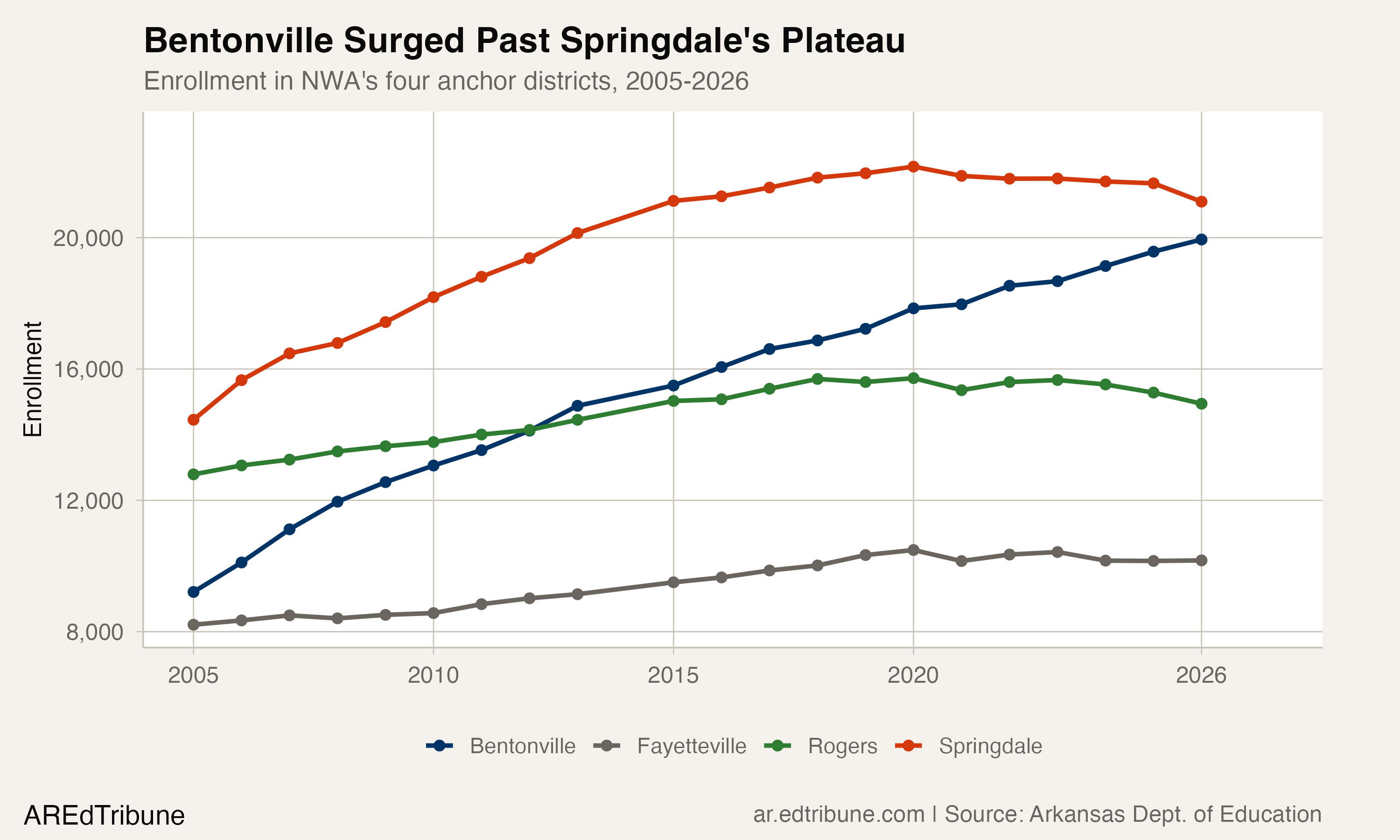
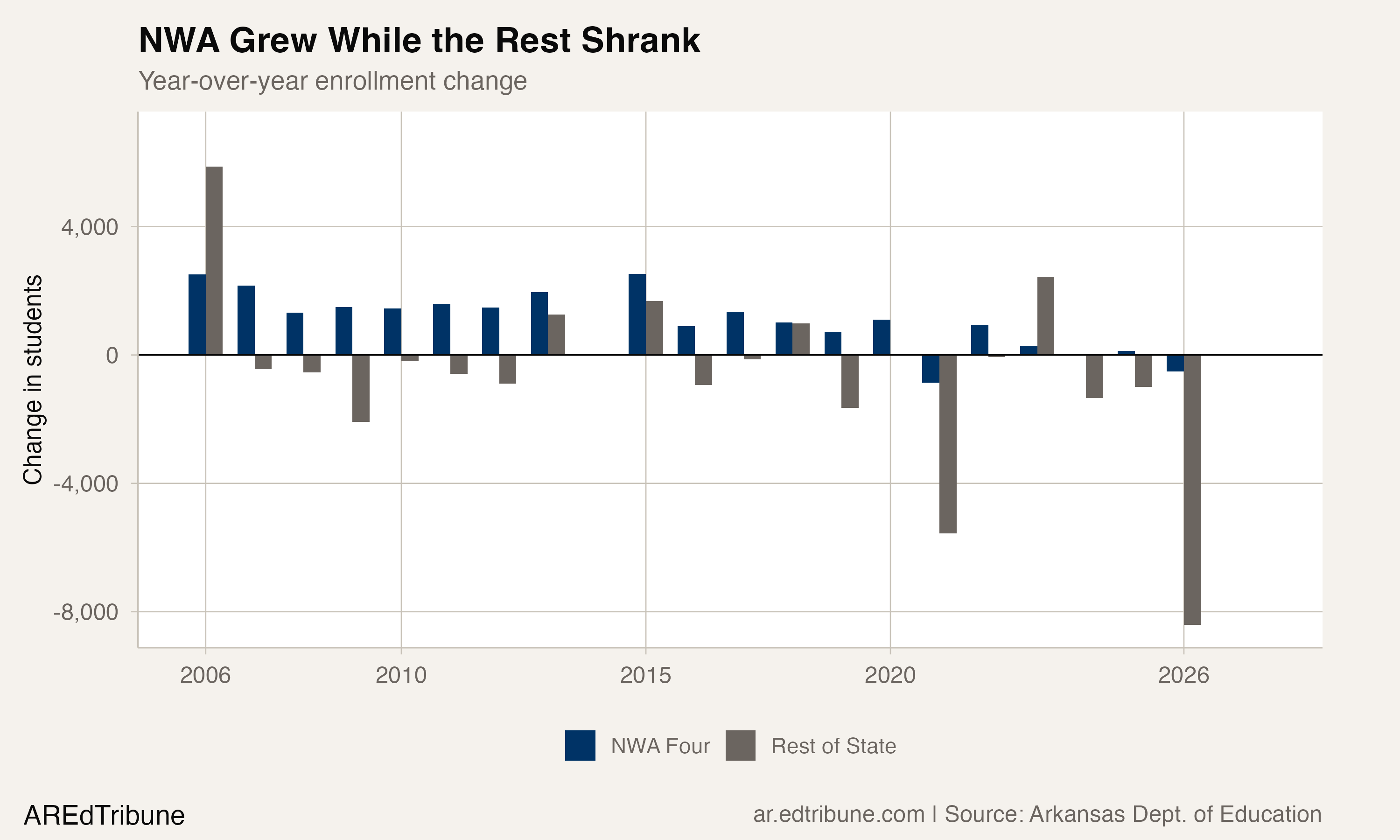
The growth pattern has shifted. From 2005 through 2020, the four districts reliably added 1,000 to 2,500 students per year. Since 2020, annual gains have nearly vanished: +926 in 2022, +282 in 2023, -24 in 2024, and -511 in 2026. NWA peaked at 66,666 students in 2025. That plateau arrived even as the regional population kept climbing. Bentonville projects another 3,000 students over the next decade, but the aggregate NWA numbers suggest the era of uninterrupted gains may be closing.
Two growth stories inside one region
Bentonville's trajectory looks nothing like Springdale's, and the difference is largely about who moved in.
Bentonville drew corporate transplants. Its white enrollment share dropped from 87.0% to 66.3%, but the more distinctive shift is its Asian student population, which grew from 2.4% to 10.2% of the district. That Asian share is more than double the statewide figure and reflects the global workforce that Walmart's home office and its vendor ecosystem attract.
Springdale's change runs deeper. White students fell from 59.5% to 28.8% of the district. Hispanic students rose from 31.8% to 49.9%. The district is home to the largest Marshallese community in the United States, with nearly 3,000 students from the Marshall Islands, and more than 35% of its students are English language learners.
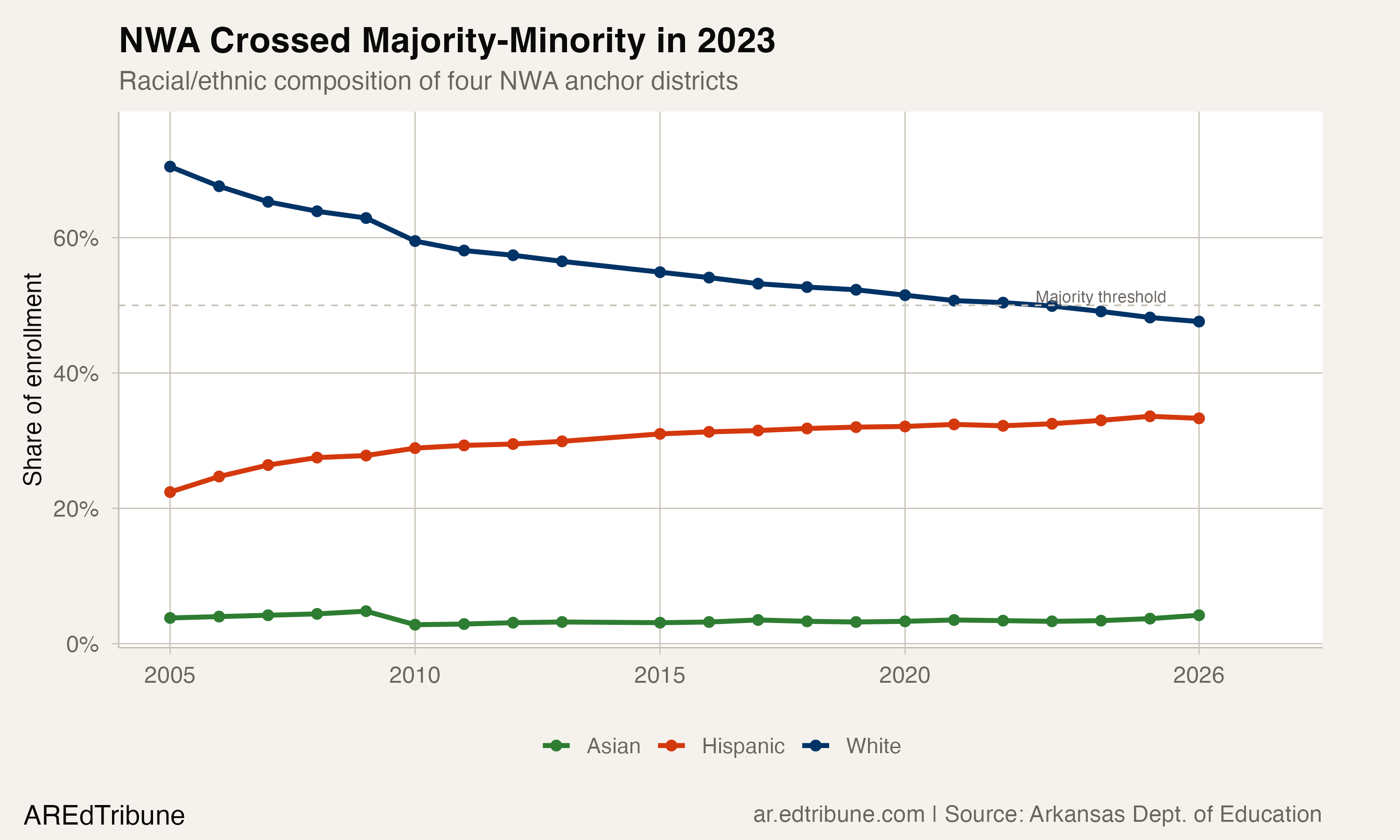
Across all four anchor districts combined, white enrollment fell below 50% for the first time in 2023 and stood at 47.6% in 2026. Hispanic enrollment reached 33.3%. The NWA of 2026 is majority-minority.
The mirror image: 250 miles southeast
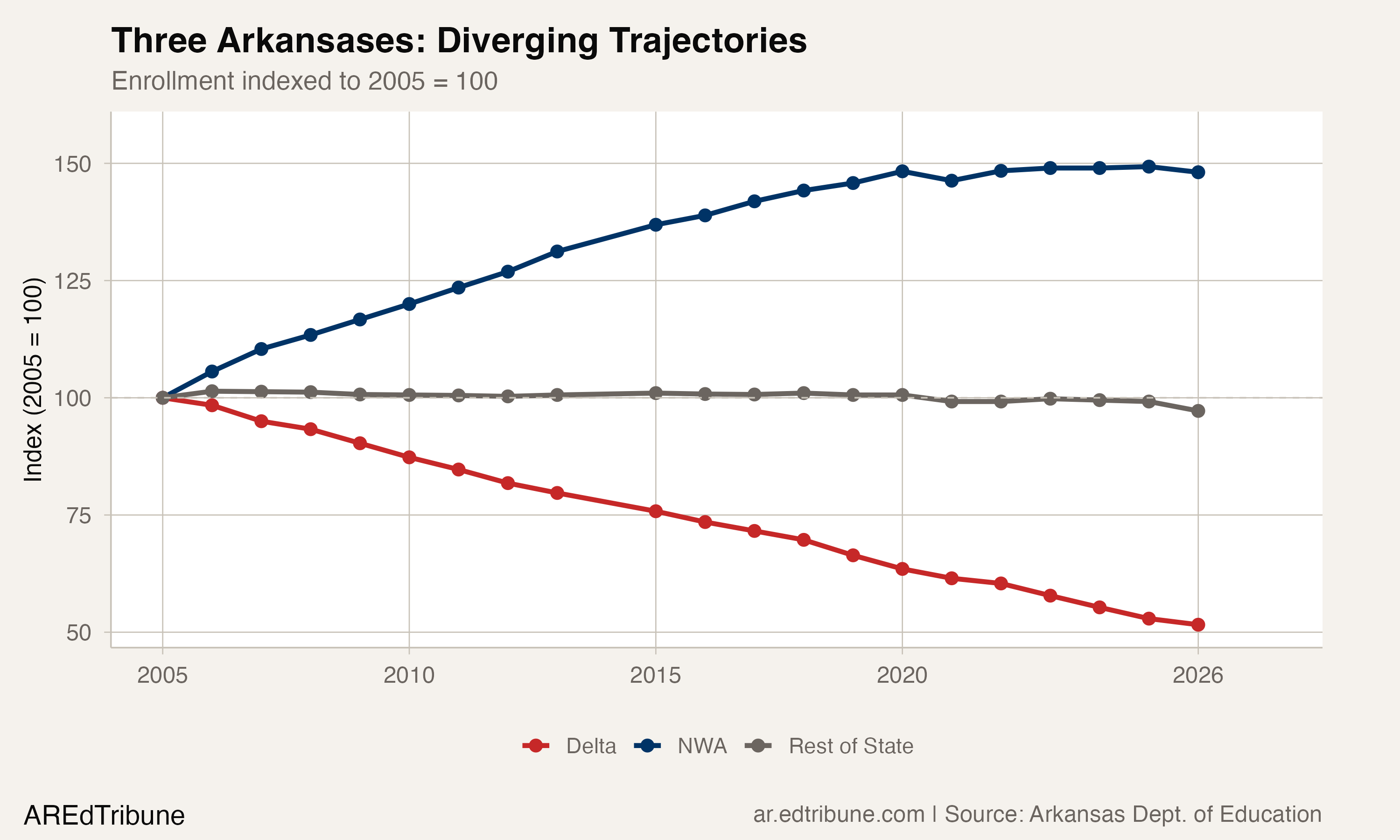
While NWA gained 21,488 students, nine districts in the Arkansas Delta lost 13,769, a 55.3% decline. Pine Bluff↗ET alone dropped from 5,738 to 2,658 (-53.7%). Blytheville fell from 3,118 to 1,244 (-60.1%). Forrest City shrank from 3,854 to 1,809 (-53.1%).
The causes in the Delta are structural: persistent poverty, agricultural automation, and decades of out-migration. Without Benton and Washington counties, Arkansas would have posted its first population decline since the 1960 census. For school districts, each lost student represents over $7,000 in per-pupil state revenue that does not come back.
"Declining populations complicate district finances because most funding comes from the local tax base and per-student state funding." -- The 74, Sept. 2024
Dumas, in Desha County, cut 39 positions in 2024, including 22 teachers, and closed an elementary school after enrollment fell 18% in three years.
The satellite ring
Growth has also spilled beyond the four anchor districts. Pea Ridge↗ET, north of Bentonville on the Missouri border, more than doubled from 1,223 to 2,665 students (117.9%). Farmington grew 54.2%. Siloam Springs added 1,019 students.
Including the broader ring of 11 satellite districts, the NWA region enrolled 86,317 students in 2026, 18.5% of the state, up from 13.3% in 2005. Nearly one in five Arkansas students now attends school in the NWA corridor.
Not every satellite has shared in the growth. Greenland lost 39.7% of its enrollment, and West Fork lost 39.4%. Both are small districts near Fayetteville that may be losing students to open-enrollment transfers into the larger anchor districts.
What the share gain obscures
NWA's share of the state rose from 9.8% to 14.2%, but much of that gain reflects the rest of the state shrinking, not NWA growing. Arkansas's total enrollment barely changed: 455,515 in 2005, 465,421 in 2026, a net increase of 9,906 over 21 years. NWA gained 21,488. Everyone else combined lost 11,582. The state is not growing. The students are moving.
The 2023 LEARNS Act, which eliminated caps on public school transfers and raised minimum teacher pay to $50,000, may accelerate this dynamic. Easier transfers benefit districts with perceived quality and capacity. NWA has both.
The immediate question for NWA's districts is whether the 2020-2026 plateau is a pause or a turning point. Bentonville is planning for growth. The enrollment data, for the first time in two decades, is not confirming that bet.
Detailed code that reproduces the analysis and figures in this article is available exclusively to EdTribune subscribers.
Discussion
Sign in to join the discussion.
Loading comments...